Facts
The petitioner’s father, a Railway employee, died in harness on 5 December 2013.
Source reference: p. 2The petitioner was selected for compassionate appointment as Technician Grade-III and was issued an offer of appointment subject to satisfactory police character verification.
Source reference: pp. 2, 5–7During verification, the respondents discovered that the petitioner was a named accused in three criminal cases.
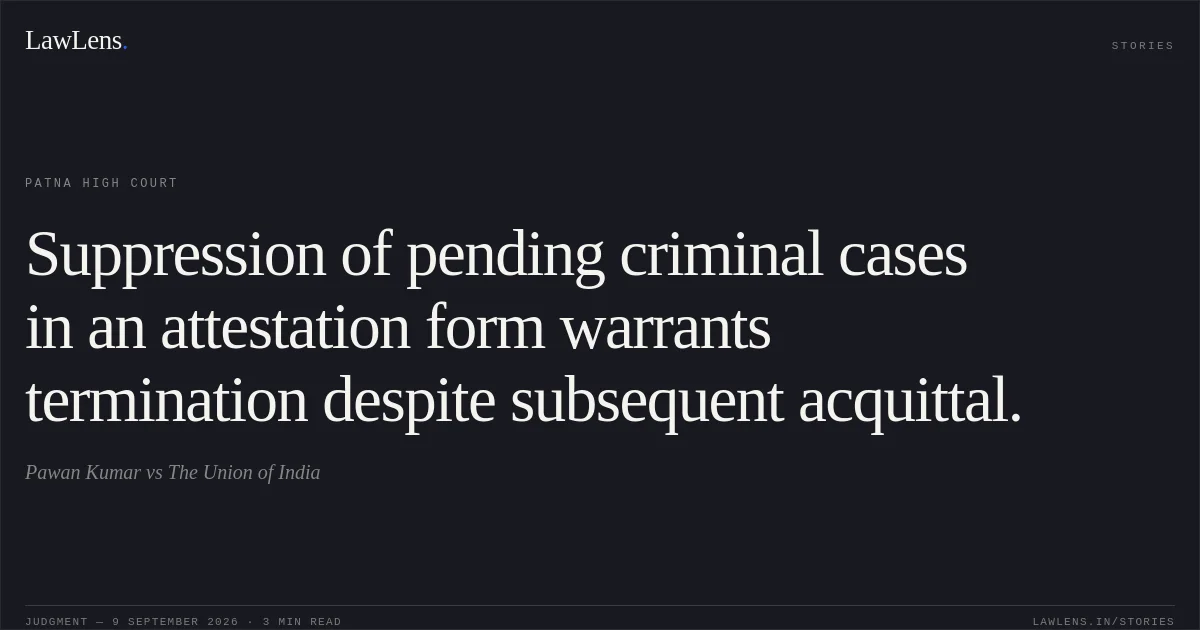
Source reference: pp. 2–4, 7–8Although he disclosed that the cases were false and subsequently produced judgments dated 8 June 2016 acquitting him, the respondents terminated his training/service on 26 August 2016 for concealing the pending criminal cases and furnishing false information.
Source reference: pp. 3–5The Central Administrative Tribunal dismissed his Original Application, holding that the termination was valid.
Source reference: pp. 1–2Issues
Whether the petitioner’s failure to disclose that he was an accused in three pending criminal cases, coupled with his declaration that no case was pending against him, constituted suppression of material information and furnishing of false information warranting termination?
Source reference: pp. 7–8, 13–14Whether the petitioner’s subsequent acquittal in all three criminal cases entitled him to reinstatement or invalidated the termination order?
Source reference: pp. 9–12, 14–17Whether the Tribunal erred in upholding the termination order dated 26 August 2016?
Source reference: pp. 1–2, 18Law Applied
Under the terms of the offer letter and attestation form, concealment of an actual fact or furnishing false information could result in termination without notice.
Source reference: pp. 5–8Relying on Avtar Singh v. Union of India, (2016) 8 SCC 471, the Court recognised that an employer may consider the nature of the criminal case, the fact of suppression, and the circumstances of acquittal while assessing suitability.
Source reference: pp. 9–12The Court principally relied on Satish Chandra Yadav v. Union of India, (2023) 7 SCC 536, particularly the principles that suppression of material information relating to arrest or prosecution bears upon character, conduct and antecedents; acquittal does not automatically confer a right to appointment; and the employer may independently assess suitability.
Source reference: pp. 15–17Commissioner of Police v. Sandeep Kumar, (2011) 4 SCC 644, and Ravindra Kumar v. State of U.P., (2024) 5 SCC 264, were distinguished as decisions based on their peculiar facts, where non-disclosure was not treated as invariably fatal.
Source reference: pp. 9–12Reasoning
The Court found that the petitioner had expressly stated in the attestation form that no criminal case was pending against him, despite being a named accused in three cases.
Source reference: pp. 7–8, 13–14This was not a mere omission but a false declaration concerning material facts relevant to his character and antecedents.
Source reference: pp. 7–8, 13–14The appointment was expressly conditional upon satisfactory character verification, and the petitioner had been warned that concealment or false information could result in termination without notice.
Source reference: pp. 5–7The subsequent acquittals did not cure the suppression because, on the date of appointment, all three proceedings were pending.
Source reference: p. 14Further, the acquittals were based on failure of the prosecution to prove the charges beyond reasonable doubt and, in part, on compromise; therefore, the Court did not treat them as clean acquittals.
Source reference: p. 14Applying Satish Chandra Yadav, the Court held that acquittal does not automatically establish suitability for public employment, particularly where the candidate has concealed the criminal cases.
Source reference: pp. 15–18Holding
The Court answered the issues against the petitioner.
It held that the petitioner had suppressed material information and furnished false information in the attestation form, and that his subsequent acquittal did not invalidate the termination or create an automatic right to appointment.
Source reference: pp. 14–18The termination order dated 26 August 2016 was upheld, as was the Central Administrative Tribunal’s order dated 26 February 2026.
Source reference: p. 18The writ petition was accordingly dismissed.
Source reference: p. 18Acts & Sections Cited
2 provisions across 1 statute referred to in this judgment. Each provision opens on LawLens.
Indian Penal Code, 18602
Original Court PDF
Pawan KumarvsThe Union of India
Click to open original judgment
Original judgment, available to read, download and summarize on LawLens.in