Facts
The petitioners sought to quash FIR No. 0181 of 2025, which alleged offences under Sections 420, 467, 468, 471, and 120-B of the IPC.
Source reference: para. 1The complainant, Vikram Singh Rana, alleged that the petitioners induced him to pay approximately ₹19.01 crore for 25 bighas of land in Purukul through various companies (Sai Ram Infra Project Pvt. Ltd., Avanta Reality, and Prat & Whitney).
Source reference: para. 4, 16The sale deeds were not executed, and the petitioners allegedly forged documents naming the complainant as a nominee to facilitate a 100% share transfer of Avanta Reality to Sai Ram Infra.
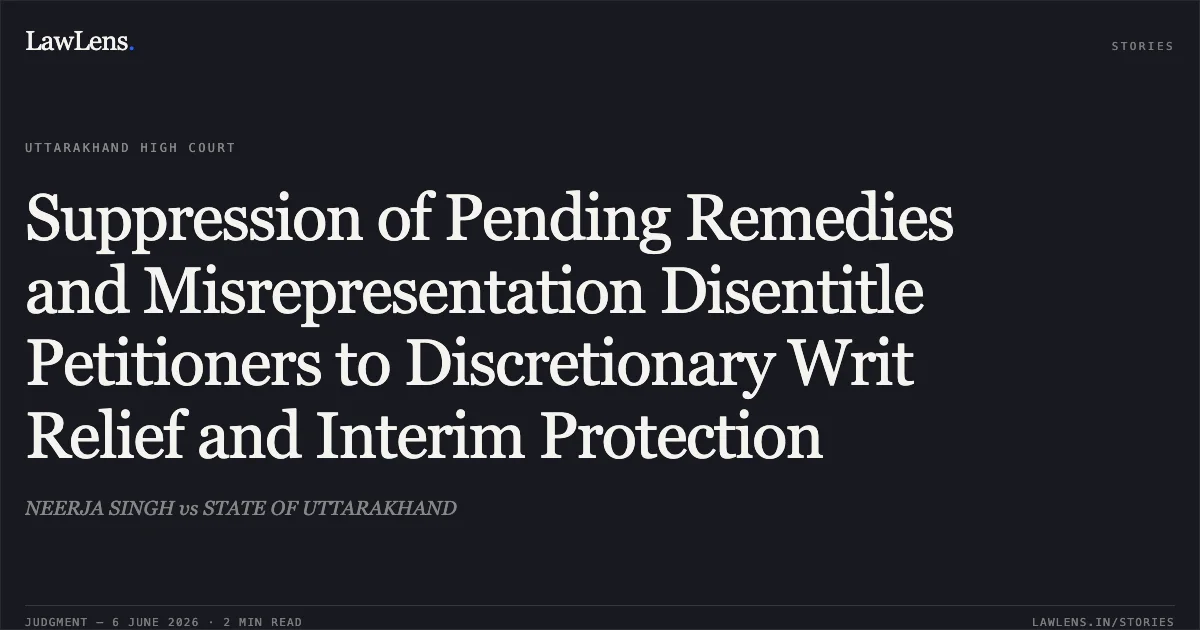
Source reference: para. 5, 23While the petitions were pending, the court found that the petitioners had suppressed the fact that they had also filed for anticipatory bail in the Sessions Court, where the prosecution had already committed not to arrest them.
Source reference: para. 10, 25Issues
1. Whether the suppression of a parallel anticipatory bail application and the use of contradictory stands regarding money receipts disentitle the petitioners to relief under writ jurisdiction.
Source reference: para. 10, 25, 272. Whether the dispute is purely civil in nature, warranting the quashing of the FIR.
Source reference: para. 293. Whether the FIR and preliminary enquiry disclose cognizable offences against the petitioners.
Source reference: para. 23, 27Law Applied
The court primarily applied the doctrine of "Clean Hands," which dictates that a person seeking discretionary relief under Article 226 of the Constitution must disclose all material facts.
Source reference: para. 25It followed established precedents holding that misrepresentation or withholding relevant documents (such as pending bail applications) constitutes suppression and warrants the refusal of relief.
Source reference: para. 10, 25Regarding the quashing of the FIR, the court applied the standard of whether the allegations, if taken at face value, disclose cognizable offences under the Indian Penal Code (IPC), specifically Sections 420 (cheating) and 467/471 (forgery).
Source reference: para. 23, 27Reasoning
The Court observed that the petitioners obtained interim protection by misrepresenting an "apprehension of arrest" to the High Court while the prosecution had already assured their safety in the Sessions Court.
Source reference: para. 10, 25This conduct was termed a "misleading approach".
Source reference: para. 27Substantively, the court rejected the "civil nature" argument, noting that the petitioners took contradictory stands: they denied receiving money while also claiming the complainant (acting as a broker) had already been paid via separate sale deeds.
Source reference: para. 12, 17, 27The court highlighted that a preliminary enquiry by the Circle Officer and the account statements evidenced the receipt of ₹19.01 crore, and one petitioner had previously admitted the receipt in court before attempting to withdraw the statement.
Source reference: para. 18, 23, 27The allegation that a forged document was used to transfer company shares specifically supported the continuation of criminal proceedings.
Source reference: para. 23, 27Holding
The court held that the petitioners were disentitled to relief due to the suppression of material facts, misrepresentation of urgency, and contradictory factual assertions.
The court found that the FIR, supported by a preliminary enquiry and account statements, disclosed cognizable offences. Consequently, both writ petitions were dismissed.
Source reference: para. 23, 30The court vacated the interim protection and imposed costs of ₹2,00,000 on the petitioners in WPCRL 1530/2025 and ₹50,000 on the petitioner in WPCRL 1432/2025, to be deposited in the Advocates Welfare Fund.
Source reference: para. 30Acts & Sections Cited
4 provisions across 1 statute referred to in this judgment. Each provision opens on LawLens.
Indian Penal Code, 18604
Original Court PDF
NEERJA SINGHvsSTATE OF UTTARAKHAND
Click to open original judgment
Original judgment, available to read, download and summarize on LawLens.in