Facts
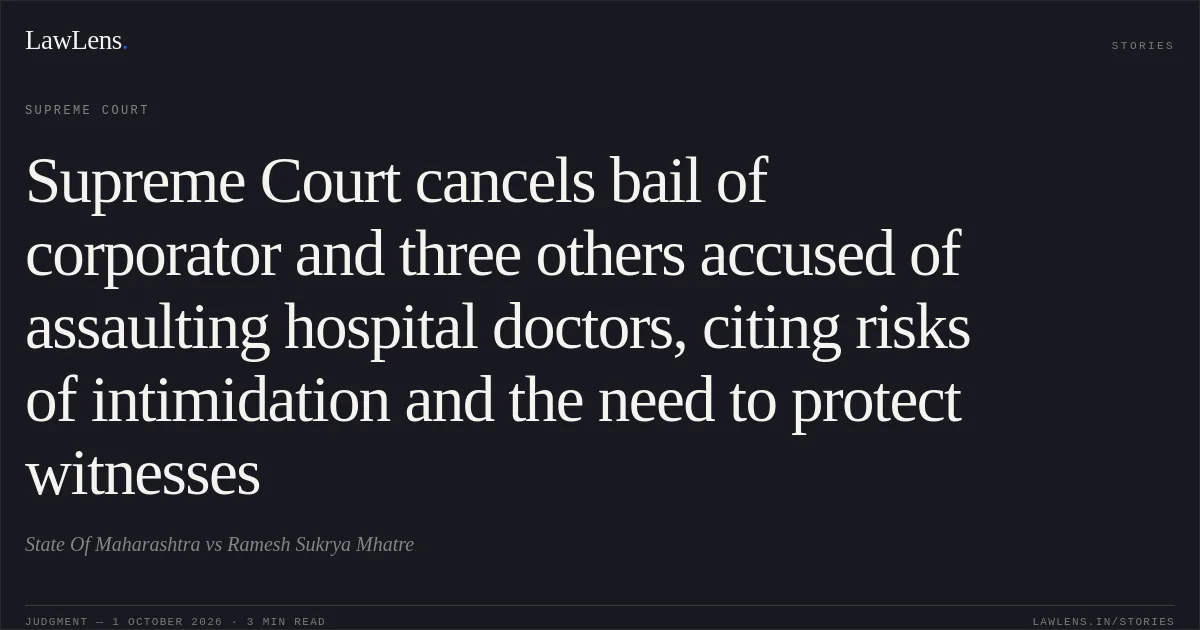
The prosecution alleged that respondent No. 1, an elected municipal corporator, led respondents Nos. 2–4 in assaulting and abusing three doctors, including a woman doctor, at a municipal hospital while they were on duty.
Source reference: para. 12–14The incident arose from a dispute concerning the shifting of a pregnant patient in labour; the informant also alleged that respondent No. 1 threatened him.
Source reference: para. 12–14The Magistrate granted bail to respondent No. 1 and, on parity, to respondents Nos. 2–4. The Bombay High Court initially stayed those orders, but subsequently permitted the respondents to remain on bail subject to conditions, including residence outside Maharashtra and restrictions on contacting witnesses.
Source reference: para. 18–28The State appealed against the High Court’s later order.
Source reference: para. 29–30Issues
1. Whether the High Court’s order permitting the respondents to remain on bail was liable to be set aside for failing to give cogent reasons for departing from its earlier prima facie assessment and for not properly considering material bail factors.
Source reference: para. 53–582. Whether respondents Nos. 2–4 could retain bail on the basis of parity once the grant of bail to respondent No. 1 was found unsustainable.
Source reference: para. 64Law Applied
In exercising bail discretion, a court must assess the totality of the circumstances, including the nature of the allegations, criminal antecedents, risk of repetition or interference with witnesses, and relevant societal concerns; imposing conditions arises only after the court determines that the accused is entitled to bail.
Source reference: para. 59The Court relied on Ash Mohammad v. Shiv Raj Singh, which treats criminal antecedents as a material consideration in bail adjudication.
Source reference: para. 59Where a court reverses an earlier prima facie view in the same proceedings, it must provide cogent and discernible reasons for doing so.
Source reference: para. 54–58Article 136 of the Constitution empowers the Supreme Court to interfere with a bail order affected by perversity or non-application of mind.
Source reference: para. 53, 71Section 13(1)(a) of the Maharashtra Municipal Corporations Act, 1949, concerning removal of a councillor for misconduct or disgraceful conduct, was considered a relevant circumstance.
Source reference: para. 62For witness protection, the Court referred to Section 9 of the Maharashtra Witness Protection and Security Act, 2017, and Mahender Chawla v. Union of India.
Source reference: para. 75Reasoning
The High Court had earlier stayed the Magistrate’s bail orders after a prima facie assessment of the allegations, but its later order relied principally on custody undergone, investigation progress, and the anticipated completion of forensic analysis without explaining why the earlier concerns no longer applied.
Source reference: para. 54–58The Supreme Court held that the courts below had not adequately considered respondent No. 1’s stated criminal antecedents, the alleged threats and potential influence over witnesses, or the effect of the incident on the victim doctors and the medical fraternity.
Source reference: para. 59–66Because respondents Nos. 2–4 had obtained bail substantially by parity with respondent No. 1, that basis also failed once his bail was found unsustainable.
Source reference: para. 64The Court therefore concluded that the High Court’s exercise of discretion was vitiated by non-consideration of material circumstances.
Source reference: para. 68Holding
The Supreme Court allowed the appeal under Article 136 and set aside the High Court’s order insofar as it restored bail to respondents Nos. 1–4; their bail was cancelled, and they were directed to surrender before the trial court by 5 October 2026.
The respondents remain at liberty to renew their bail applications if circumstances materially change.
Source reference: para. 72The Court otherwise retained the High Court’s directions, modified the trial-completion timeline to require the Special Fast Track Court to endeavour to conclude the trial within six months of the order, and directed the trial court to ensure appropriate protection for material witnesses.
Source reference: para. 73–76It also directed the State to independently consider, in accordance with law, whether preventive-detention provisions are attracted.
Source reference: para. 67Acts & Sections Cited
15 provisions across 6 statutes referred to in this judgment. Each provision opens on LawLens.
Bharatiya Nyaya Sanhita, 20237
Maharashtra Medicare Service Persons and Medicare Service Institutions (Prevention of Violence and Damage or Loss to Property) Act, 2010.2
Bharatiya Nagarik Suraksha Sanhita, 20232
Maharashtra Municipal Corporations Act.1
Indian Penal Code, 18602
Maharashtra Witness Protection and Security Act, 20171
Original Court PDF
State Of MaharashtravsRamesh Sukrya Mhatre
Click to open original judgment
Original judgment, available to read, download and summarize on LawLens.in