Facts
Orris owned land on which Three C Shelters Private Limited (the corporate debtor) was developing the Greenopolis project.
Source reference: para. 4–6M/s Straight Edge Contracts Private Limited filed a petition under Section 9 of the Insolvency and Bankruptcy Code, 2016 (IBC), claiming operational debt; the petition was admitted and CIRP commenced.
Source reference: para. 4–6On applications by other stakeholders, the NCLT found that the alleged debt and the Section 9 proceedings resulted from fraud and collusion between Straight Edge and the corporate debtor. It nevertheless held that it lacked power to recall the admission order.
Source reference: para. 10–12, 16–17The NCLAT held that recall was available and set aside the CIRP. Orris, homebuyer representatives and individual homebuyers appealed to the Supreme Court.
Source reference: para. 19–20The Supreme Court affirmed the finding of fraud and collusion but noted that neither the NCLT nor the NCLAT had properly decided whether the CIRP should continue for the benefit of other stakeholders.
Source reference: para. 13, 48Issues
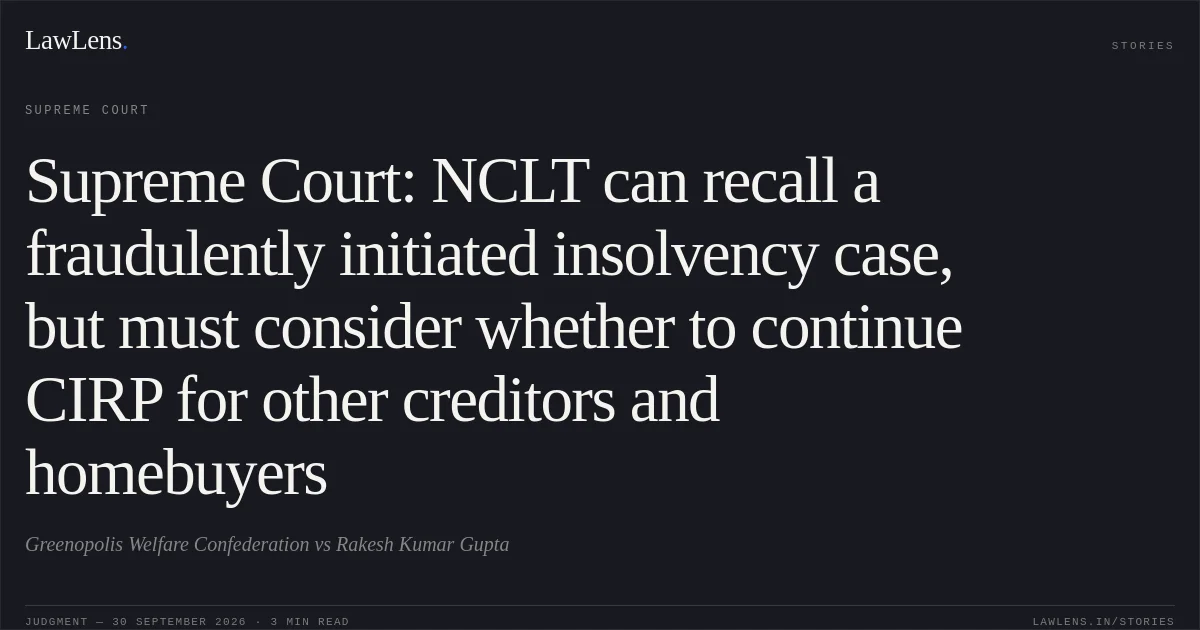
1. Whether the Adjudicating Authority (AA) has power to recall admission of a Section 9 petition and the resulting CIRP where the petition was initiated through fraud and collusion.
Source reference: para. 1, 16, 28–302. Whether a finding of fraud and collusion necessarily requires termination of the CIRP, or whether the process may continue in the interests of other stakeholders.
Source reference: para. 2, 31, 45–48Law Applied
Under the IBC, the existence of a debt and other statutory conditions for admission are jurisdictional facts; if jurisdiction is invoked through fraudulent or collusive misrepresentation of such facts, the AA may recall the admission because fraud cannot sustain the assumption of statutory jurisdiction.
Source reference: para. 22–30, 49(i)The Court relied on Carona Ltd. v. Parvathy Swaminathan & Sons for the principle that a jurisdictional fact is a condition precedent to exercise of jurisdiction, and on Shrisht Dhawan v. M/s Shaw Brothers for the distinction between errors in jurisdictional facts and errors made in exercising jurisdiction.
Source reference: para. 22–24It also relied on GLAS Trust Company LLC v. Byju Raveendran and Indus Biotech (P) Ltd. v. Kotak India Venture (Offshore) Fund for the principle that, after admission, CIRP becomes an in rem process involving all creditors, rather than a proceeding controlled by the initiating creditor.
Source reference: para. 32Sections 12A, 14, 17, 18, 20, 21, 25, 30 and 53 of the IBC support the collective character of CIRP and show that withdrawal or continuation after admission concerns the wider creditor body, not merely the original applicant.
Source reference: para. 35–44Section 65 may also be invoked where CIRP is initiated fraudulently or with malicious intent.
Source reference: para. 49(iv)Reasoning
The Court found that the alleged operational debt was fictitious and that the Section 9 petition had been used to trigger CIRP and moratorium, thereby affecting homebuyers and other claimants; the jurisdictional basis for admission was therefore vitiated by fraud and collusion.
Source reference: para. 28–30The AA consequently had power to recall admission and dismiss the initiating petition.
Source reference: para. 32–47, 49(ii)–(v)But recall of the original application did not automatically require termination of the entire CIRP: after admission, the process had become collective, with independent creditors, the resolution professional and the Committee of Creditors involved.
Source reference: para. 32–47, 49(ii)–(v)The AA must therefore separately decide whether continuation would serve the IBC’s purposes, after hearing the RP, the CoC and other stakeholders and assessing whether the process can proceed with integrity and transparency.
Source reference: para. 32–47, 49(ii)–(v)As that consequential decision had not been made, the Supreme Court remitted the matter rather than itself ordering termination or continuation.
Source reference: para. 48Holding
The Court held that the AA has jurisdiction to recall admission of an IBC application where its jurisdictional foundation is proved to have been procured by fraud and collusion.
However, such a finding does not automatically invalidate all subsequent CIRP proceedings; the AA must decide whether they should continue in the interests of the wider stakeholder body.
Source reference: para. 49(v)The appeals were allowed in part, the NCLAT’s order was set aside, and the CIRP was restored to the AA for a decision on continuation after hearing the RP, CoC and other stakeholders, including homebuyers.
Source reference: para. 50–51If continued, it must be concluded expeditiously.
Source reference: para. 50–51The contempt petitions were closed.
Source reference: para. 50–51Acts & Sections Cited
14 provisions across 2 statutes referred to in this judgment. Each provision opens on LawLens.
Insolvency and Bankruptcy Code, 2016.
Real Estate (Regulation and Development) Act, 2016.1
Original Court PDF
Greenopolis Welfare ConfederationvsRakesh Kumar Gupta
Click to open original judgment
Original judgment, available to read, download and summarize on LawLens.in