Facts
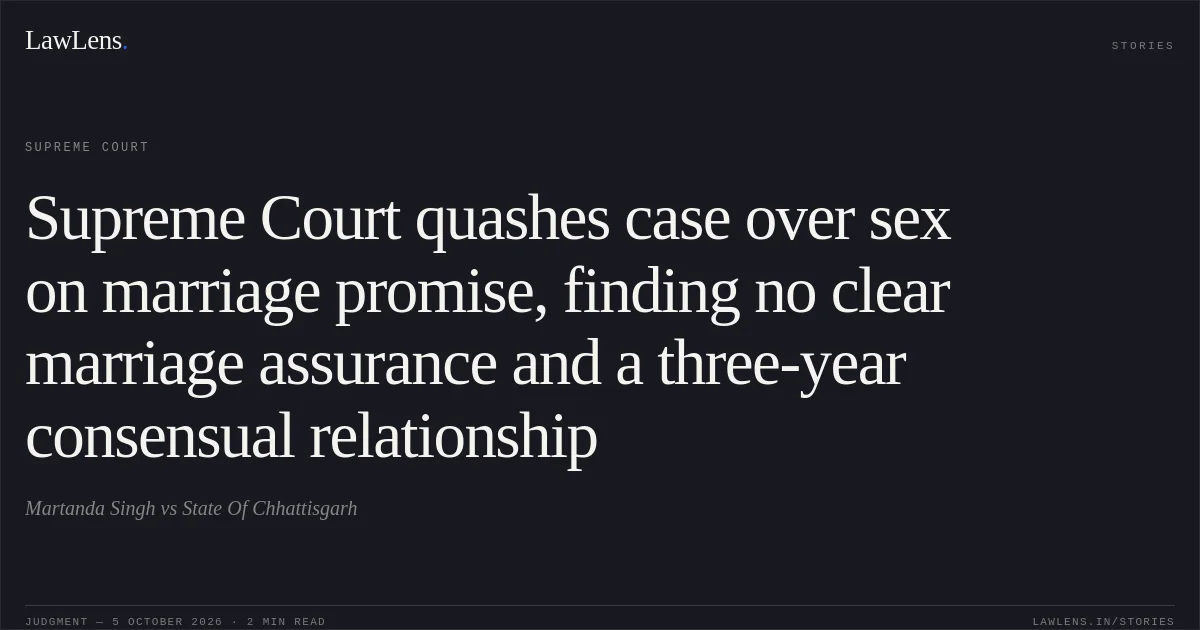
The second respondent, an engineering graduate, met the appellant at a coaching academy. They entered into a relationship and, on an understanding that they would marry, had a physical relationship over approximately three years.
Source reference: pp. 2–3Their families discussed marriage, but the proposal fell through and the parties separated. The second respondent alleged that the appellant had sexually exploited her on the pretext of marriage and lodged a complaint; FIR No. 191 of 2025 was registered at Sirgitti Police Station, Bilaspur.
Source reference: pp. 2–3A chargesheet was filed and the case proceeded as Sessions Case No. 216 of 2025 before the Additional Sessions Judge, Bilaspur, where it was listed for framing of charges.
Source reference: p. 5Issues
1. Whether the allegations, viewed against the parties’ three-year consensual relationship and the circumstances of the failed marriage proposal, disclosed that the appellant’s promise to marry was false from the outset and that the second respondent’s consent was vitiated by misconception of fact.
Source reference: pp. 2, 4–52. Whether the criminal proceedings should be quashed in the circumstances of the case.
Source reference: p. 5Law Applied
The Court relied on Deepak Gulati v. State of Haryana, (2013) 7 SCC 675, which requires adequate evidence that, at the inception of the relationship, the accused never intended to keep a promise to marry; failure to fulfil a promise concerning a future uncertain event does not, by itself, establish misconception of fact.
Source reference: p. 2The Court also referred to Section 90 of the Indian Penal Code, under which consent given under fear or misconception of fact is not valid consent, and held that such misconception cannot be loosely inferred where the relationship was consensual.
Source reference: pp. 2, 4Reasoning
The Court found no clear assurance or promise of marriage in the complaint that established an intention to deceive from the beginning. The parties had a relationship lasting about three years, during which they willingly continued their physical relationship; their families had also discussed marriage.
Source reference: pp. 3–4On those facts, the Court concluded that the second respondent’s consent was not shown to have been coerced or obtained by misrepresentation, and that the later failure of the marriage proposal did not establish criminal culpability. It further observed that criminal prosecution could not be used as a means to compel marriage.
Source reference: p. 4Holding
The Supreme Court held that the allegations did not disclose criminal culpability on the part of the appellant and found no basis for continuing the prosecution.
It allowed the appeal, quashed the chargesheet dated 17 June 2025, and directed that no further proceedings be taken on the charge; Sessions Case No. 216 of 2025 was ordered closed.
Source reference: p. 5Acts & Sections Cited
1 provisions across 1 statute referred to in this judgment. Each provision opens on LawLens.
Indian Penal Code, 18601
Original Court PDF
Martanda SinghvsState Of Chhattisgarh
Click to open original judgment
Original judgment, available to read, download and summarize on LawLens.in