Facts
The respondent-company had obtained credit facilities from the State Bank of India from 2010; its accounts were declared non-performing in 2016. The company’s directors alleged that bank officials discriminated against them on caste grounds, failed to extend RBI rehabilitation measures, and made or relied on forged or false documents to initiate coercive action
Source reference: paras. 4–7, pp. 2–4The allegations led to FIR No. 1 of 2019 under the Scheduled Castes and Scheduled Tribes (Prevention of Atrocities) Act, 1989. The High Court declined to interfere with the prosecution; the accused bank officers appealed to the Supreme Court
Source reference: paras. 2, 7–8, pp. 1, 4Issues
1. Whether the allegations justified continuation of the criminal prosecution against the bank officers under the SC/ST Act
Source reference: paras. 8–10, pp. 4–62. Whether complaints concerning RBI guidelines, rehabilitation measures, and alleged false or forged information could instead be pursued in recovery proceedings before the appropriate forum
Source reference: para. 10, p. 6Law Applied
The Court considered Section 3(1)(q) of the SC/ST Act, invoked in connection with allegations of false or frivolous information being submitted to public authorities
Source reference: para. 5, p. 3It held that non-compliance with RBI guidelines or circulars does not, by itself, justify criminal prosecution merely because the borrower’s directors belong to Scheduled Castes or Scheduled Tribes; the allegations must include a specific basis for the alleged caste-based conduct
Source reference: para. 9, p. 5The Court identified the Debts Recovery Tribunal as an appropriate forum for the borrower to raise disputes concerning RBI directions, rehabilitation measures, and alleged misrepresentations affecting recovery proceedings
Source reference: para. 10, p. 6No precedent was relied on in the Court’s stated reasoning.
Source reference: no citationReasoning
The Court considered the dispute in the context of the company’s credit facilities having turned NPA and the resulting bank proceedings
Source reference: paras. 4, 9, pp. 2, 5Although the complaint alleged discriminatory treatment and irregularities in the handling of the loan, the Court found no specific allegation that an officer had denigrated the directors on the basis of caste. It concluded that alleged failures to follow RBI directions and disputes about documents or recovery measures did not, without such a specific allegation, warrant continuing the criminal prosecution. Those disputes could be raised in recovery proceedings for determination by the appropriate adjudicating authority
Source reference: paras. 8–10, pp. 4–6Holding
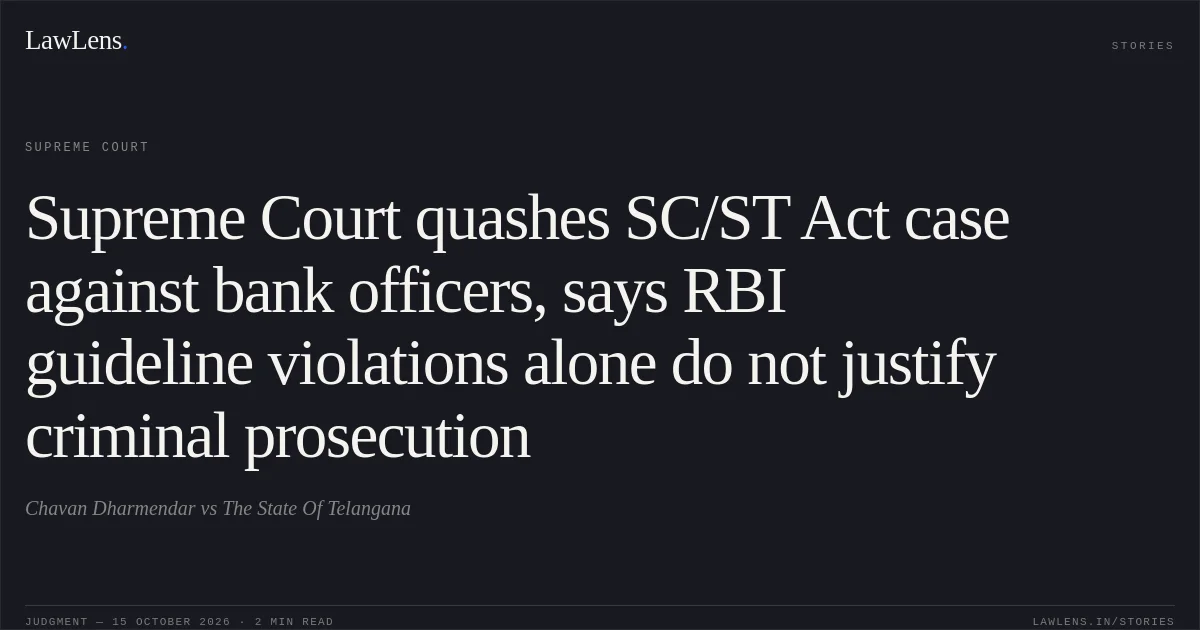
The Supreme Court held that the criminal prosecution should not continue on the allegations presented.
It allowed the appeal and quashed the proceedings arising from FIR No. 1 of 2019, while leaving the company’s contentions open for pursuit before the appropriate forum, including the Debts Recovery Tribunal
Source reference: paras. 10–11, p. 6Acts & Sections Cited
1 provisions across 1 statute referred to in this judgment. Each provision opens on LawLens.
Scheduled Castes and the Scheduled Tribes (Prevention of Atrocities) Act, 19891
Original Court PDF
Chavan DharmendarvsThe State Of Telangana
Click to open original judgment
Original judgment, available to read, download and summarize on LawLens.in