Facts
The dispute involves the estate of Gulab Singh, who died on Feb 26, 1992.
Source reference: para 2The plaintiffs (respondents herein) claimed ownership based on a Will dated Feb 18, 1992, registered years later in 2000.
Source reference: para 2The defendant, Chinti Devi (appellant’s predecessor), contested the Will, asserting natural succession, and filed a cross-suit for injunction.
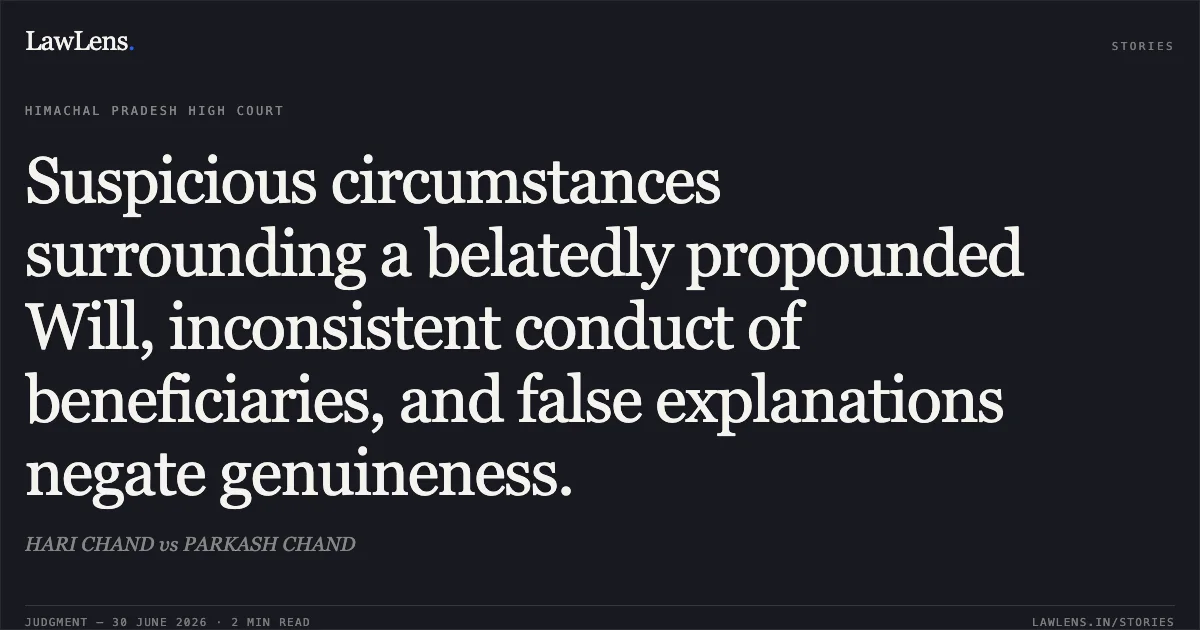
Source reference: paras 3, 6The Trial Court dismissed the plaintiffs' suit and decreed Chinti Devi’s suit, finding the Will was shrouded in suspicious circumstances, including the testator's death eight days after execution and inconsistencies regarding the date.
Source reference: para 12The First Appellate Court reversed this, declaring the Will valid.
Source reference: para 13The legal heirs of Chinti Devi appealed to the High Court.
Source reference: para 14Issues
1. Whether the Lower Appellate Court failed to discuss the entire oral and documentary evidence as required of a final court of fact.
Source reference: para 142. Whether the Will dated Feb 18, 1992, was valid despite several suspicious circumstances identified by the Trial Court.
Source reference: para 143. Whether an adverse inference should be drawn against the plaintiffs for failing to testify as witnesses.
Source reference: para 14Law Applied
Section 63 of the Indian Succession Act, 1925, and Section 68 of the Indian Evidence Act, 1872, regarding the formal requirements and proof of a Will.
Source reference: para 27, 28The principle that the propounder must dispel all "suspicious circumstances" to satisfy the judicial conscience, as established in H. Venkatachala Iyengar v. B.N. Thimmajamma.
Source reference: para 28Section 114(g) of the Indian Evidence Act, as interpreted in Vidyadhar v. Manikrao, which mandates drawing an adverse inference when a party to a suit refuses to enter the witness box to prove their case.
Source reference: para 39Order 41 Rule 31 of the CPC, which stipulates that a First Appellate Court, when reversing a finding of fact, must come into "close quarters" with the reasoning of the Trial Court.
Source reference: para 20Reasoning
The High Court found that the Appellate Court erred by ignoring critical suspicious circumstances.
Source reference: para 25The plaintiffs' father had purchased a room from the estate and the mother had sought grass-cutting permission from Chinti Devi; both acts were fundamentally inconsistent with the existence of a Will in their favour.
Source reference: paras 31-33The "Sunday" execution claim was debunked as Feb 18, 1992, was a Tuesday, proving the scribe’s explanation for the lack of register entries was false.
Source reference: para 36The Will was not produced during initial mutation proceedings in 1992, which per Kalyan Singh v. Chhoti is a major suspicion.
Source reference: para 33The Appellate Court failed to draw an adverse inference against the plaintiffs/propounders for not stepping into the witness box to be cross-examined.
Source reference: paras 39-40Holding
The High Court answered the substantial questions of law in favor of the appellants, holding that the Will was invalid due to unexplained suspicious circumstances and the non-appearance of the propounders.
The Court set aside the First Appellate Court's judgment and restored the Trial Court's decree, which dismissed the plaintiffs' suit and protected the rights of Chinti Devi’s legal heirs.
Source reference: para 42Acts & Sections Cited
2 provisions across 2 statutes referred to in this judgment. Each provision opens on LawLens.
Code of Civil Procedure, 19081
Indian Succession Act, 19251
Original Court PDF
HARI CHANDvsPARKASH CHAND
Click to open original judgment
Original judgment, available to read, download and summarize on LawLens.in