Facts
The appellant was prosecuted for allegedly pouring kerosene on his wife and setting her ablaze after a quarrel concerning missing money.
Source reference: pp. 1, 4–5The deceased sustained burns over approximately 96% of her body and subsequently died.
Source reference: pp. 1, 4–5The prosecution relied principally on the post-mortem report, two alleged dying declarations, the circumstances of the marital relationship, and the appellant’s failure to explain the death under Section 106 of the Indian Evidence Act.
Source reference: pp. 1, 4–5The Trial Court convicted the appellant under Section 302 of the Indian Penal Code and sentenced him to life imprisonment; the High Court affirmed the conviction.
Source reference: p. 2Before the Supreme Court, the appellant challenged the reliability and proof of the dying declarations, the medical evidence, the alleged motive, and the treatment of the deceased’s relatives as witnesses who had been won over.
Source reference: pp. 2–3Issues
Whether the prosecution established beyond reasonable doubt that the deceased’s death was homicidal and that the appellant caused it
Source reference: pp. 4–5, 10–11Whether the two alleged dying declarations were proved and sufficiently reliable to sustain the conviction
Source reference: pp. 8–10Whether the High Court was justified in disregarding the testimony of the deceased’s relatives and relying on alleged prior statements under Section 161 of the Code of Criminal Procedure
Source reference: pp. 6–8Whether the appellant’s failure to explain the occurrence attracted Section 106 of the Indian Evidence Act
Source reference: pp. 10–11Law Applied
The Court applied the principle that the prosecution must prove the charge of murder under Section 302 of the Indian Penal Code beyond reasonable doubt and must establish every incriminating circumstance relied upon.
Source reference: pp. 10–11It considered the governing principles concerning dying declarations, including that their evidentiary value depends upon proof of their recording, the maker’s fitness and capacity, and the declaration’s internal and surrounding reliability.
Source reference: pp. 8–10A statement under Section 161 of the Code of Criminal Procedure is not substantive evidence and cannot be relied upon for conviction unless the witness is properly confronted with the alleged prior statement and the contradiction is duly proved through the Investigating Officer.
Source reference: pp. 7–8Section 106 of the Indian Evidence Act does not relieve the prosecution of its primary burden; an adverse inference can arise only where a relevant incriminating circumstance has first been established against the accused.
Source reference: pp. 10–11The prosecution must therefore present a consistent and complete evidentiary case leaving no reasonable doubt as to guilt.
Source reference: p. 11Reasoning
The Court found that the prosecution had not conclusively established a homicidal death.
Source reference: pp. 4–5Although the post-mortem report showed burns over 96% of the body, including the scalp, the pattern could also be consistent with the deceased having doused herself with kerosene; the doctor was not examined on whether the death was suicidal or homicidal.
Source reference: pp. 4–5The medical evidence also created doubt about the deceased’s capacity to make a reliable statement, since the post-mortem doctor testified that a person with 80–90% burns could speak well, whereas the deceased had suffered 96% burns.
Source reference: p. 5The first dying declaration was not properly proved: the Head Constable who allegedly recorded it had died, and the Sub-Inspector neither affirmed the recorder’s signature nor identified the document as the statement received by him.
Source reference: pp. 8–9Its timing was also doubtful, as it was allegedly recorded on 7 May 2013 but treated as the basis of the FIR only at 1:00 a.m. on 8 May 2013.
Source reference: p. 9The second dying declaration overlapped in time with the first, despite being recorded by the Executive Magistrate, and the alleged motives in the two declarations differed.
Source reference: p. 10Further, the deceased’s relatives did not incriminate the appellant in their testimony; the High Court improperly treated their evidence as contrary to earlier Section 161 statements without properly confronting them or proving the contradictions through the Investigating Officer.
Source reference: pp. 6–8Since the relatives stated that the appellant was present and attempted to extinguish the fire, no adverse inference could be drawn under Section 106.
Source reference: pp. 10–11Holding
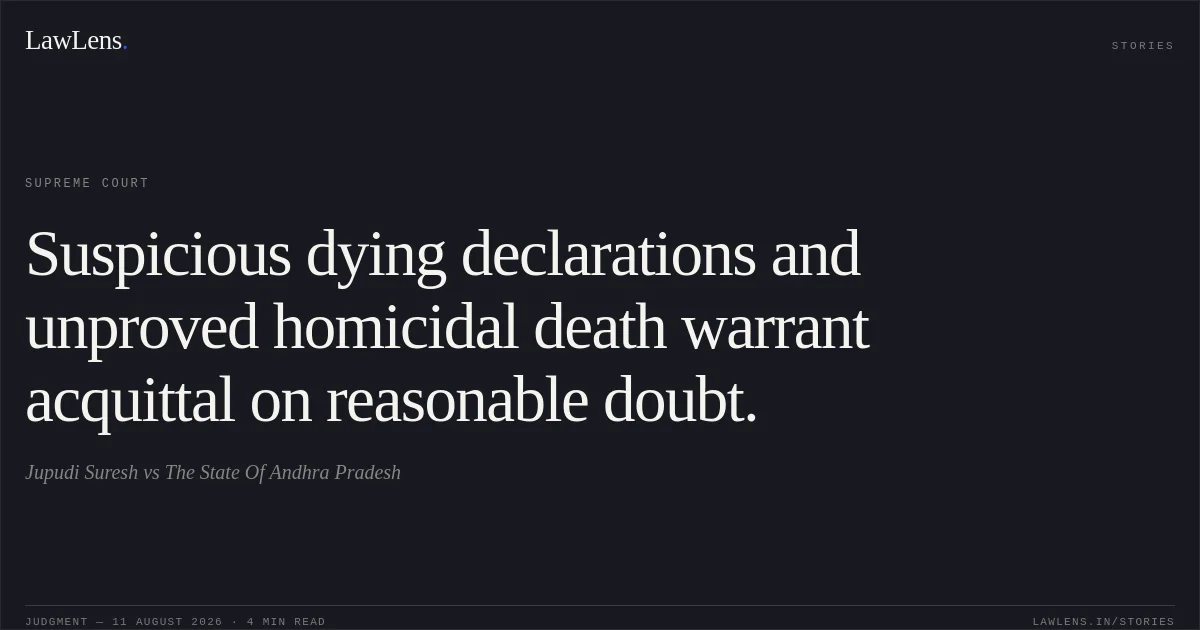
The Supreme Court held that the prosecution failed to prove, beyond reasonable doubt, either that the death was homicidal or that the appellant caused it.
The dying declarations were found suspicious and insufficiently proved, the relatives’ testimony did not support the prosecution, and Section 106 of the Indian Evidence Act was inapplicable in the circumstances.
Source reference: pp. 10–11The conviction and sentence imposed by the Trial Court and affirmed by the High Court were set aside, and the appellant was acquitted.
Source reference: p. 11The Court directed that he be released if not required in any other case; if already on bail, his bail bonds were cancelled.
Source reference: p. 11Acts & Sections Cited
3 provisions across 2 statutes referred to in this judgment. Each provision opens on LawLens.
Code of Criminal Procedure, 19731
Indian Penal Code, 18602
Original Court PDF
Jupudi SureshvsThe State Of Andhra Pradesh
Click to open original judgment
Original judgment, available to read, download and summarize on LawLens.in