Facts
The prosecutrix, a widow, alleged that the appellant first raped her under threat of life in a forest on 10.12.1999.
Source reference: para. 3, 12Subsequently, the appellant promised to marry her, leading to a long-term relationship where they lived together in a rented house.
Source reference: para. 3The prosecutrix alleged she became pregnant twice, but the appellant forcibly terminated the pregnancies by physical assault.
Source reference: para. 3, 12The relationship collapsed when the appellant flatly refused to marry her, leading to the FIR in 2004.
Source reference: para. 3The Trial Court convicted the appellant under Sections 376 and 313 of the IPC, sentencing him to seven and five years of rigorous imprisonment, respectively.
Source reference: para. 2The appellant challenged this, claiming the relationship was consensual.
Source reference: para. 8Issues
1. Whether the physical relationship established under a promise of marriage constitutes rape under Section 376 IPC due to "misconception of fact" regarding consent.
Source reference: para. 11, 152. Whether there was sufficient evidence to sustain the conviction for causing miscarriage without consent under Section 313 IPC.
Source reference: para. 21Law Applied
The court applied Section 376 (Rape), Section 313 (Causing miscarriage without woman's consent), and Section 90 (Consent known to be given under fear or misconception) of the Indian Penal Code.
Source reference: para. 2, 17It relied on the distinction between a "false promise" and a "breach of promise" established in Naim Ahamed v. State (NCT of Delhi) (2023) and Mandar Deepak Pawar v. State of Maharashtra (2022), holding that consent is vitiated only if the accused had no intention to marry from the inception.
Source reference: para. 15, 16, 18Reasoning
Regarding Section 376, the Court found that the appellant was already married at the time of the proposal, a fact he concealed from the prosecutrix.
Source reference: para. 19This concealment, combined with the initial act of force in 1999 and the lack of any unforeseen circumstances preventing the marriage, proved a "deceitful intention" from the inception.
Source reference: para. 19Thus, the consent was vitiated under Section 90 as a "misconception of fact".
Source reference: para. 19However, regarding Section 313, the Court found the prosecution's evidence lacking; despite the prosecutrix's claims of assaulted miscarriage, no medical documents were produced, and the treating physician was not examined.
Source reference: para. 21The High Court noted the Trial Court failed to satisfy the essential ingredients of Section 313 beyond a reasonable doubt.
Source reference: para. 21Holding
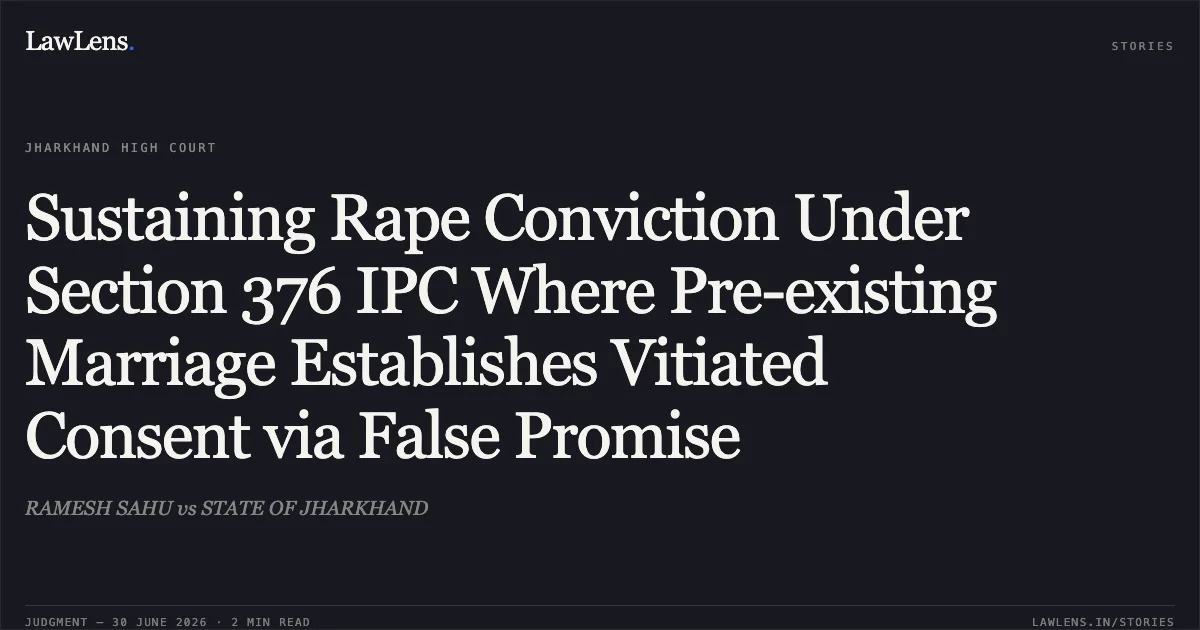
The Court upheld the conviction and sentence under Section 376 IPC (7 years RI) but set aside the conviction and sentence under Section 313 IPC due to insufficient evidence.
The appeal was partly allowed. The appellant's bail was cancelled, and he was directed to surrender within two months to serve the remainder of the sentence for rape.
Source reference: para. 22, 23Acts & Sections Cited
8 provisions across 2 statutes referred to in this judgment. Each provision opens on LawLens.
Indian Penal Code, 18606
Code of Criminal Procedure, 19732
Original Court PDF
RAMESH SAHUvsSTATE OF JHARKHAND
Click to open original judgment
Original judgment, available to read, download and summarize on LawLens.in