Facts
Respondent No. 2, Sita Rani, was married to petitioner Gurjit Singh and had two children. Gurjit Singh was residing in Italy, while Sita Rani lived in the matrimonial home with the children and her mother-in-law, Harjinder Kaur.
Source reference: paras. 3–4She alleged that on 17.08.2016, she was induced to send the children with Harjinder Kaur and Pardeep Kumar on the pretext of attending a religious ceremony at the house of petitioner Inderjit Kaur.
Source reference: paras. 3–4FIR No. 279 dated 25.11.2016 was initially registered under Sections 365 and 506 IPC at Police Station Parao, Ambala Cantt. During investigation, Sections 406, 420 and 120-B IPC were added, while Section 365 IPC was subsequently deleted and Pardeep Kumar was found innocent.
Source reference: para. 5A charge-sheet was presented against Inderjit Kaur, against whom charges under Sections 420 and 506 IPC were framed on 12.07.2017. No charge-sheet or charges had been filed against Gurjit Singh, Harjinder Kaur and Jarnail Singh, who were stated to be residing in Italy.
Source reference: para. 6The petitioners invoked the High Court’s inherent jurisdiction under Section 482 Cr.P.C. and sought quashing of the FIR, charge-sheet, charges and all consequential proceedings.
Source reference: paras. 7–8Issues
Whether the allegations in the FIR and the material collected during investigation disclosed the essential ingredients of offences under Sections 406, 420 and 120-B IPC in relation to the alleged taking and retention of the complainant’s children?
Source reference: paras. 16–19Whether the general allegation that Inderjit Kaur threatened the complainant with death constituted the offence of criminal intimidation under Section 506 IPC?
Source reference: para. 20Whether the High Court should exercise its inherent jurisdiction under Section 482 Cr.P.C. to quash the FIR and consequential proceedings where the basic ingredients of the alleged offences were absent, notwithstanding that charges had been framed against one petitioner?
Source reference: paras. 12–15, 21–23Law Applied
The Court applied Section 482 Cr.P.C., which empowers the High Court to prevent abuse of the process of any court and secure the ends of justice; the Court noted that this power is pari materia with Section 528 of the Bharatiya Nagarik Suraksha Sanhita, 2023.
Source reference: para. 12Relying principally on State of Haryana v. Bhajan Lal, 1992 Supp (1) SCC 335, the Court reiterated that quashing is permissible where, even accepting the FIR and accompanying material at face value, no offence is made out, or where the proceedings are manifestly abusive or malicious.
Source reference: para. 12Under Section 406 IPC, criminal breach of trust requires entrustment of property or dominion over property followed by dishonest misappropriation, conversion, use or disposal.
Source reference: para. 17Section 420 IPC requires deception and dishonest or fraudulent inducement resulting in delivery of property, or the making, alteration or destruction of a valuable security.
Source reference: para. 18Section 120-B IPC requires an agreement or meeting of minds to commit an unlawful act or to accomplish a lawful act by unlawful means.
Source reference: para. 19Criminal intimidation under Section 506 IPC requires a threat accompanied by the requisite intention to cause alarm or compel the complainant to act or refrain from acting.
Source reference: para. 20The Court also relied on Paramjeet Batra v. State of Uttarakhand, (2013) 11 SCC 673; Randheer Singh v. State of Uttar Pradesh, (2021) 14 SCC 626; Gian Singh v. State of Punjab, (2012) 10 SCC 303; Narinder Singh v. State of Punjab, (2014) 6 SCC 466; and Dhruvaram Murlidhar Sonar v. State of Maharashtra, (2019) 18 SCC 191, for the principles that criminal proceedings cannot be used as harassment, that inherent powers are distinct from compounding, and that proceedings may be quashed where the basic ingredients of the offence are absent.
Source reference: paras. 13–15Reasoning
The Court held that the deletion of Section 365 IPC removed the principal allegation concerning kidnapping or abduction, although it proceeded to examine the remaining offences on the basis of the FIR and investigation material.
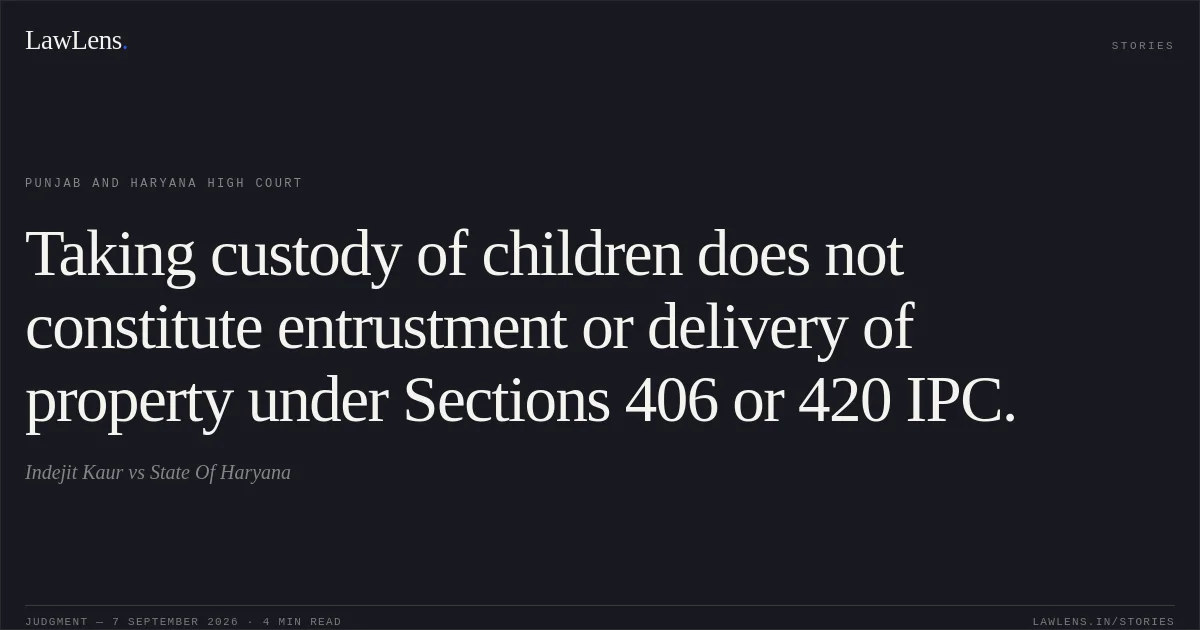
Source reference: para. 16Section 406 IPC was not attracted because the allegations concerned custody of children and did not involve entrustment or dishonest misappropriation of any property belonging to the complainant.
Source reference: para. 17Section 420 IPC was likewise not made out: even if Inderjit Kaur had induced the complainant to send the children to her mother-in-law on the pretext of a religious ceremony, what was allegedly obtained was custody of the children, not delivery of property or a valuable security as required by Section 420 IPC.
Source reference: para. 18The allegation of conspiracy was merely a general conclusion based on the fact that the children left with the mother-in-law and were subsequently unavailable; no specific material disclosed an agreement or meeting of minds to commit an offence.
Source reference: para. 19The allegation under Section 506 IPC was also insufficient because it did not specify the date, time, occasion, words used, surrounding circumstances or any resulting alarm or compulsion on the complainant’s part.
Source reference: para. 20The Court declined to determine disputed questions concerning the authenticity or voluntariness of the affidavit or whether the children were taken to Italy with the complainant’s consent, observing that the prosecution failed on the face of the pleadings themselves.
Source reference: para. 21The framing of charges against Inderjit Kaur did not bar the exercise of inherent jurisdiction where the statutory ingredients were absent.
Source reference: para. 21Holding
The Court answered the issues in favour of the petitioners.
It held that the allegations, even if accepted in their entirety, did not constitute offences under Sections 406, 420 or 120-B IPC, that Section 365 IPC had already been deleted, and that the vague allegation of threat was insufficient to sustain proceedings under Section 506 IPC.
Source reference: paras. 23–24Both petitions were accordingly allowed.
Source reference: para. 24FIR No. 279 dated 25.11.2016, registered at Police Station Parao, Ambala Cantt., together with the charge-sheet, charges and all consequential proceedings, was quashed qua all the petitioners.
Source reference: para. 24Acts & Sections Cited
10 provisions across 3 statutes referred to in this judgment. Each provision opens on LawLens.
Indian Penal Code, 18604
Code of Criminal Procedure, 19735
Bharatiya Nagarik Suraksha Sanhita, 20231
Original Court PDF
Indejit KaurvsState Of Haryana
Click to open original judgment
Original judgment, available to read, download and summarize on LawLens.in

![Family pension requires proof of statutory eligibility, relationship, and dependency; nomination alone is insufficient.. KM REHANA BEGUM vs Ordnance clothing Factory. CAT - ['Allahabad']. LawLens](/stories/thumbnails/family-pension-requires-proof-of-statutory-eligibility-relationship-and-dependency-nominat-10fed670614c40668a3edf148a9f3d3a.webp)