Facts
The appellant-husband married respondent no. 1 on 11 January 1996. Owing to matrimonial disputes, he had earlier instituted proceedings for dissolution of marriage, which were subsequently withdrawn following an amicable settlement. The wife later initiated proceedings under Section 498-A IPC, the Protection of Women from Domestic Violence Act, 2005, and Section 125 CrPC.
Source reference: p. 2The husband claimed that he pronounced Talaq-E-Hasan on 15 May 2011, 16 June 2011 and 18 August 2011, and that the Muslim Marriage and Divorce Registrar issued notices communicating the three pronouncements to the wife. He also claimed to have paid Mohrana through two cheques. The Family Court held that the divorce was invalid because no proper reconciliation process had first been undertaken through arbitrators from both families, as contemplated by Qur’an 4:35. The husband appealed against that decision.
Source reference: p. 3; paras. 2, 10–12Issues
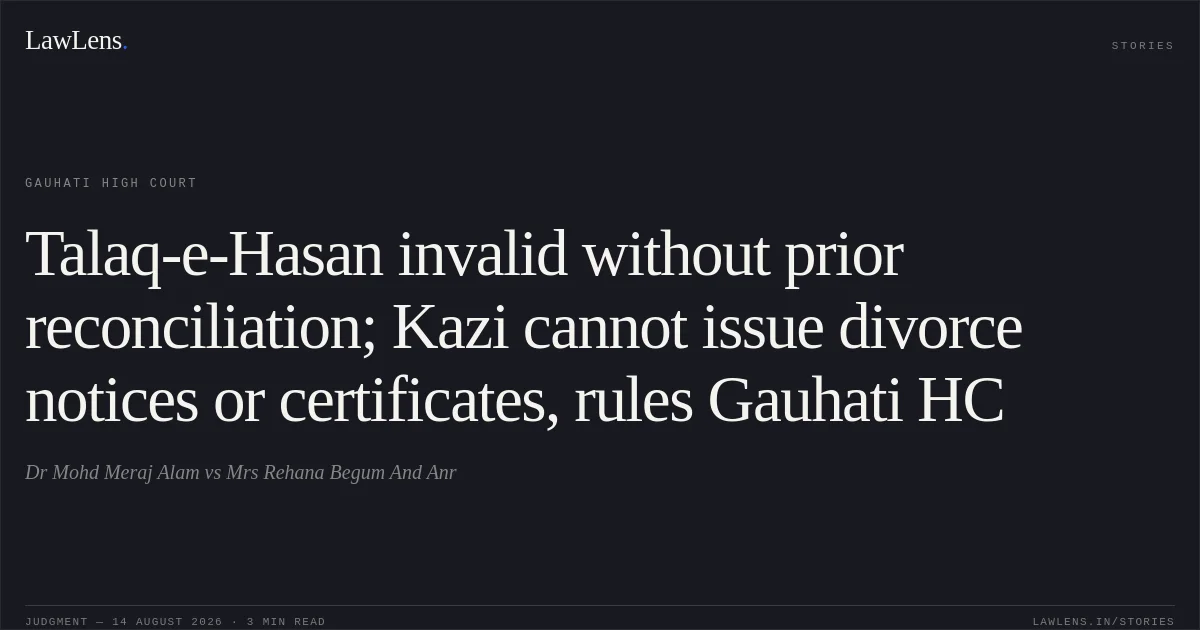
Whether a divorce by way of Talaq-E-Hasan could validly be effected without a prior attempt at reconciliation through arbitrators representing both families.
Source reference: para. 10; p. 7Whether the Muslim Marriage and Divorce Registrar possessed the statutory authority to issue notices requiring the parties to appear for reconciliation or to issue a divorce certificate under the Assam Muslim Marriages and Divorces Registration Act, 1935 and the Rules framed thereunder.
Source reference: paras. 14–16; pp. 5–7Whether the three Talaq pronouncements made by the appellant resulted in a valid dissolution of the marriage.
Source reference: para. 17; p. 7Law Applied
The Court relied on Qur’an 4:35, which requires the appointment of one arbitrator from each family and an effort at reconciliation where a marital separation is feared.
Source reference: paras. 11–12It also referred to the principles governing Talaq-E-Hasan and the Supreme Court’s decision in Shayara Bano v. Union of India, (2017) 9 SCC 1, which recognized Talaq-E-Hasan as the proper form of Talaq in contrast to instantaneous triple Talaq.
Source reference: para. 6Under Sections 2(2), 2A, 3, 6, 9 and 11 of the Assam Muslim Marriages and Divorces Registration Act, 1935, Muslim Registrars may register marriages and divorces, subject to prescribed verification, and provide attested copies of register entries; the Act does not confer adjudicatory power to compel appearance or conduct reconciliation.
Source reference: paras. 14–16Rules 27, 29 and 31 of the 1935 Rules prescribe examination and verification requirements for registration but do not authorize the Registrar to issue notices for reconciliation or divorce certificates.
Source reference: para. 15Reasoning
The Court held that the appearances before the Kazi did not constitute the reconciliation process contemplated by Qur’an 4:35. Although the wife and her father appeared on one occasion, there was no arbitrator representing the husband’s family and no evidence of a sustained reconciliation effort through arbitrators appointed from both sides. The Kazi could not be treated as the husband’s family arbitrator merely because he facilitated the proceedings. Consequently, the essential prior reconciliation requirement had not been fulfilled before the three Talaq pronouncements.
Source reference: para. 13Independently, the Court found that the Registrar’s statutory role was limited to verifying and registering a divorce already effected; he had no power under the 1935 Act or Rules to compel the wife’s attendance, conduct a reconciliation proceeding, or issue a divorce certificate. The Registrar’s notices and registration therefore could not cure the absence of a valid underlying divorce.
Source reference: paras. 14–16Holding
The Court answered the issues against the appellant and held that the three pronouncements of Talaq-E-Hasan did not validly dissolve the marriage because the mandatory prior reconciliation process through family arbitrators had not taken place.
It further held that the Muslim Marriage and Divorce Registrar lacked authority to issue compulsory notices or a divorce certificate and could only register a validly effected divorce and provide an attested copy of the register entry. The appeal was dismissed, and the Family Court’s judgment declaring the Talaq null and void was affirmed.
Source reference: paras. 16, 18Acts & Sections Cited
2 provisions across 2 statutes referred to in this judgment. Each provision opens on LawLens.
Protection of Women from Domestic Violence Act, 20051
Code of Criminal Procedure, 19731
Original Court PDF
Dr Mohd Meraj AlamvsMrs Rehana Begum And Anr
Click to open original judgment
Original judgment, available to read, download and summarize on LawLens.in