Facts
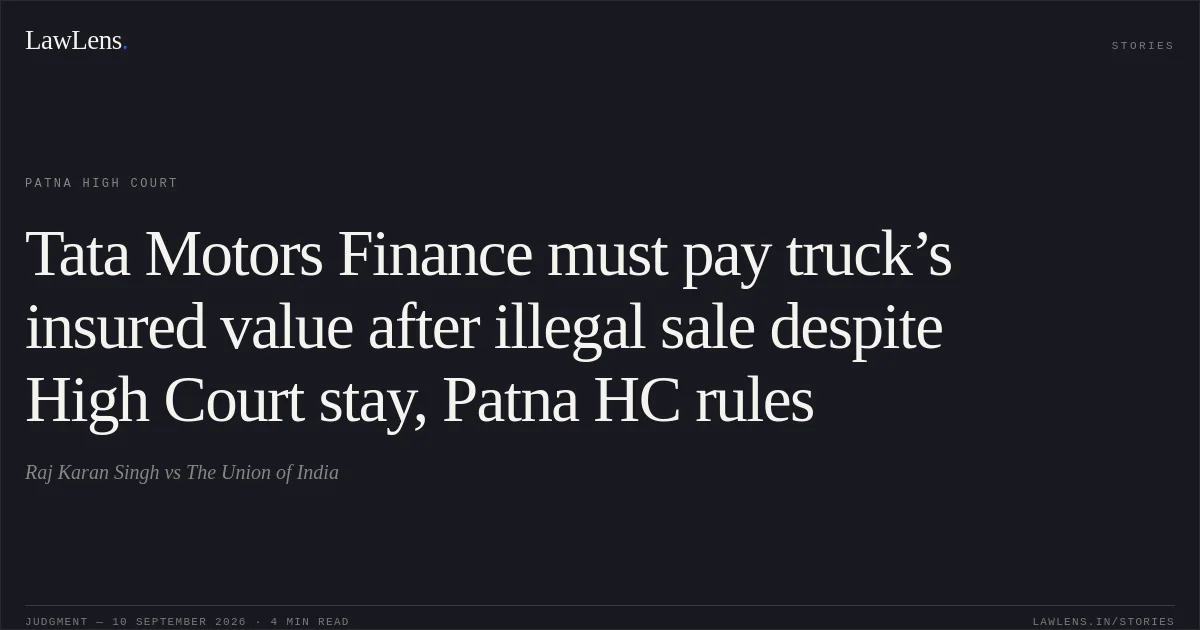
The petitioner purchased a Tata LPT 4825 commercial truck bearing Registration No. BR06GF5379 with a loan of ₹42,06,495 from Tata Motors Finance Ltd. under an agreement dated 28 February 2023. Although he regularly paid monthly instalments of ₹98,130, he defaulted on two occasions due to financial difficulties and paid the last instalment on 9 August 2024.
Source reference: p. 2–3The vehicle was allegedly seized by the finance company on 11 August 2024 without prior notice while carrying iron rods valued at approximately ₹20,00,023, resulting in business disruption and alleged loss to a third party. The petitioner also alleged that he was abused and assaulted when he approached the finance company’s office.
Source reference: p. 3–4During the writ proceedings, the High Court directed on 25 September 2024 that the vehicle should not be sold, if it had not already been sold. Nevertheless, the finance company auctioned the vehicle on 19 October 2024, asserting that it had acted pursuant to an arbitral award dated 30 November 2023 and had no knowledge of the Court’s interim order.
Source reference: p. 4–5The petitioner ultimately confined his relief to compensation because the vehicle had been sold to a third party.
Source reference: p. 18–21Issues
1. Whether a writ petition under Article 226 is maintainable against a private NBFC concerning repossession and sale of a hypothecated vehicle arising from a loan agreement.
Source reference: p. 5–8, 15–18; paras. 7–222. Whether the finance company’s seizure and subsequent sale of the vehicle, allegedly without following the statutory procedure and despite the High Court’s interim order, violated the petitioner’s fundamental rights and principles of natural justice.
Source reference: p. 14–18, 19–21; paras. 17–22, 27–283. Whether the finance company could directly act upon an arbitral award and sell the vehicle without seeking enforcement under Section 36 of the Arbitration and Conciliation Act, 1996.
Source reference: p. 19–21; paras. 27–284. Whether the petitioner was entitled to restoration of the vehicle or monetary compensation after the vehicle had been sold to a third party.
Source reference: p. 18–22; paras. 23–30Law Applied
The Court applied Article 226 of the Constitution, which permits the High Court to issue writs not only for enforcement of fundamental rights but also “for any other purpose,” subject to judicial discretion and the availability of an efficacious alternative remedy.
Source reference: p. 16–18; paras. 21–22Relying on Kaushal Kishore v. State of Uttar Pradesh, (2023) 4 SCC 1, the Court held that fundamental rights under Articles 19 and 21 may, in appropriate circumstances, be enforced against non-State actors, particularly where conduct affects dignity, livelihood, or personal liberty.
Source reference: p. 9–15; paras. 13–18Under Radha Krishan Industries v. State of Himachal Pradesh, as reiterated in Karnataka Power Transmission Corporation Ltd. v. Rekha, 2026 INSC 847, the rule requiring exhaustion of alternative remedies is discretionary and does not bar writ jurisdiction where fundamental rights or natural justice are implicated, proceedings are without jurisdiction, or the controversy warrants writ intervention.
Source reference: p. 16–18; para. 21Section 36 of the Arbitration and Conciliation Act, 1996 requires an arbitral award to be enforced in the same manner as a civil-court decree after expiry of the period for setting it aside; the award-holder cannot unilaterally execute it by taking the law into its own hands.
Source reference: p. 20–21; para. 27The Court also relied on Dhananjay Seth v. Union of India, C.W.J.C. No. 3456 of 2021, for the principle that where a repossessed vehicle has been sold and cannot be restored, its value as on the date of seizure may be adjusted against the outstanding loan, with any surplus paid to the borrower.
Source reference: p. 18–19, 21–22; paras. 24–25, 28Reasoning
The Court rejected the preliminary objection that the writ was barred merely because Tata Motors Finance was a private NBFC and the dispute arose from a contractual relationship. It found that the petitioner alleged forcible seizure of the vehicle, deprivation of his means of livelihood, and conduct contrary to human dignity, engaging Article 21 and the recognised exceptions to the alternative-remedy rule.
Source reference: p. 14–18; paras. 17–22The finance company’s reliance on the arbitral award did not justify direct sale of the vehicle because enforcement of the award had to proceed under Section 36 through the competent civil court; the respondent could not unilaterally execute the award.
Source reference: p. 19–21; paras. 27–28In addition, the sale took place after the High Court had directed that the vehicle not be sold, and the Court treated the sale as illegal and contrary to law, irrespective of the respondent’s assertion that it lacked knowledge of the interim order.
Source reference: p. 4–5, 19–21; paras. 5–6, 27Since the vehicle had already been sold and third-party rights had arisen, physical restoration was considered impracticable and potentially productive of further litigation. Applying Dhananjay Seth, the Court therefore substituted monetary relief measured by the vehicle’s insurance value on the date of seizure.
Source reference: p. 20–22; para. 28Holding
The writ petition was held maintainable against the private finance company because the case involved alleged violation of fundamental rights, natural justice, and action without jurisdiction.
The Court held that the respondent’s sale of the vehicle, particularly after the interim order and without resort to Section 36 enforcement proceedings, was illegal.
Source reference: p. 19–21; paras. 27–28As the vehicle had been sold to a third party, it was not ordered to be released. Tata Motors Finance Ltd. was directed to pay the petitioner the vehicle’s value according to its insurance value on the date of seizure, with that amount first adjusted against the outstanding loan and any surplus paid to the petitioner. The petitioner was left at liberty to challenge the accounts and pursue further compensation before the appropriate forum.
Source reference: p. 21–22; para. 28The respondent was additionally directed to pay ₹25,000 as litigation costs within 30 days of receipt or production of the judgment.
Source reference: p. 22; para. 29The writ petition was accordingly allowed in these terms.
Source reference: p. 22; para. 30Acts & Sections Cited
2 provisions across 1 statute referred to in this judgment. Each provision opens on LawLens.
Arbitration and Conciliation Act, 19962
Original Court PDF
Raj Karan SinghvsThe Union of India
Click to open original judgment
Original judgment, available to read, download and summarize on LawLens.in