01Facts
The petitioner approached the Madhya Pradesh High Court under Article 226 seeking payment of salary for the period from November 2017 to November 2018, after adjustment of the pension received during that period, together with interest.
p. 1 · ¶ 1The petitioner contended that the issue was covered by the Division Bench decision in Balkrishna Rathi v. State of Madhya Pradesh, Writ Appeal No. 378 of 2018, decided on 7 September 2021, which granted full salary to similarly situated teachers for the period during which they were prevented from working after premature retirement at the age of 62 years. The State was unable to distinguish the petitioner’s case from Balkrishna Rathi.
p. 2 · ¶ 2–302Issues
i.Whether the petitioner was entitled to salary for the period from November 2017 to November 2018, despite not having actually worked during that period, subject to adjustment of pension received.
p. 1 · ¶ 1 · p. 11 · ¶ 16ii.Whether the principle of “no work, no pay” barred payment of salary where the petitioner had been prevented from rendering service due to premature retirement.
pp. 4–7 · ¶ 6, 10 · p. 10 · ¶ 1303Law Applied
The Court relied on the Supreme Court’s decision in Dr. R.S. Sohane v. State of Madhya Pradesh, which recognized that eligible teachers in aided private colleges could continue in service until the age of 65 years, and on the State Government’s order dated 26 February 2020 implementing that entitlement.
pp. 7–9 · ¶ 11It applied the principle that “no work, no pay” does not operate where an employee was willing to work but was prevented by the employer from doing so, as stated in State of Uttar Pradesh v. Dayanand Chakrawarty, (2013) 7 SCC 595, and Shobha Ram Raturi v. Haryana Vidyut Prasaran Nigam Ltd., (2016) 16 SCC 663.
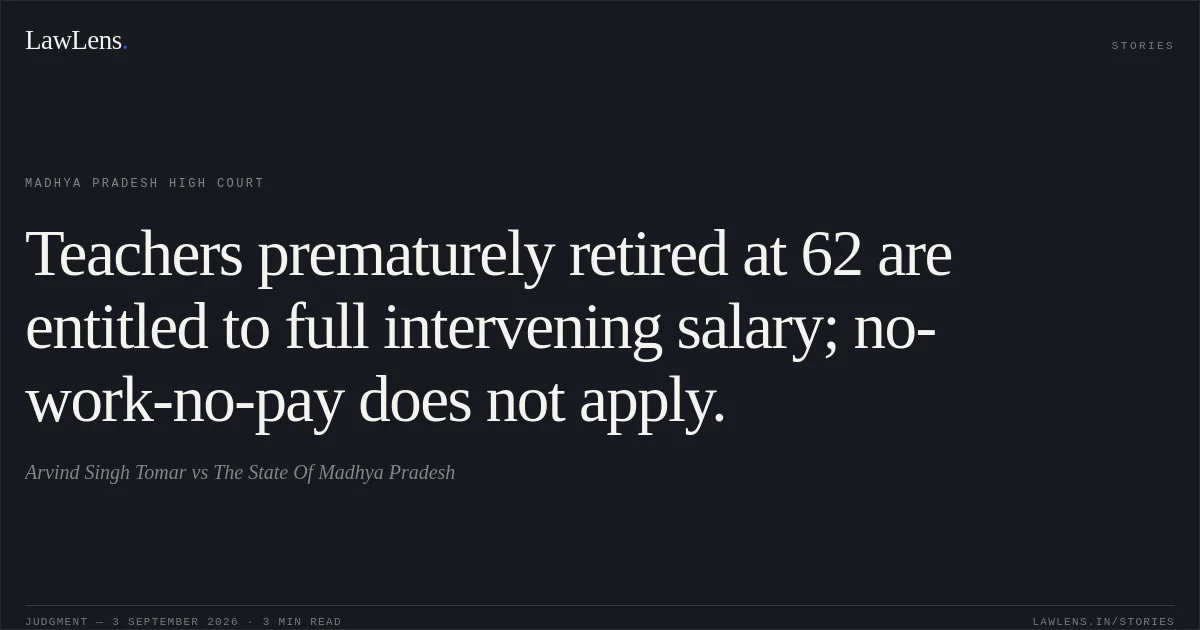
pp. 4–7 · ¶ 10 · p. 10 · ¶ 13The Court followed the Division Bench ruling in Balkrishna Rathi, which held that teachers prematurely retired at 62 years were entitled to full salary for the intervening period up to 65 years.
pp. 2–11 · ¶ 4–16It also relied on Article 14 and the principle of equal treatment of similarly situated employees, as explained in Inder Pal Yadav v. Union of India, (1985) 2 SCC 468.
pp. 10–11 · ¶ 14–1504Reasoning
The Court found that the petitioner was similarly situated to the teachers covered by Balkrishna Rathi, and that the State had not shown any distinguishing circumstance.
p. 2 · ¶ 2–3 · p. 11 · ¶ 15Since the applicable law recognized the enhanced retirement age of 65 years, the petitioner’s non-performance during the relevant period was attributable to the respondents’ action in preventing him from continuing in service, rather than to voluntary absence. Accordingly, the “no work, no pay” principle was inapplicable.
pp. 7–9 · ¶ 11 · p. 10 · ¶ 13Denying the petitioner the benefit granted to similarly situated teachers would create an impermissible class within a homogeneous class and violate Article 14. The Court therefore applied the binding reasoning in Balkrishna Rathi and directed payment of full salary, while adjusting the pension already drawn for the same period.
pp. 10–11 · ¶ 14–15 · p. 11 · ¶ 16 · final order05Holding
The petition was allowed. The respondents were directed to pay the petitioner salary for the period from November 2017 to November 2018 after adjusting the pension received during that period.
final order, clause (i)The respondents were directed to complete the payment within three months of receiving a certified copy of the order. In the event of default, the amount would carry interest at 6% per annum from the date of entitlement until actual payment.
final order, clause (ii)Original Court PDF
Arvind Singh TomarvsThe State Of Madhya Pradesh
Click to open original judgment
Original judgment, available to read, download and summarize on LawLens.in