Facts
Panjab University advertised posts of Assistant Professors for its constituent colleges, inviting applications for temporary appointments for particular academic sessions. The respondents were selected through duly constituted selection processes and appointed against sanctioned posts. Although their appointments were described as temporary and subject to termination upon regular recruitment, they continued in service for more than ten years—and, in several cases, for approximately one-and-a-half decades—while receiving regular pay scales and other benefits applicable to regular employees.
Source reference: paras. 3–4, 11The respondents sought regularisation of their services. The University opposed the claim, contending that the original Selection Committees were not constituted in accordance with UGC recommendations and that the posts were required to be filled through fresh regular recruitment, in which the respondents could compete. The learned Single Judge allowed the writ petitions and directed regularisation. The University filed the present connected appeals.
Source reference: paras. 6–7Issues
Whether teachers appointed on a temporary basis against advertised and sanctioned posts, who had continuously served the University for more than ten years, could claim regularisation of their services?
Source reference: para. 11Whether the University could require such teachers to compete afresh for the posts after permitting them to work continuously for approximately one-and-a-half decades?
Source reference: paras. 12–15Whether the principles governing regularisation recognised in State of Karnataka v. Uma Devi, Jaggo v. Union of India, Shripal v. Nagar Nigam, Ghaziabad, Dharam Singh v. State of U.P., and Union of India v. K. Velajagan applied to the respondents, notwithstanding the decision in Sunil Kumar Yadav v. State of Jharkhand?
Source reference: paras. 16–25Law Applied
The Court applied the constitutional principles governing regularisation under State of Karnataka v. Uma Devi (2006) 4 SCC 1, while relying on the later decisions in Jaggo v. Union of India, 2024 INSC 1034, Shripal v. Nagar Nigam, Ghaziabad, 2025 INSC 144, and Dharam Singh v. State of U.P., 2025 INSC 998, which caution that Uma Devi cannot be used to justify indefinite or exploitative temporary employment where the work is perennial and the employee has served for a prolonged period.
Source reference: paras. 5, 16–17The Court also relied on Union of India v. K. Velajagan, 2025 SCC OnLine SC 837, as recognising that even Assistant Professors and Lecturers working on an ad hoc or hourly basis may be considered for regularisation in view of their long service. The governing principle was that long, continuous service against duly advertised and sanctioned posts, following consideration of eligible candidates and accompanied by payment of regular scales, may justify regularisation where the temporary label has become merely nominal.
Source reference: paras. 12–18, 25The Court distinguished Sunil Kumar Yadav v. State of Jharkhand because that case concerned contractual para-teachers engaged under a specific statutory scheme seeking regularisation against a different post, whereas the present respondents sought regularisation on the very posts against which they had been selected and had continuously worked.
Source reference: paras. 19–22Reasoning
The Court found that the respondents’ appointments were not backdoor or wholly illegal appointments: the posts had been advertised, eligible candidates had been invited to compete, the respondents possessed the requisite qualifications, and the posts were sanctioned. Their uninterrupted service for more than a decade demonstrated both the perennial nature of the work and the University’s continuing institutional need for their services. In these circumstances, the University could not indefinitely characterise the appointments as stopgap arrangements or compel the respondents to compete with younger candidates after permitting them to serve for approximately one-and-a-half decades.
Source reference: paras. 11–15The fact that the respondents already received regular pay scales meant that regularisation principally altered their legal status from temporary to regular, without conferring an unwarranted additional financial advantage. The Court rejected the University’s reliance on Sunil Kumar Yadav, holding that its factual and legal context was materially different. It also declined to apply the earlier distinction that regularisation could not extend to teachers holding Class-I posts, observing that the subsequent decision in K. Velajagan supported consideration of regularisation even for Assistant Professors and Lecturers. Nevertheless, the Court modified the Single Judge’s direction by making regularisation subject to verification that each respondent had completed at least ten years of actual service and that there was no serious adverse material regarding conduct or performance.
Source reference: paras. 15, 19–26, 29–31Holding
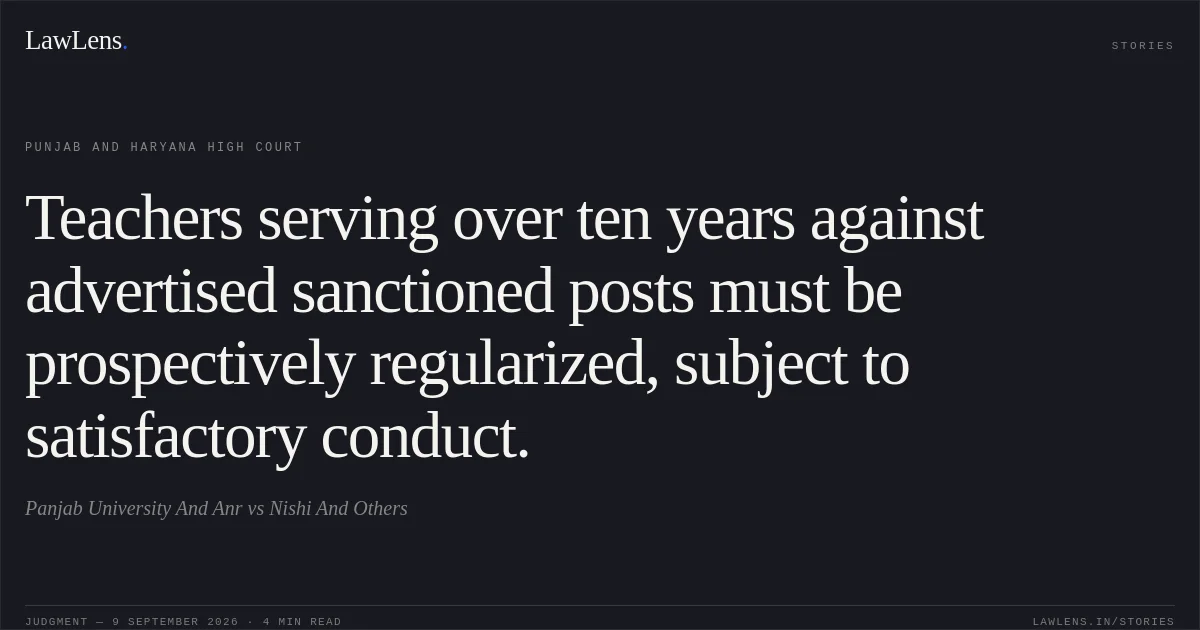
The appeals were dismissed, and the decision of the learned Single Judge was substantially upheld, subject to modification. The University was directed to consider and regularise the services of respondents who had completed a minimum of ten years of actual service against the posts on which they were working, provided there was no adverse material concerning their work or conduct.
Regularisation was to operate prospectively, and the respondents conceded that they would not claim retrospective financial benefits; however, their past experience would remain valid for future promotion purposes. The University was directed to complete the process within three months, and no respondent was to be terminated during that period. Any respondent completing ten years of service subsequently was also to receive the benefit when that requirement was fulfilled.
Source reference: paras. 31–32Original Court PDF
Panjab University And AnrvsNishi And Others
Click to open original judgment
Original judgment, available to read, download and summarize on LawLens.in