Facts
A consent decree was passed by a Division Bench on May 22, 1997, based on the "Mittal Settlement" for the partition of properties
Source reference: para 1-2, 13While the settlement identified the properties, it lacked technical descriptions (e.g., title deed details), leading the Collector to report an inability to assess stamp duty for registration on November 28, 2025
Source reference: para 2, 21Previously, an application by Defendant No. 1 under Section 152 of the CPC to modify the decree was rejected by the High Court in 1999 and the Supreme Court in 2009, as the requested changes did not constitute clerical or arithmetical errors
Source reference: para 15-16However, a subsequent coordinate bench order on April 3, 2019, held that a party cannot be left remediless and directed the Department to draw up the decree by collecting particulars from the pleadings and materials on record
Source reference: para 18-19Defendant No. 1 filed the current application (GA/5/2023) and a supplementary affidavit providing technical details of the properties to facilitate valuation by the Collector
Source reference: para 2-3Issues
1. Whether the technical details provided in a supplementary affidavit can be used for stamp duty assessment without violating the earlier judicial rejections of decree modification
Source reference: para 17, 232. Whether the doctrine of merger or the principle of res judicata prevents the court from granting relief regarding the drawing up and completion of the decree
Source reference: para 9-10, 233. Whether the supplementary affidavit constitutes an impermissible attempt to "improve" the case
Source reference: para 11, 24Law Applied
The Court applied Section 152 of the Code of Civil Procedure, 1908, regarding the correction of clerical or arithmetical mistakes in judgments or decrees
Source reference: para 15-16It also relied on Rule 11, Chapter XVIA of the Original Side Rules of the Calcutta High Court, which allows the Department to add short recitals to a decree by collecting particulars from pleadings and materials on record
Source reference: para 19, 23The court distinguished Kunhayammed & Ors. v. State of Kerala regarding the doctrine of merger
Source reference: para 9, 23State Bank of India v. Ram Chandra Dubey regarding the finality of rejected prayers
Source reference: para 10, 25Bharat Bhari Udyog Nigam Ltd. v. Jessop and Co. Ltd. Staff Association regarding the use of supplementary affidavits to improve a case
Source reference: para 11, 24Reasoning
The Court reasoned that the 1999 and 2009 rejections were specifically confined to the parameters of Section 152 CPC and did not strip the parties of their right to enjoy the fruits of the decree
Source reference: para 16-17It emphasized the 2019 coordinate bench order, which attained finality and explicitly permitted the Department to use existing pleadings to complete the decree
Source reference: para 18-19Regarding the technical details in the supplementary affidavit, the Court found they were not "new" but existed within the historical pleadings of the parties; thus, providing them now was a procedural necessity for the Collector’s valuation rather than a substantive modification of the decree
Source reference: para 22, 24The Court dismissed the "merger" argument, noting that the current prayer for drawing up and registering the decree is distinct from the prior failed attempt to correct the decree text itself
Source reference: para 23, 25Holding
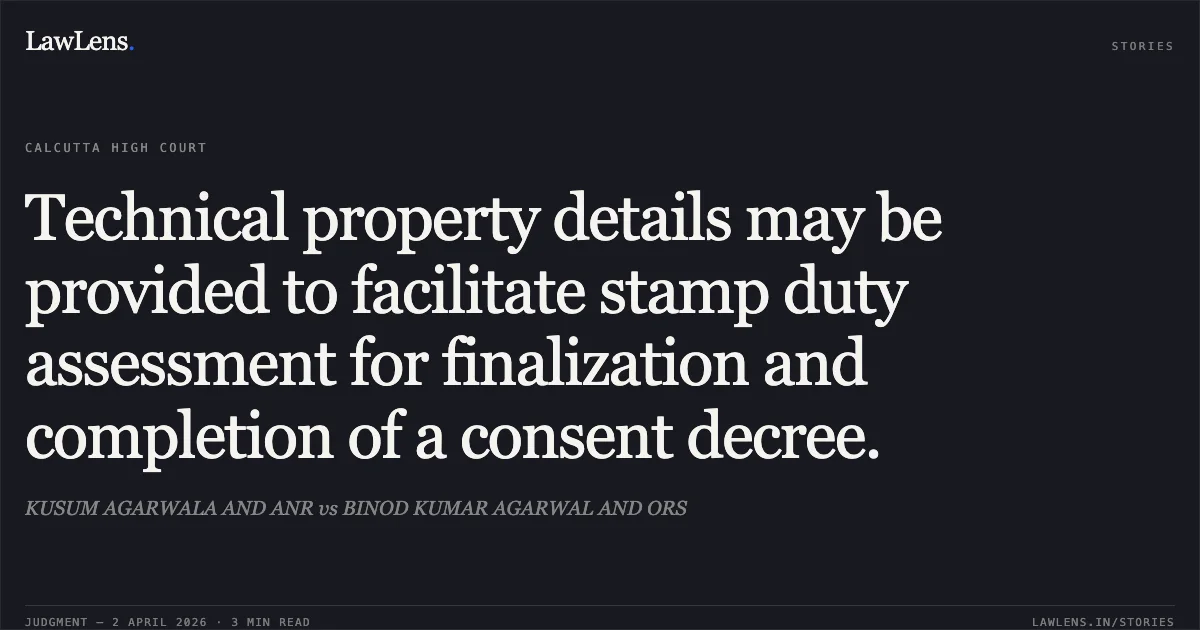
The Court allowed the application, holding that the technical details provided are sufficient for the Collector to assess the valuation of the immovable properties
The Court directed the parties to file Form No. 1 with the Collector within a fortnight, containing the details from the supplementary affidavit. The Collector was directed to assess the stamp duty and submit a report to the Court within four weeks
Source reference: para 26The prayer for a stay by the opposing parties was rejected
Source reference: para 28Acts & Sections Cited
4 provisions across 1 statute referred to in this judgment. Each provision opens on LawLens.
Code of Civil Procedure, 19084
Original Court PDF
KUSUM AGARWALA AND ANRvsBINOD KUMAR AGARWAL AND ORS
Click to open original judgment
Original judgment, available to read, download and summarize on LawLens.in