Facts
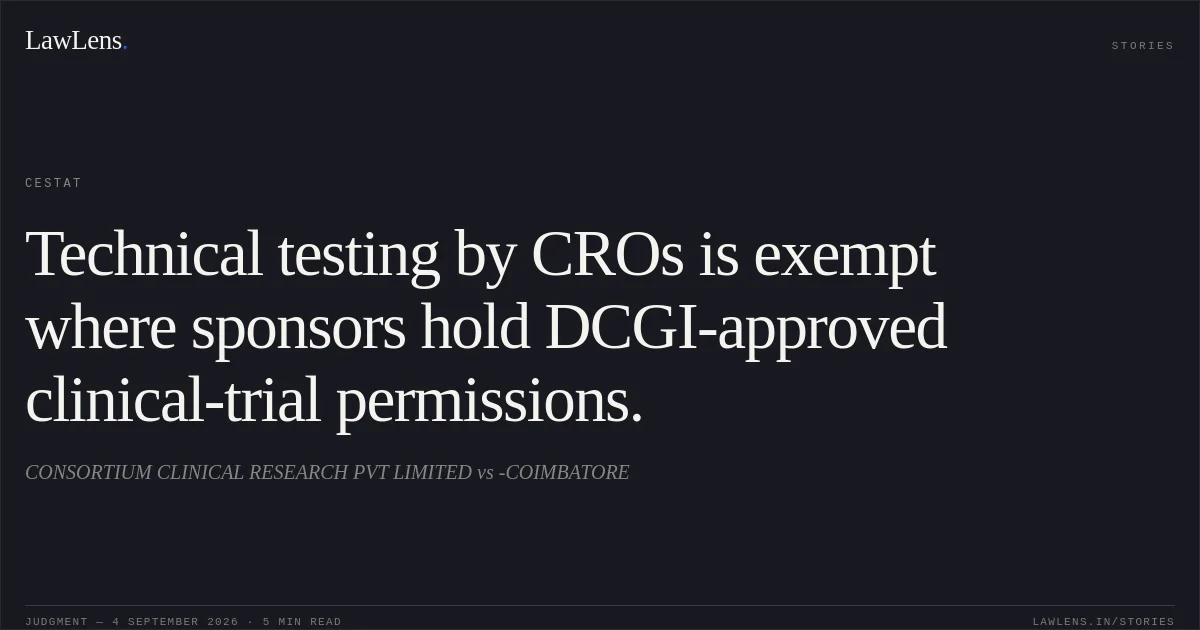
The appellant, a Clinical Research Organisation (“CRO”), provided contract research and clinical trial-management services to pharmaceutical and biotechnology companies, including testing and analysis of newly developed drugs on human participants.
Source reference: para. 2The Department had corresponded with the appellant regarding its clinical research activities as early as 2010, and the appellant had furnished information concerning its business, agreements with sponsors, and clinical research workflow.
Source reference: paras. 3–4The Department subsequently issued show-cause notices alleging non-payment of Service Tax on: (i) technical testing and analysis services for the period 01.10.2009 to 31.07.2014; and (ii) commercial training or coaching services for the period 01.10.2009 to 31.03.2014. The aggregate demand was Rs. 65,25,515, along with interest and penalties.
Source reference: para. 5The Adjudicating Authority rejected the exemption claim, confirmed the demands, invoked the extended limitation period, and imposed penalties under Sections 76, 77 and 78 of the Finance Act, 1994.
Source reference: para. 9Issues
1. Whether the technical testing and analysis services provided by the appellant in relation to clinical trials were exempt under Notification No. 11/2007-ST and, from 01.07.2012, Entry 7 of Notification No. 25/2012-ST, notwithstanding that the DCGI approvals were issued to the sponsors rather than independently to the appellant-CRO?
Source reference: paras. 13–212. Whether the amount of Rs. 2,19,395 recovered from employees upon premature resignation constituted consideration for commercial training or coaching services, or consideration for a declared service under Section 66E(e) of the Finance Act, 1994?
Source reference: paras. 13, 22–243. Whether the extended period of limitation under the proviso to Section 73(1) of the Finance Act, 1994 was validly invoked?
Source reference: paras. 13, 25–284. Whether the interest and penalties imposed under the Finance Act, 1994 were sustainable?
Source reference: paras. 13, 29–30Law Applied
Notification No. 11/2007-ST exempted technical testing and analysis services relating to testing newly developed drugs on human participants when provided by a Clinical Research Organisation approved to conduct clinical trials by the DCGI; materially similar exemption was continued under Entry 7 of Notification No. 25/2012-ST from 01.07.2012.
Source reference: para. 14The Tribunal relied on Deenanath Mangeshkar Hospital & Research Centre v. Commissioner of Central Excise & Customs, 2019 (11) TMI 1511 (CESTAT Mumbai), which held that clinical trials are conducted under DCGI permission granted to the sponsor and that no independent institutional approval of the CRO was shown to be required.
Source reference: paras. 17–18Although exemption notifications are to be strictly construed under Commissioner of Customs (Import), Mumbai v. Dilip Kumar & Co., 2018 (361) E.L.T. 577 (S.C.), the rule does not require a condition incapable of fulfilment to be imposed where the regulatory framework does not provide for such approval.
Source reference: paras. 16, 20–21Commercial training or coaching service under Section 65(105)(zzc), read with Section 65(26), requires consideration for training or coaching supplied by a commercial training centre; a refundable employee deposit or compensation for premature resignation is not such consideration.
Source reference: para. 23Section 66E(e) similarly does not tax a mere employment-contract recovery as consideration for an agreement to tolerate an act or situation, consistent with GE T & D India Ltd. v. Deputy Commissioner of Central Excise, 2019 (12) TMI 1566 (Madras).
Source reference: para. 24Under the proviso to Section 73(1), the extended limitation period requires fraud, collusion, wilful misstatement, suppression of facts, or contravention with intent to evade tax; mere non-payment or non-registration is insufficient, as held in Pushpam Pharmaceuticals Co. v. Collector of Central Excise, 1995 (78) E.L.T. 401 (S.C.), Continental Foundation Joint Venture v. Commissioner of Central Excise, 2007 (216) E.L.T. 177 (S.C.), and Uniworth Textiles Ltd. v. Commissioner of Central Excise, 2013 (288) E.L.T. 161 (S.C.).
Source reference: paras. 25–26Reasoning
The Tribunal held that the appellant was functioning as a CRO, rather than merely as a trial site, and had conducted clinical trials under written agreements with sponsors whose trials had DCGI-approved permissions.
Source reference: paras. 17–21The regulatory scheme contemplated approval of the clinical trial through the sponsor and did not provide for a separate, general DCGI approval to be issued independently to every CRO. Requiring such approval would impose an impossible condition and defeat the exemption intended for CRO-performed clinical testing.
Source reference: paras. 17–21The contrary decision in Diabetes Thyroid Hormone Research Institute Pvt. Ltd. was distinguished because that assessee was only a trial site and not the CRO performing the relevant functions.
Source reference: para. 19Regarding the training demand, the evidence showed that the amount was a security deposit collected from employees trained and appointed on the condition that they would serve for at least one year. It was refundable upon completion of the service period and retained only upon premature resignation.
Source reference: paras. 22–24The amount therefore represented compensation for breach of the employment undertaking, not a fee for commercial training or coaching, nor consideration for a declared service under Section 66E(e).
Source reference: paras. 22–24The extended limitation period was also held unsustainable. The Department had investigated the appellant’s clinical research activities in 2010, and the appellant had disclosed the relevant nature of its business and supplied the requested information.
Source reference: paras. 25–28Its failure to register or pay tax resulted from a disclosed and tenable belief that the services were exempt, not from deliberate suppression or an intent to evade tax.
Source reference: paras. 25–28Holding
The Tribunal allowed both appeals and set aside the impugned adjudication order in its entirety.
It held that the appellant’s technical testing and analysis services were exempt under Notification No. 11/2007-ST and Entry 7 of Notification No. 25/2012-ST, even though the DCGI-approved permissions were issued to the sponsors rather than separately to the appellant-CRO.
Source reference: para. 21It further held that the employee deposit recoveries were compensation for premature breach of the employment undertaking and not consideration for commercial training, coaching, or a declared service under Section 66E(e).
Source reference: paras. 23–24The extended limitation period was held to be improperly invoked, and the demands, interest, and penalties were consequently set aside, with consequential relief in accordance with law.
Source reference: paras. 27–30Acts & Sections Cited
7 provisions across 1 statute referred to in this judgment. Linked provisions open on LawLens.
the Act (alias, unresolved)7
Original Court PDF
CONSORTIUM CLINICAL RESEARCH PVT LIMITEDvs-COIMBATORE
Click to open original judgment
Original judgment, available to read, download and summarize on LawLens.in