Facts
The appellant-plaintiff, M/s Sai Silks (Kalamandir) Limited, instituted a suit for permanent injunction, trade mark infringement and passing off under the Trade Marks Act, 1999, read with Section 55 of the Copyright Act, 1957. It claimed rights in the marks, including “Kancheepuram Vara Mahalakshmi Silks,” “Vara Mahalakshmi Silks Kancheepuram” and “Vara Mahalakshmi”.
Source reference: para. 2The appellant filed I.A. No. 2449 of 2024 seeking appointment of a Local Commissioner to inspect the respondents’ premises and seize allegedly infringing goods, packaging and raw materials. It also filed I.A. No. 2450 of 2024 seeking an ex parte interim injunction restraining use of “Kanchipuram Varahi Lakshmi Silks” or any deceptively similar mark.
Source reference: para. 3The II Additional Chief Judge, City Civil Court, Hyderabad, dismissed both applications on 24 July 2025, holding that the differences between the competing label marks outweighed their phonetic similarities, that the appellant’s mark contained common and geographically descriptive words, and that the respondents had not copied any distinctive or essential feature of the appellant’s mark.
Source reference: para. 4Before the High Court, the appellant contended that “Vara Mahalakshmi” had acquired distinctiveness through extensive use and that the respondents’ mark was phonetically, visually and structurally deceptive. The respondents relied on prior Business MoUs and contended that the appellant could not claim exclusive rights over the constituent elements of a composite mark under Section 17 of the Trade Marks Act, 1999.
Source reference: paras. 5–6Issues
Whether the respondents’ mark, “Kanchipuram Varahi Lakshmi Silks,” was deceptively similar to the appellant’s registered marks so as to constitute trade mark infringement or passing off and justify an interim injunction?
Source reference: paras. 7–14, 23–31Whether the appellant could claim exclusive rights over the words “Kancheepuram,” “Vara,” “Mahalakshmi” or “Silks,” either individually or as elements of its composite mark, under Sections 17 and 29 of the Trade Marks Act, 1999?
Source reference: paras. 16–22Whether the appellant satisfied the requirements for interim relief—prima facie case, irreparable injury and balance of convenience—and was entitled to appointment of a Local Commissioner for seizure of allegedly infringing materials?
Source reference: paras. 3, 13, 30–32Law Applied
The Court applied Section 29 of the Trade Marks Act, 1999, under which the proprietor of a registered trade mark may restrain use of an identical or deceptively similar mark where the statutory requirements, including likelihood of confusion or association, are satisfied.
Source reference: para. 9Section 27(2) preserves the common-law action for passing off in respect of unregistered marks, requiring proof of goodwill or reputation, misrepresentation and consequential damage—the classical trinity stated in Reckitt & Colman Products Ltd. v. Borden Inc., (1990) RPC 341 (HL).
Source reference: paras. 10–13The Court also relied on Section 2(1)(zb), which recognises a trade mark as a graphical representation capable of distinguishing one person’s goods or services from those of others, including through packaging, colour combinations and trade dress.
Source reference: para. 12Section 17 provides that registration of a composite mark confers exclusive rights in the mark taken as a whole, but not in parts that are common to the trade or non-distinctive; this limitation applied particularly to the appellant’s mark.
Source reference: paras. 19–22Interim protection required satisfaction of the prima facie case, irreparable injury and balance of convenience, together with the requirements applicable to infringement or passing off.
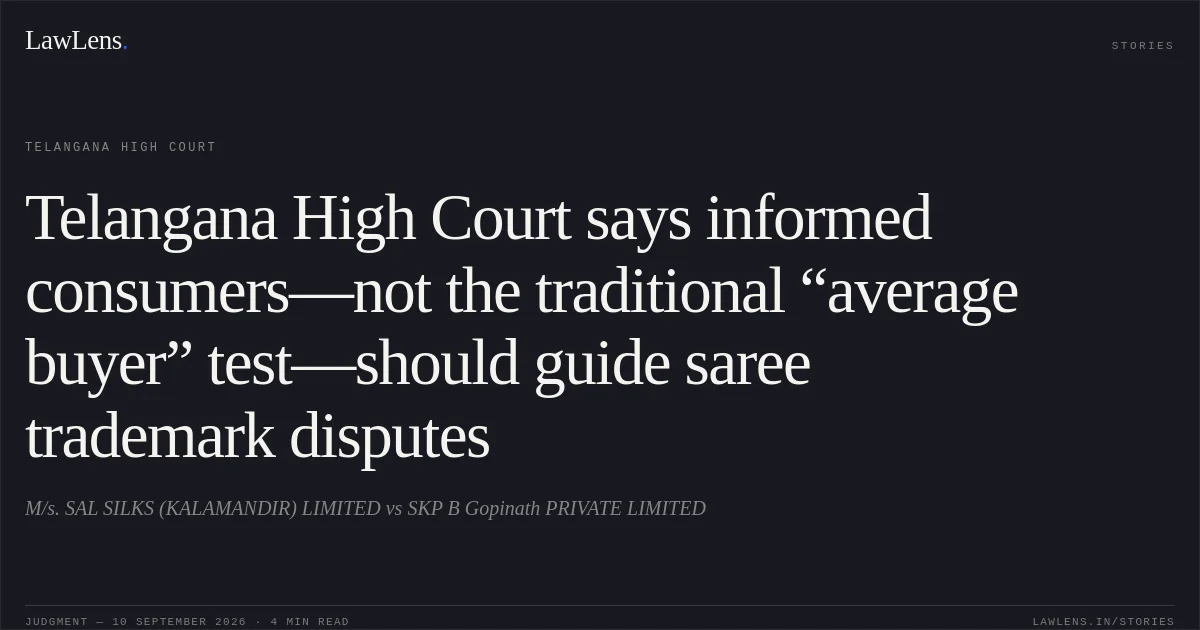
Source reference: para. 13The Court also considered the concept of a consumer with average intelligence and imperfect recollection, but held that, in the context of saree purchases, the assessment should account for a perceptive and informed consumer who considers the shop, source, quality and visual presentation of the product.
Source reference: paras. 27–28Reasoning
The Court compared the competing marks as composite label marks and held that their visual and overall differences outweighed their phonetic similarities.
Source reference: paras. 15–16, 23“Kancheepuram” was treated as a geographical indication of origin associated with Kanchipuram silk sarees, while “Silks” was considered descriptive and common to the trade. The expressions “Vara” and “Mahalakshmi” referred to Goddess Lakshmi, and “Varahi Lakshmi” was found to be a religious or cultural variation rather than a distinctive appropriation by the appellant.
Source reference: paras. 16–18Applying Section 17, the Court held that the appellant’s registrations were predominantly composite label marks containing a yellow-red colour scheme, a deity depiction and common words. None of the constituent words, individually, had acquired the necessary distinctiveness to justify exclusive protection.
Source reference: paras. 19–22The appellant’s label also lacked a single dominant or essential feature uniquely associated with it.
Source reference: paras. 24–26The Court further reasoned that saree purchases are generally planned and involve visual and tactile evaluation. Consumers would ordinarily be conscious of the particular shop or outlet from which they intended to purchase sarees; therefore, phonetic similarity alone was insufficient to establish a likelihood of confusion.
Source reference: paras. 27–29Since the appellant failed to establish a prima facie case of deceptive similarity, misrepresentation or likely damage, the requirements for interim injunction and appointment of a Local Commissioner were not met.
Source reference: paras. 13, 30–31Holding
The High Court held that the respondents’ mark “Kanchipuram Varahi Lakshmi Silks” was not deceptively similar to the appellant’s composite marks and that the appellant could not claim exclusive rights over the common, descriptive or non-distinctive expressions forming part of its marks.
The appellant failed to establish the prima facie case and likelihood of confusion necessary for interim protection.
Source reference: paras. 30–31The Court therefore found no error in the Trial Court’s dismissal of I.A. Nos. 2449 and 2450 of 2024, dismissed Civil Miscellaneous Appeal No. 441 of 2025 along with all connected applications, and made no order as to costs.
Source reference: paras. 30–32Acts & Sections Cited
6 provisions across 2 statutes referred to in this judgment. Each provision opens on LawLens.
Trade Marks Act, 19995
Copyright Act, 19571
Original Court PDF
M/s. SAL SILKS (KALAMANDIR) LIMITEDvsSKP B Gopinath PRIVATE LIMITED
Click to open original judgment
Original judgment, available to read, download and summarize on LawLens.in