Facts
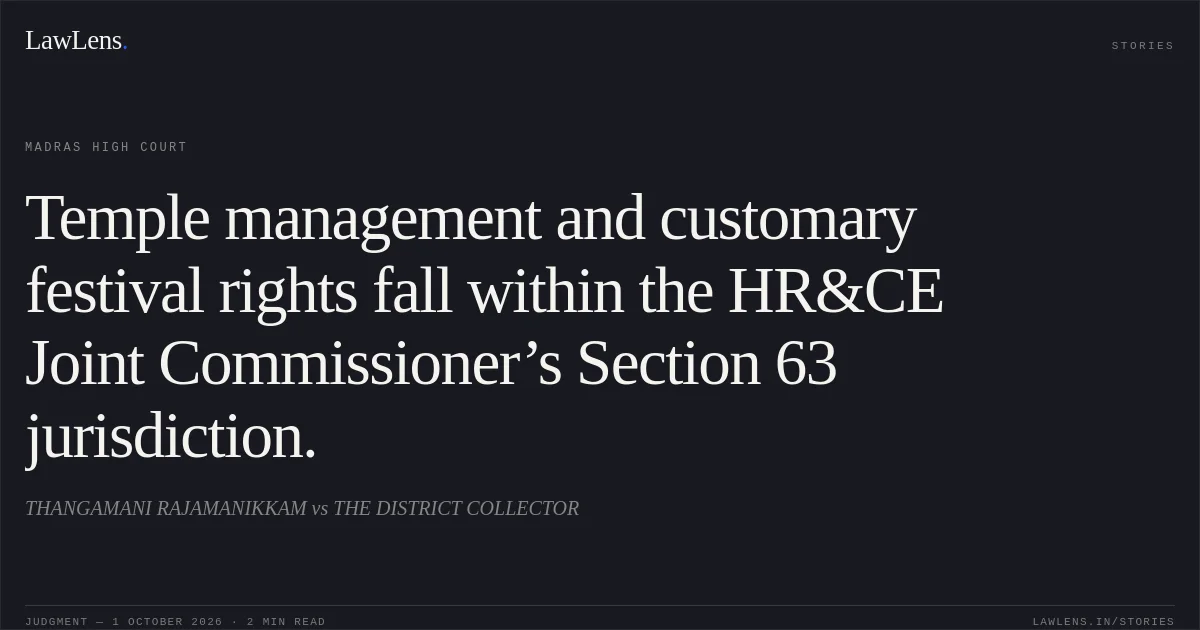
The petitioner sought to quash the Revenue Divisional Officer’s proceedings dated 3 September 2026 and obtain permission to hold the 35th Sri Krishna Jayanthi festival, including a procession, at Arulmigu Sri Prasanna Venkatesa Perumal Temple on 4 October 2026.
Source reference: p. 2The petitioner asserted that the festival and procession were traditional, while alleging that objections to them arose from caste differences.
Source reference: para. 3, p. 3In an earlier writ petition filed by the private respondent, the Court had directed the HR&CE Assistant Commissioner to inspect the temple, hear the parties, and determine who was entitled to conduct the festival; the other authorities were to maintain law and order.
Source reference: para. 4, p. 4; para. 6, pp. 4–5Following an inspection, the Assistant Commissioner reported that both sides claimed rights and that he could not decide the dispute.
Source reference: para. 7, p. 5Issues
Whether the competing claims regarding management of the temple, entitlement to conduct the festival, and the nature of the festival events should be determined by the HR&CE authorities.
Source reference: paras. 7–8, pp. 5–6Whether the petitioner could be granted permission to conduct the festival before those competing claims were resolved.
Source reference: paras. 7–9, pp. 5–6Law Applied
Section 63 of the Tamil Nadu Hindu Religious and Charitable Endowments Act, 1959, governs the determination of the matters identified by the Court, including claims concerning temple management, the conduct of ceremonies, and traditional rights relating to them.
Source reference: para. 8, p. 6The Court directed that the Joint Commissioner decide the parties’ claims in accordance with law, on their merits and without reference to caste.
Source reference: para. 8, p. 6The earlier order had assigned the authorities responsible for law and order that limited role, while directing the HR&CE authority to consider who was entitled to conduct the festival.
Source reference: para. 6, pp. 4–5Reasoning
The Assistant Commissioner’s inspection did not resolve the parties’ competing claims, and the report that both sides asserted rights left the entitlement to conduct the festival undecided.
Source reference: para. 7, p. 5The Court treated the claims about temple management, festival ceremonies, and any associated traditional rights as matters for determination under Section 63, rather than as questions to be resolved through a law-and-order order.
Source reference: para. 8, p. 6Because those matters remained pending, the Court directed that the festival be conducted in accordance with the Joint Commissioner’s eventual decision, rather than granting the petitioner immediate permission.
Source reference: para. 8, p. 6Holding
The Court disposed of the writ petition without granting the requested permission to conduct the festival.
It directed that either claimant may apply to the jurisdictional Joint Commissioner, who must give notice to both sides and decide the issues as expeditiously as possible and, in any event, within four months of receiving the application.
Source reference: paras. 8–10, pp. 6–7The authorities were also directed to inspect the reportedly dilapidated temple and take necessary steps to protect its structure.
Source reference: para. 9, p. 6No costs were ordered, and the connected miscellaneous petition was closed.
Source reference: para. 10, p. 7Acts & Sections Cited
1 provisions across 1 statute referred to in this judgment. Each provision opens on LawLens.
TAMIL NADU HINDU RELIGIOUS AND CHARITABLE ENDOWMENTS ACT, 19591
Original Court PDF
THANGAMANI RAJAMANIKKAMvsTHE DISTRICT COLLECTOR
Click to open original judgment
Original judgment, available to read, download and summarize on LawLens.in