Facts
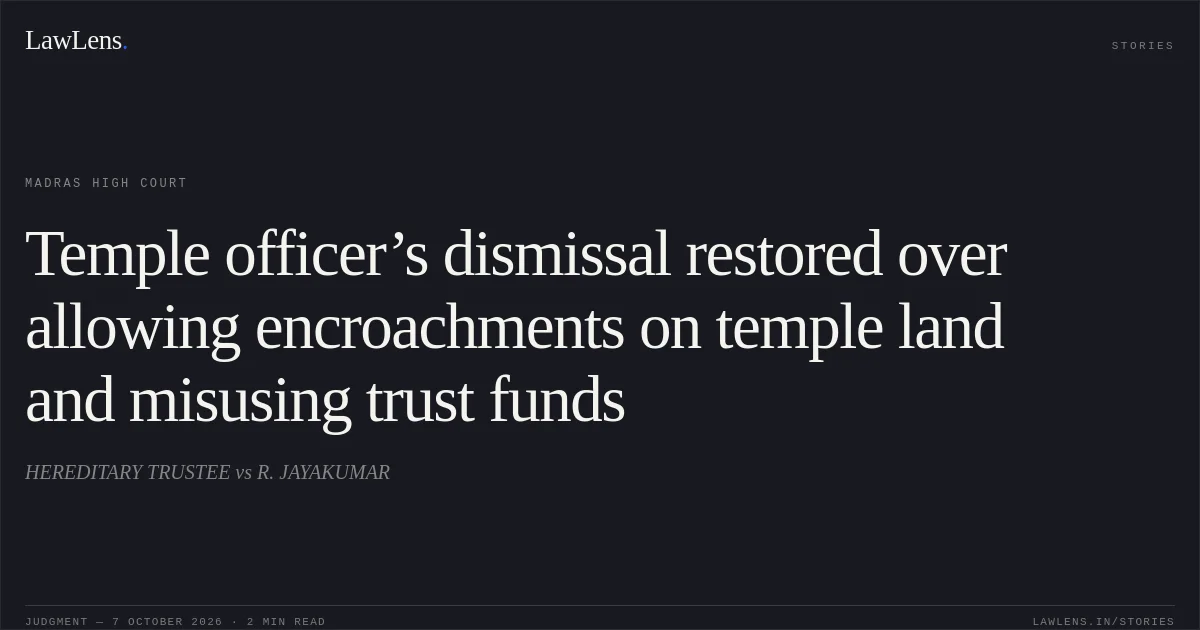
R. Jayakumar, an Executive Officer posted at Arulmigu Thiyagaraja Swamy Temple, faced disciplinary proceedings concerning alleged failures to protect temple and Kattalai properties, unauthorised construction and encroachment, financial irregularities in renovation works, and failure to hand over charge.
Source reference: pp. 5–7Nineteen of the charges were found proved, and he was removed from service; his departmental appeal was dismissed.
Source reference: pp. 5–7The writ court set aside the removal but substituted a penalty postponing his first promotion by five years, finding inadequate consideration of the charges by the disciplinary authority.
Source reference: p. 8The Hereditary Trustee and the departmental authorities appealed against that decision.
Source reference: pp. 1–4Issues
Whether the Executive Officer had responsibility for managing and safeguarding the Kattalai’s properties and funds, notwithstanding the scheme decree assigning duties to the trustees.
Source reference: pp. 14–19, 21Whether the writ court could set aside the removal penalty and substitute a lesser punishment, and whether removal was disproportionate to the proved charges.
Source reference: pp. 8, 22Law Applied
Under the Tamil Nadu Hindu Religious and Charitable Endowments Act, 1959, an Executive Officer’s functions relate to the administration of a religious institution’s properties; Section 45(2), as quoted from T.R. Ramesh v. State of Tamil Nadu, confines assigned powers and duties to property administration.
Source reference: pp. 19–20The Court also referred to Sections 6(16) and 6(17), concerning religious charity and religious endowment, and to Sections 34-A, 34-B, 39 and 43-A.
Source reference: pp. 18–19In A.A. Gopalakrishnan v. Cochin Devaswom Board, (2007) 7 SCC 482, the Supreme Court emphasised that temple properties must be protected from usurpation and misappropriation and that courts have a duty to safeguard such properties.
Source reference: pp. 5, 21–22The Court further held that modifying a disciplinary penalty under Article 226 was legally unsustainable in the circumstances of this case.
Source reference: p. 22Reasoning
The Court read the scheme decree as requiring trustees to manage specified aspects of the Kattalai, while also requiring them to consult the Executive Officer, hand over collected rents and profits to him, and coordinate with him on leases and budgets.
Source reference: pp. 14–19It therefore rejected the contention that responsibility for the properties rested solely with the trustees.
Source reference: pp. 14–19Applying the Act and the temple-property protection principle, the Court treated the proved failures—including alleged encroachments, unauthorised disbursement of renovation funds and failure to protect trust property—as serious breaches of the Executive Officer’s property-management responsibilities.
Source reference: pp. 13–14, 19–22It concluded that the writ court had wrongly substituted a lesser punishment and that removal was not disproportionate; it also stated that the required legal formalities had been followed.
Source reference: p. 22Holding
The Court answered that the Executive Officer bore responsibility for safeguarding and managing the relevant properties and funds, and that the writ court should not have replaced the removal penalty with a lesser punishment in this case.
It allowed both writ appeals, set aside the writ court’s order dated 20 February 2024, and restored the original order of punishment.
Source reference: pp. 22–23No costs were ordered, and the connected miscellaneous petitions were closed.
Source reference: pp. 22–23Acts & Sections Cited
3 provisions across 1 statute referred to in this judgment. Each provision opens on LawLens.
TAMIL NADU HINDU RELIGIOUS AND CHARITABLE ENDOWMENTS ACT, 19593
Original Court PDF
HEREDITARY TRUSTEEvsR. JAYAKUMAR
Click to open original judgment
Original judgment, available to read, download and summarize on LawLens.in