Facts
The Plaintiff (Respondent No. 1) filed a civil suit for possession and permanent injunction regarding a shop situated on Plot No. 237, Mungeli, claiming ownership via a registered sale deed dated 05.05.1976
Source reference: para 2The Plaintiff alleged he permitted his brother, the Appellant (Defendant No. 1), to use the shop temporarily, but the Appellant refused to vacate it
Source reference: para 2The Appellant filed a counterclaim asserting the property was joint family property and that he had conducted an independent electronics business there since 1980
Source reference: para 3-5The Appellant further sought a temporary injunction under Order 39 Rules 1 and 2 of the CPC to restrain the Plaintiff from using the shop as a passage to access the residential portion at the rear and from interfering with his business
Source reference: para 3, 6The Plaintiff maintained that the shop was the only access to his residence and had been used as such for 25 years
Source reference: para 8The Trial Court rejected the Appellant's injunction application on 09.02.2026
Source reference: para 1, 9Issues
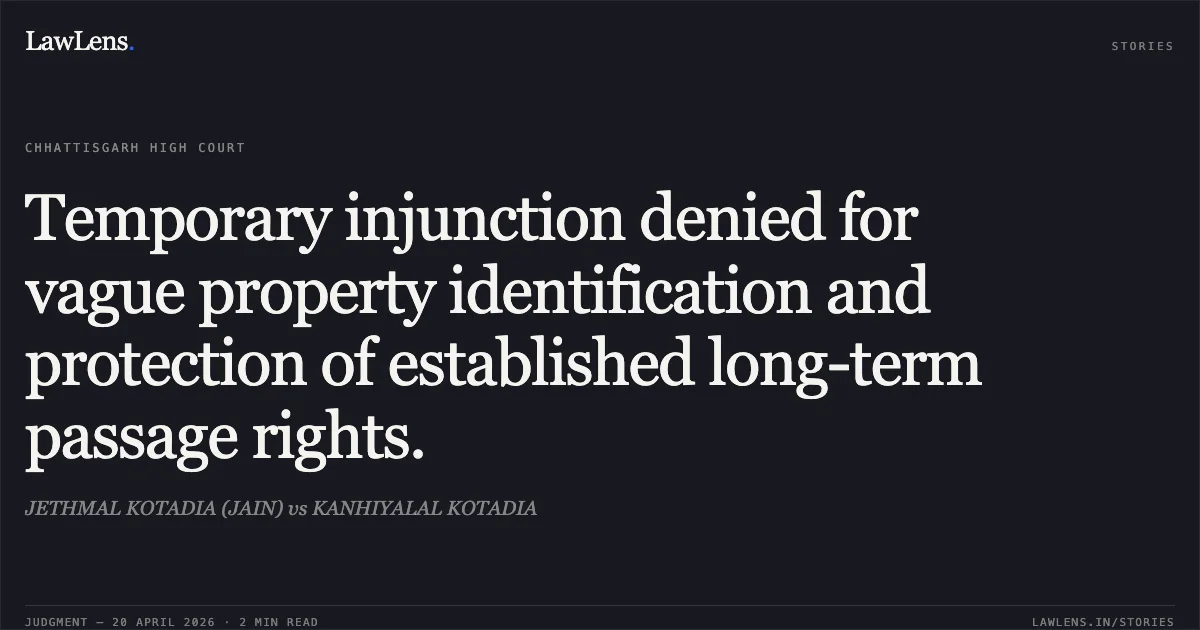
1. Whether the Trial Court exercised its discretion properly in finding that the Appellant failed to establish a prima facie case due to the lack of specific identification of the suit property in the counterclaim
Source reference: para 9, 112. Whether the balance of convenience and the requirement of irreparable injury favored the Appellant to warrant a temporary injunction
Source reference: para 12, 13Law Applied
The Court applied the tripartite test for temporary injunctions under Order 39 Rules 1 and 2 of the Code of Civil Procedure (CPC), 1908, requiring the applicant to prove a prima facie case, balance of convenience, and irreparable loss
Source reference: para 11-13It also applied the standard for appellate review in Miscellaneous Appeals under Order 43 Rule 1(r), which dictates that interference with a trial court's discretionary order is only warranted if the exercise of discretion was arbitrary, capricious, or contrary to settled law
Source reference: para 1, 14Reasoning
The Court found that the Appellant failed to establish a prima facie case because the counterclaim lacked a clear and specific description of the property, creating uncertainty regarding the subject matter of the injunction
Source reference: para 11In contrast, the Plaintiff provided a registered sale deed to support his claim of ownership
Source reference: para 11Regarding the balance of convenience, the Court noted that the Plaintiff had used the shop as a passage to his residence for 25 years; therefore, restraining this access would cause the Plaintiff significant hardship
Source reference: para 12The Court further determined that no irreparable injury would be caused to the Appellant by refusing the injunction, as any potential business interference could be compensated, whereas obstructing the Plaintiff’s only access to his home would result in serious prejudice
Source reference: para 13The Court concluded that the Trial Court’s findings were based on sound judicial principles and did not suffer from perversity or material irregularity
Source reference: para 14-15Holding
The High Court dismissed the appeal at the admission stage and affirmed the Trial Court's order dated 09.02.2026
The Court held that the Appellant failed to meet the legal requirements for a temporary injunction
Source reference: para 11-13It clarified that its observations were limited to the interim stage and directed the Trial Court to proceed with the main suit on its merits in accordance with the law
Source reference: para 17Acts & Sections Cited
3 provisions across 1 statute referred to in this judgment. Each provision opens on LawLens.
Code of Civil Procedure, 19083
Original Court PDF
JETHMAL KOTADIA (JAIN)vsKANHIYALAL KOTADIA
Click to open original judgment
Original judgment, available to read, download and summarize on LawLens.in


![Subsequent exoneration does not retrospectively invalidate a finalized promotion select list.. UNNIKRISHNAN M vs M/o Environment And Forests. CAT - ['Ernakulam']. LawLens](/stories/thumbnails/subsequent-exoneration-does-not-retrospectively-invalidate-a-finalized-promotion-select-li-ce80a0e84f2f4887857271e8b4341c42.webp)