Facts
The landlord sought recovery of possession under Section 21(2)(a) of the Tamil Nadu Regulation of Rights and Responsibilities of Landlords and Tenants Act, 2017.
Source reference: p. 2The Rent Court dismissed the application, finding that the landlord had not established a landlord–tenant relationship concerning a building or superstructure.
Source reference: pp. 2–4On appeal, the Rent Tribunal reversed and ordered eviction.
Source reference: pp. 2–4The tenant’s case was that the lease concerned vacant land and that he had put up the shed; the landlord claimed that the shed was his.
Source reference: pp. 2–4A suit for specific performance concerning an alleged sale agreement between the parties was pending.
Source reference: pp. 2–4The tenant challenged the Tribunal’s order under Article 227.
Source reference: pp. 2–4Issues
Whether the Rent Tribunal was justified in ordering eviction without determining whether the tenancy concerned vacant land alone or land together with a superstructure
Source reference: pp. 4–5Whether the tenant could remain in possession pending disposal of the specific-performance suit, notwithstanding the eviction order
Source reference: pp. 5–6Law Applied
Section 21(2)(a) of the Tamil Nadu Regulation of Rights and Responsibilities of Landlords and Tenants Act, 2017, was invoked as the basis for the landlord’s recovery-of-possession application.
Source reference: p. 2The Court treated the nature of the leased subject matter—vacant land alone or land with a building or superstructure—as material to the Rent Court’s consideration under the Act.
Source reference: pp. 3–5Reasoning
The Court found that the Tribunal had focused on whether a tenancy existed and had accepted the landlord’s case because there was no written lease, but had failed to decide what was leased.
Source reference: pp. 4–5That omission was significant because the tenant specifically asserted that the land was vacant when let, and the landlord’s witness admitted that the tenant had put up the superstructure and obtained the electricity connection at his own cost.
Source reference: pp. 4–5Although the Court considered the Rent Court’s reasoning on this issue justified, it noted that the tenant did not dispute being a lessee, subject to the outcome of the specific-performance suit.
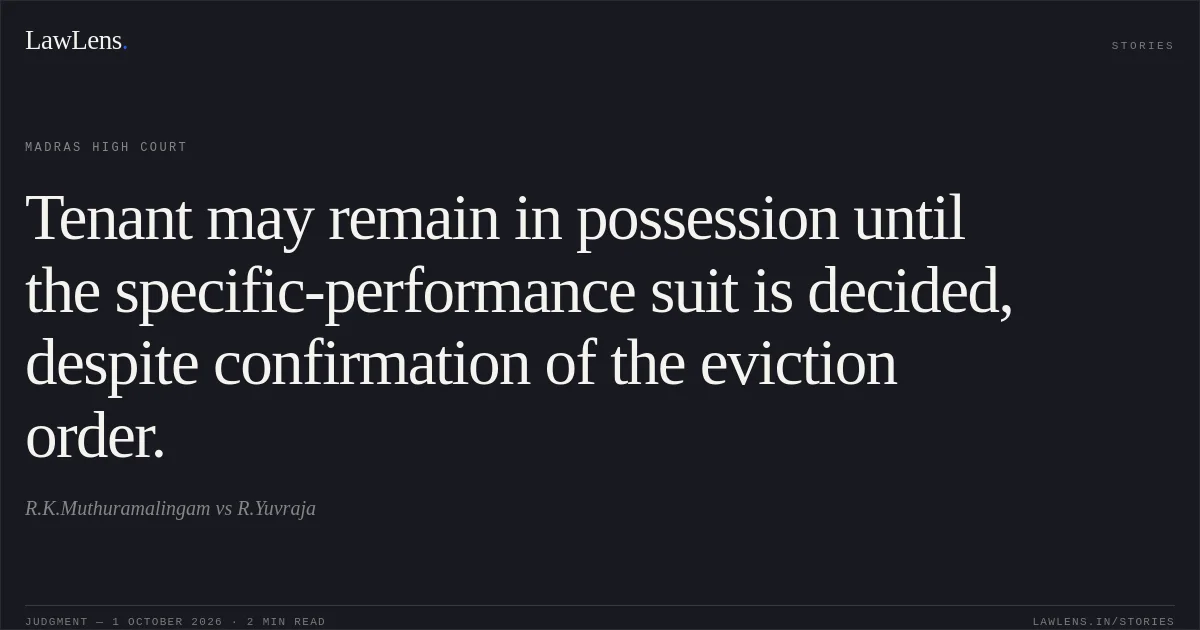
Source reference: pp. 5–6In light of those circumstances, it confirmed the eviction order but made its effect contingent on the outcome of that suit.
Source reference: pp. 5–6Holding
The Civil Revision Petition was dismissed, and the Rent Tribunal’s eviction order was confirmed.
The tenant was permitted to remain in possession until the specific-performance suit was decided, which the trial court was directed to dispose of by 31 January 2027.
Source reference: pp. 5–6If the tenant succeeded in that suit, the eviction order would become ineffective; if the suit was dismissed, the landlord could execute the eviction order to recover possession.
Source reference: pp. 5–6The landlord could withdraw rent arrears deposited through March 2026, and the tenant was directed to pay subsequent monthly rent of ₹18,320 directly to the landlord.
Source reference: pp. 5–6Acts & Sections Cited
1 provisions across 1 statute referred to in this judgment. Linked provisions open on LawLens.
Tamil Nadu Regulation of Rights and Responsibilities of Landlords and Tenants Act, 20171
Original Court PDF
R.K.MuthuramalingamvsR.Yuvraja
Click to open original judgment
Original judgment, available to read, download and summarize on LawLens.in