Facts
The petitioners challenged an eviction order dated 12 September 2014 passed by the Administrator, Auqaf Shahdara Sharief, declaring them unauthorised occupants of land situated in Village Dodasan Bala, District Rajouri, and directing their eviction.
Source reference: pp. 2–7, paras. 1–12They also challenged Mutation No. 311, attested in 1958 in favour of Khankah Sharief Peer Baba Jeevan Shah, and sought correction of the revenue record and recognition of their ownership or tenancy rights under the original Hindu proprietors.
Source reference: pp. 2–7, paras. 1–12The petitioners claimed that their predecessors had been cultivating tenants of Inderjeet and his co-sharers and that the Khankah was situated on separate land.
Source reference: pp. 2–7, paras. 1–12The respondents asserted that the land was Shamilat property, that the Khankah had been recorded as a Maroosi or occupancy tenant, and that the petitioners or their predecessors were Gair-Maroosi tenants under the Shrine.
Source reference: pp. 8–11, paras. 13–15They relied upon Mutation No. 311, revenue records, rent receipts, and statements recorded during the eviction proceedings to contend that the petitioners had acknowledged the Shrine as their landlord.
Source reference: pp. 8–11, paras. 13–15The Court found that rent receipts and the recorded statements of petitioners Nos. 1, 2 and 4 established their tenancy under Khankah Sharief Peer Baba Jeevan Shah.
Source reference: pp. 14–15, para. 20Petitioner No. 3 had failed to produce documentary material proving tenancy under the original owners.
Source reference: pp. 14–15, para. 20In OWP No. 1807/2014, the petitioners raised substantially identical claims and several of them had likewise acknowledged their status as tenants of the Shrine.
Source reference: p. 19, paras. 28–29Issues
Whether the petitioners suppressed material facts concerning their admitted tenancy under Khankah Sharief Peer Baba Jeevan Shah and were therefore disentitled to relief under Article 226 of the Constitution.
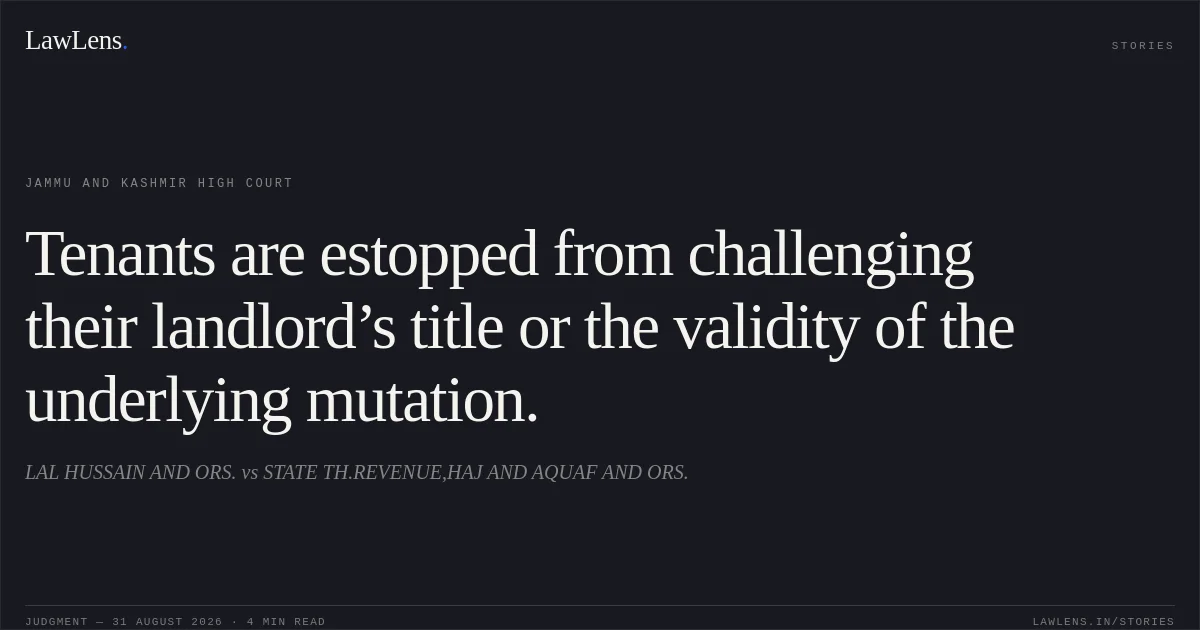
Source reference: pp. 14–16, paras. 19–22Whether the petitioners, having accepted the Khankah as their landlord and having paid rent, were legally estopped from challenging its title, ownership, or the validity of Mutation No. 311.
Source reference: pp. 17–18, paras. 23–26Whether the petitioners could, in the writ proceedings, challenge the transfer or mutation of the land in favour of the Khankah on the grounds that the original owners were Hindus, that no Waqf deed existed, or that ownership should instead have been conferred upon cultivating tenants under the Big Landed Estates Abolition Act.
Source reference: pp. 5–7 and 17–18, paras. 8–12, 26Whether OWP No. 1807/2014, involving substantially identical claims and evidence of tenancy, was liable to be dismissed for the same reasons.
Source reference: p. 19, paras. 28–29Law Applied
The Court applied the equitable principle that a party invoking writ jurisdiction must make full and candid disclosure of all material facts; suppression or misrepresentation disentitles the litigant to relief under Article 226, as explained in Dalip Singh v. State of U.P., (2010) 2 SCC 114, and K.D. Sharma v. Steel Authority of India Ltd., (2008) 12 SCC 481.
Source reference: pp. 15–16, paras. 21–22It further applied the doctrine of tenant’s estoppel embodied in Section 116 of the Indian Evidence Act, 1872, and referred to the corresponding principle under Section 122 of the Bharatiya Sakshya Adhiniyam, 2023: a tenant who has entered into possession under, or acknowledged, a landlord cannot deny that landlord’s title during the continuance of the tenancy.
Source reference: pp. 12–13 and 17–18, paras. 17, 23–25The Court relied on Anar Devi v. Nathu Ram, (1994) 4 SCC 250, and Ambika Savaria v. Sanjay Sharma, (2016) 15 SCC 185, for the proposition that even a tenant already in possession may be estopped from denying the title of a subsequent landlord after attornment or conduct recognising that landlord.
Source reference: pp. 12–13 and 17–18, paras. 17, 23–25The respondents also relied upon the J&K Wakafs Act, 2001, including its provisions concerning Waqf property and eviction of unauthorised occupants, although the Court resolved the petitions principally on suppression of facts and tenant’s estoppel.
Source reference: pp. 9–10, para. 14Reasoning
The Court held that the petitioners’ assertion that they were tenants directly under Inderjeet and his co-sharers was materially incomplete because the documentary record showed that they had acknowledged the Shrine as their landlord and had paid rent to the Auqaf.
Source reference: pp. 14–15, para. 20This concealment was material because the petitioners’ alleged tenancy under the original owners formed the basis of their challenge to Mutation No. 311 and the eviction proceedings.
Source reference: pp. 14–15, para. 20Applying the clean-hands rule, the Court concluded that the suppression alone justified dismissal of the writ petition.
Source reference: pp. 15–16, paras. 21–22Independently, the Court found that the petitioners’ rent payments, recorded statements, and conduct established a landlord–tenant relationship with the Khankah.
Source reference: pp. 14–15 and 17–18, paras. 20, 23–26Under the rule of tenant’s estoppel, they could not continue to recognise the Shrine as landlord and simultaneously dispute its title when faced with eviction.
Source reference: pp. 14–15 and 17–18, paras. 20, 23–26Consequently, the Court declined to examine the petitioners’ substantive objections concerning the alleged invalidity of the Waqf, the absence of a Waqf deed, the religious status of the original owners, or the alleged entitlement of the tenants under the Big Landed Estates Abolition Act.
Source reference: pp. 17–18, para. 26Those objections, according to the Court, could at best have been raised by the original owners and not by tenants who had acknowledged the Shrine’s title.
Source reference: pp. 17–18, para. 26The same reasoning applied to OWP No. 1807/2014 because the petitioners therein had also acknowledged their tenancy under the Shrine and the record contained supporting rent receipts.
Source reference: p. 19, paras. 28–29Holding
The Court dismissed OWP No. 930/2018, holding that the petitioners had suppressed their material tenancy relationship with the Khankah and were estopped from challenging the Shrine’s title or Mutation No. 311.
It also dismissed OWP No. 1807/2014 on the same grounds, thereby leaving the eviction order dated 12 September 2014 undisturbed.
Source reference: p. 19, para. 29In CPOWP No. 21/2015, the respondents were granted a final opportunity to file a statement of facts, with the matter directed to be listed on 23 October 2026.
Source reference: p. 19, paras. 30–31Acts & Sections Cited
1 provisions across 1 statute referred to in this judgment. Each provision opens on LawLens.
Bharatiya Sakshya Adhiniyam, 20231
Original Court PDF
LAL HUSSAIN AND ORS.vsSTATE TH.REVENUE,HAJ AND AQUAF AND ORS.
Click to open original judgment
Original judgment, available to read, download and summarize on LawLens.in