Facts
The Petitioner (tenant) sought to set aside an eviction order dated 06.01.2026 passed by the Additional Rent Controller (ARC), Patiala House Courts
Source reference: p. 1-2The original landlord, Shri Kranti Arora, had filed an eviction petition under Section 14(1)(e) of the Delhi Rent Control (DRC) Act, citing a bona fide requirement for himself and his wife to stay in Delhi for medical treatment
Source reference: p. 2During the pendency of the proceedings, the original landlord passed away
Source reference: p. 2The Petitioner failed to file an application for 'leave to defend' within the statutory period
Source reference: p. 3, 6Consequently, the ARC passed the eviction order, holding that the requirement survived for the benefit of the surviving spouse (Respondent)
Source reference: p. 3Issues
1. Whether the bona fide requirement of the landlord stood extinguished upon his death during the pendency of the eviction proceedings
Source reference: p. 2 / para. 2-42. Whether a revision petition under Section 25B(8) of the DRC Act is maintainable when the tenant has failed to file an application seeking leave to defend within the prescribed time
Source reference: p. 8-9 / para. 26-28Law Applied
The court applied Section 25B of the Delhi Rent Control Act, 1958, specifically sub-section (4), which mandates that a tenant cannot contest an eviction prayer unless leave to defend is sought and obtained; failure to do so results in the deemed admission of the landlord’s statements
Source reference: p. 6-7The court relied on Prithipal Singh v. Satpal Singh, affirming that Section 25B is a complete code and the timeline for leave to defend is mandatory
Source reference: p. 7Regarding revisional jurisdiction, the court cited Abid-Ul-Islam v. Inder Sain Dua and Sarla Ahuja v. United India Insurance Co. Ltd., which establish that the High Court’s power under Section 25B(8) is supervisory/revisional, not appellate, and is confined to the "decision-making process"
Source reference: p. 4-5Reasoning
The Court observed that under Section 25B(4), the Petitioner's failure to file for leave to defend resulted in a statutory admission of the eviction petition's contents
Source reference: p. 6Therefore, the Petitioner was legally precluded from contesting the merits of the bona fide requirement
Source reference: p. 7On the merits of the subsequent event (the death of the landlord), the Court analyzed Paragraph 19 of the original eviction petition and found that the requirement was pleaded for both the late Kranti Arora and his wife
Source reference: p. 8Thus, the need did not expire with the husband’s death but subsisted for the widow
Source reference: p. 8Furthermore, the Court reasoned that allowing a revision petition after a tenant voluntarily forfeited their right to contest at the trial stage would circumvent the legislative intent of the DRC Act’s summary procedure
Source reference: p. 9Holding
The Court held that the petition was both devoid of merit and legally non-maintainable
It affirmed that the bona fide requirement survived for the Respondent (widow)
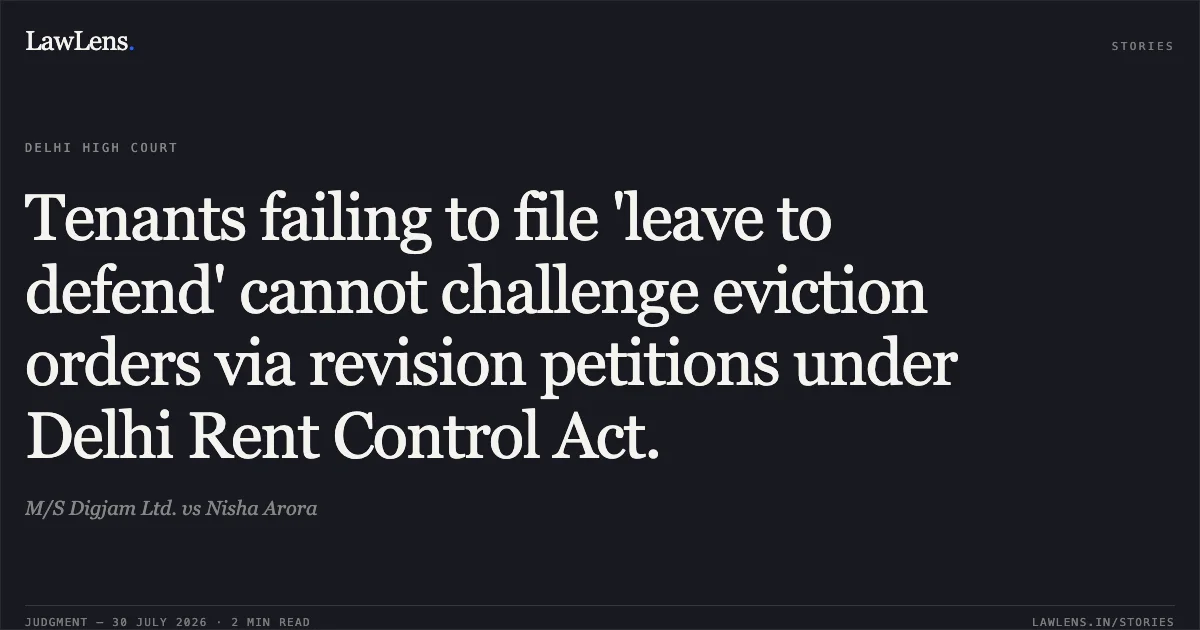
Source reference: p. 8The Court answered that a tenant who fails to seek leave to defend cannot subsequently invoke revisional jurisdiction to challenge the consequential eviction order
Source reference: p. 9The Revision Petition was dismissed with costs of Rs. 25,000/- to be deposited with the Delhi High Court Bar Association
Source reference: p. 10Original Court PDF
M/S Digjam Ltd.vsNisha Arora
Click to open original judgment
Original judgment, available to read, download and summarize on LawLens.in


