Facts
The Bihar State Food and Civil Supplies Corporation issued NIT No. 573 dated 26 June 2024 for selection and empanelment of contractors for doorstep delivery of food grains in Nalanda district.
Source reference: pp. 2–3The petitioner was technically qualified and, after the financial bid and negotiations, consented to execute the work at the approved L-1 rate of SOR + 6.25%, namely ₹38.25 per quintal.
Source reference: pp. 2–3Before executing the agreement, the petitioner represented that the approved rate was commercially unviable and requested permission to work at SOR + 20%, or alternatively sought refund of her earnest money deposit of ₹3,00,000.
Source reference: p. 3The District Transport Committee rejected the representation and resolved to forfeit the deposit and blacklist her for five years for failure to execute the agreement.
Source reference: p. 3The petitioner challenged the forfeiture and blacklisting on the grounds that the action was beyond the tender conditions and was taken without a show-cause notice or hearing.
Source reference: pp. 3–4Issues
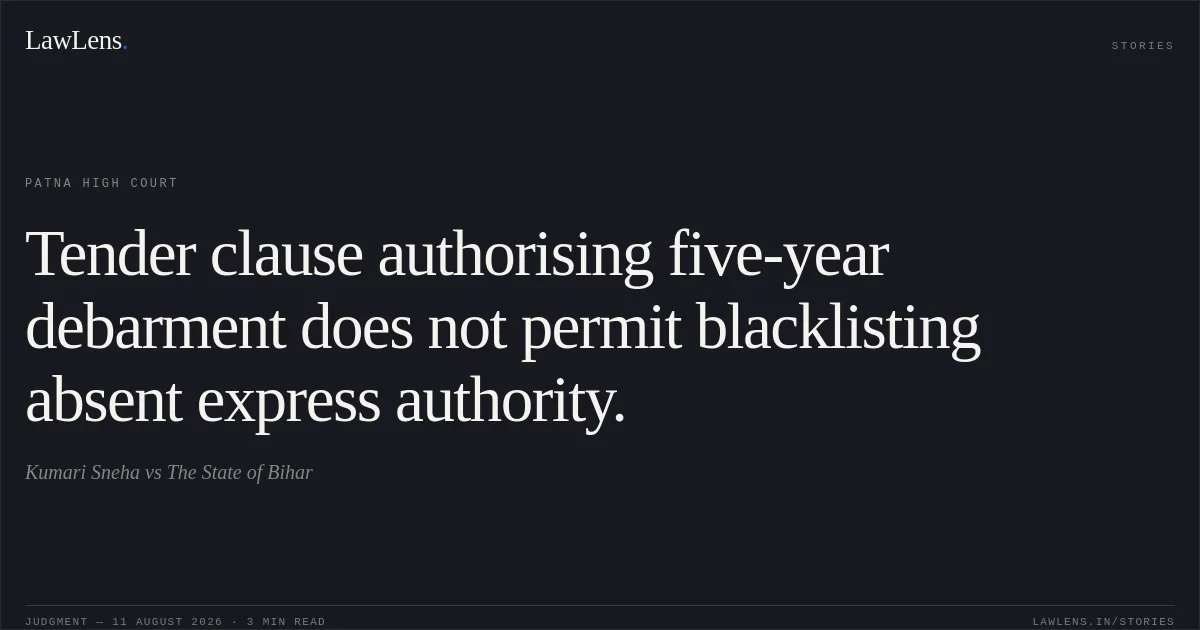
Whether the respondents were justified in blacklisting the petitioner for five years when Clause 12(c) of the NIT provided only for debarment from participating in future BSFCSCL tenders for five years?
Source reference: p. 5, para. 7Whether the respondents could impose consequences beyond those expressly stipulated in the tender conditions, including blacklisting as distinct from contractual debarment?
Source reference: pp. 5–8, paras. 8–12Law Applied
Clause 12(c) of the NIT authorized termination of the contract, forfeiture of the security deposit, recovery of losses or damages, and debarment from participating in future BSFCSCL tenders for five years upon failure to furnish the requisite security deposit or execute the agreement.
Source reference: p. 5, para. 8The Court held that the rights and liabilities arising from a tender are governed by its express conditions and that the authority cannot impose a consequence beyond those conditions.
Source reference: p. 8, para. 12Relying on Kulja Industries Ltd. v. Chief General Manager, Western Telecom Project, BSNL, (2014) 14 SCC 731, the Court recognized that blacklisting is a stigmatic administrative action with serious civil and commercial consequences, subject to natural justice, judicial review, and proportionality.
Source reference: pp. 6–7, para. 10Relying on UMC Technologies Pvt. Ltd. v. Food Corporation of India, (2021) 2 SCC 551, it reiterated that blacklisting requires a valid, specific, and unambiguous show-cause notice and an opportunity to defend, and that an order cannot travel beyond the notice issued.
Source reference: pp. 7–8, para. 11Reasoning
Clause 12(c) expressly prescribed debarment from future BSFCSCL tenders for five years, but did not authorize blacklisting.
Source reference: pp. 5–6, paras. 8–10The Court treated debarment and blacklisting as legally distinct: debarment was a contractual restriction under the NIT, whereas blacklisting was a stigmatic administrative penalty carrying wider and more serious consequences.
Source reference: pp. 5–6, paras. 8–10Since the respondents described and imposed the action as “blacklisting,” they had imposed a consequence not contemplated by the tender conditions.
Source reference: p. 8, para. 12The respondents therefore could not substitute the expressly stipulated consequence of debarment with the more onerous consequence of blacklisting.
Source reference: p. 8, para. 12The Court nevertheless observed that the authorities could impose consequences expressly permitted by Clause 12(c), including forfeiture and debarment, subject to the tender terms and applicable law.
Source reference: p. 9, para. 13Holding
The Court answered the framed issue in favour of the petitioner and held that the respondents were not justified in blacklisting her because Clause 12(c) authorized only debarment from participation in BSFCSCL tenders for five years.
The impugned order dated 2 December 2024 was set aside insofar as it concerned the petitioner, and the matter was remitted to the authorities for a fresh order strictly in accordance with the NIT and applicable law.
Source reference: p. 9, paras. 14–15The writ petition was allowed.
Source reference: p. 9, paras. 16–17The Court further directed that the forfeited security deposit, if any, be refunded to the petitioner within four weeks from receipt or production of the order.
Source reference: p. 9, paras. 16–17Acts & Sections Cited
1 provisions across 1 statute referred to in this judgment. Linked provisions open on LawLens.
Notice Inviting Tender1
Original Court PDF
Kumari SnehavsThe State of Bihar
Click to open original judgment
Original judgment, available to read, download and summarize on LawLens.in