Facts
The petitioner, a proprietorship firm and MSME, participated in a tender issued by the Cantonment Board, Nainital, for establishing six unipoles and fifty poles for advertisements within the Nainital Cantonment area. In the earlier tender process, the petitioner quoted ₹16,95,660 per year, amounting to ₹50,86,980 for three years. Its bid was rejected on the ground that the GeM Portal did not reflect its MSME status. The petitioner’s challenge to that rejection became infructuous after the earlier tender was cancelled
Source reference: p.1; para. 2The Cantonment Board thereafter issued a fresh auction/tender notice dated 22 August 2026 on the GeM Portal. The bidding window was allegedly open only from 22 August 2026 at 2:00 p.m. until 24 August 2026 at noon. The petitioner contended that the period was insufficient, particularly because 22 August was the fourth Saturday and 23 August was a Sunday, and that the process violated the applicable procurement requirements prescribing ordinarily three weeks for submission of bids
Source reference: p.2; paras. 2–4During the proceedings, the Cantonment Board stated that the earlier tender had incorrectly adopted a reverse-bidding mechanism instead of the H-1/highest-bidder system. The petitioner asserted that it would have submitted a bid exceeding ₹50 lakh if a proper and adequate tender process had been followed. Pursuant to the Court’s direction, the petitioner deposited ₹25 lakh to demonstrate the bona fides of its offer, subject to conditions regarding participation and the amount of its bid in the fresh tender process
Source reference: p.4; para. 6; p.5; paras. 7–9The Cantonment Board subsequently agreed to cancel the impugned tender and issue a fresh tender. The successful bidder in the impugned process also stated that it had no objection to re-tendering, while reserving its right to participate afresh
Source reference: p.6; paras. 8–10Issues
1. Whether the auction/tender notice dated 22 August 2026, which allowed only a short period for submission of bids, violated Rule 161(ii) and (vi) of the General Financial Rules, 2017 and the corresponding procurement requirements regarding publication and minimum bidding time?
Source reference: p.3; paras. 2–4; p.2; para. 22. Whether, in the circumstances, the impugned tender process was liable to be quashed and the Cantonment Board permitted to undertake a fresh tender process?
Source reference: p.6; paras. 10–143. Whether the petitioner’s deposit of ₹25 lakh should remain subject to verification of its participation and bid in the fresh tender process?
Source reference: p.6–7; para. 12Law Applied
The Court applied Rule 161(ii) and (vi) of the General Financial Rules, 2017, and the corresponding provisions of the Union Government’s Manual for Procurement of Consultancy and Other Services.
Source reference: p.2–3; paras. 2–3Rule 161(ii) requires the procuring organisation to publish the complete bidding document on its website and the Central Public Procurement Portal, while Rule 161(vi) provides that ordinarily at least three weeks should be allowed for submission of bids from publication of the tender notice or availability of the bidding document, whichever is later.
Source reference: p.2–3; paras. 2–3The Court also applied the general principle that public procurement must be conducted through a fair, transparent and adequately publicised process, while recognising the procuring authority’s power to cancel an irregular tender and invite fresh bids.
Source reference: no citationReasoning
The petitioner alleged that the Cantonment Board allowed only approximately three days for bidding, including two non-working days, contrary to the ordinary three-week period contemplated by Rule 161(vi) and the procurement manual.
Source reference: p.2; paras. 2–4The record also indicated procedural uncertainty in the earlier tender, including the Board’s admission that the reverse-bidding mechanism had been used although the H-1/highest-bidder system was considered appropriate.
Source reference: p.4; para. 5Although the Court did not undertake an elaborate final adjudication on each alleged violation, the Cantonment Board agreed to cancel the impugned process and conduct a fresh tender. The successful bidder raised no objection to that course and sought liberty to participate in the re-tender.
Source reference: p.6; paras. 8–10In view of the authority’s consent, the procedural concerns surrounding the tender, and the need to permit equal participation in a properly conducted process, the Court considered re-tendering appropriate.
Source reference: no citationThe petitioner’s deposit was retained as a bona fide assurance and made refundable only upon satisfaction of specified conditions relating to its participation and bid.
Source reference: p.6–7; para. 12Holding
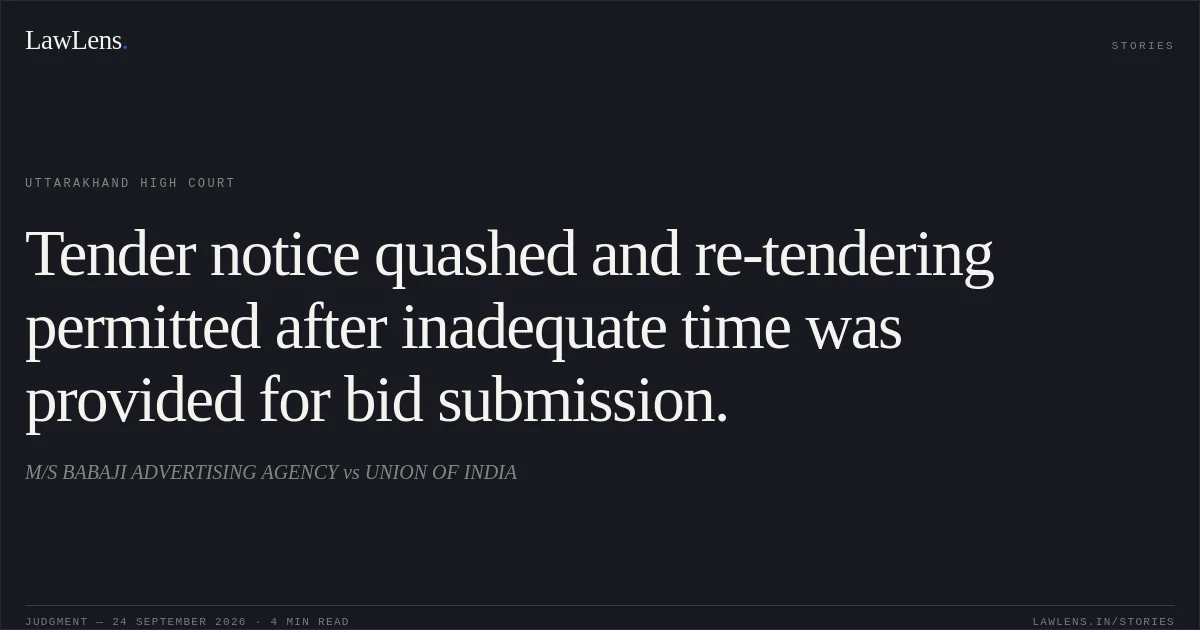
The High Court quashed the Tender Notice dated 22 August 2026 and permitted the Cantonment Board, Nainital, to conduct a fresh tender for the work.
Both the petitioner and the previously successful bidder were permitted to participate in the fresh tender process.
Source reference: p.6; para. 11The petitioner’s ₹25 lakh deposit was directed to remain with the Court until finalisation of the fresh tender. It could thereafter be withdrawn upon verification that the petitioner had submitted a technically responsive bid exceeding ₹50 lakh; otherwise, the amount would stand forfeited in favour of the Cantonment Board.
Source reference: p.6–7; para. 12The writ petition was accordingly disposed of.
Source reference: p.7; para. 14Original Court PDF
M/S BABAJI ADVERTISING AGENCYvsUNION OF INDIA
Click to open original judgment
Original judgment, available to read, download and summarize on LawLens.in