01Facts
The litigation involves two separate challenges by a school management ("Petitioners") against orders of the School Tribunal in favor of a teacher ("Respondent No. 1").
¶ 1-2In the first instance (WP 3267/2007), Respondent No. 1 was terminated on May 26, 2006, following an inquiry into allegations of assault and misconduct.
¶ 1-2The School Tribunal set aside this termination on March 16, 2007, citing management prejudice and procedural flaws, and ordered reinstatement with backwages.
¶ 1-2Despite no interim stay, the Petitioners failed to reinstate her.
¶ 4-5Subsequently (WP 4099/2017), Respondent No. 1 alleged she was prevented from joining duties on April 7, 2012, which she challenged as "otherwise termination".
¶ 4-5The Tribunal again ruled in her favor on January 27, 2017, directing reinstatement and imposing costs of ₹50,000.
¶ 4Respondent No. 1 superannuated on December 31, 2022, during the pendency of these proceedings.
¶ 802Issues
i.1. Whether the School Tribunal was justified in setting aside the 2006 termination on the grounds of prejudice and the framing of charges that were inconsistent with the inquiry's findings
¶ 13-14, 27ii.2. Whether the management's actions in 2012 amounted to "otherwise termination" or if the teacher had voluntarily refused to join her duties
¶ 17-18, 33iii.3. Whether the High Court should exercise its discretionary jurisdiction under Article 227 given the Petitioners' history of non-compliance with judicial directions
¶ 35-3603Law Applied
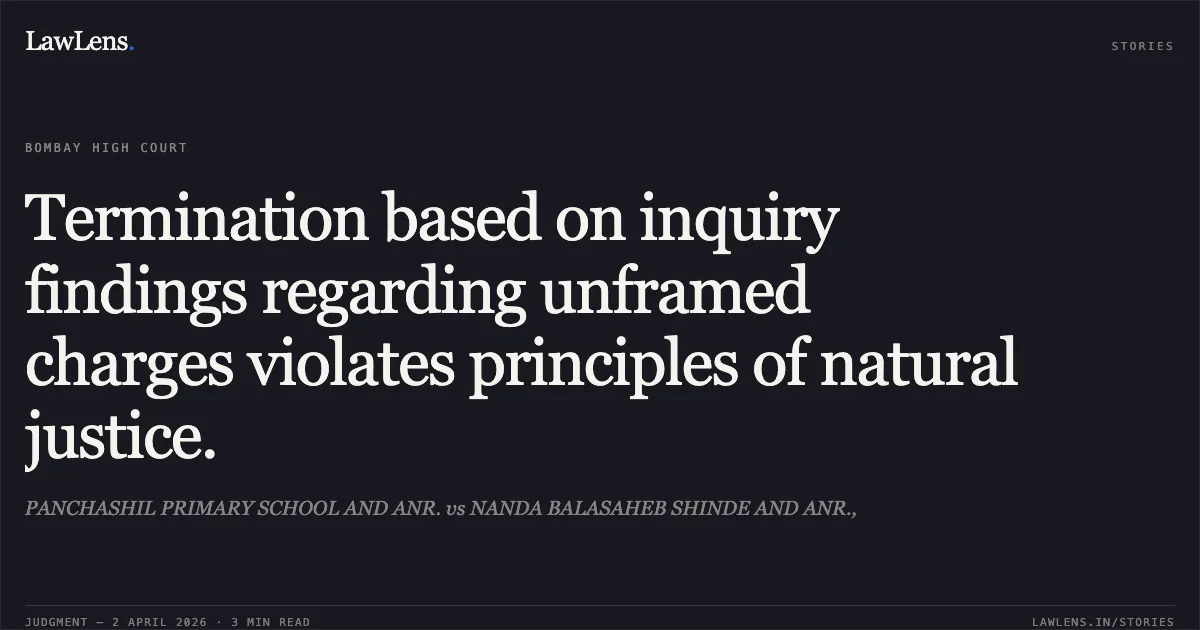
The Court applied the principles of natural justice, specifically the requirement that findings of misconduct must be based on formally framed charges.
¶ 27It relied on the supervisory jurisdiction of the High Court under Article 227 of the Constitution of India, as clarified in Shalini Shyam Shetty v. Rajendra Shankar Patil, which restricts interference to cases of patent perversity, gross failure of justice, or flouting of basic principles of natural justice.
¶ 35The Court also referenced Ahilyabai Holkar Shikshan Prasarak v. Venkatrao, noting that a Tribunal may interfere when proceedings are inconsistent with statutory rules or the rules of natural justice.
¶ 16, 3404Reasoning
Regarding the 2006 termination, the Court observed that while the inquiry committee found Respondent No. 1 guilty of assaulting the headmistress, no such specific charge was framed in the original charge sheet.
¶ 26-27This discrepancy constituted a breach of natural justice.
¶ 26-27Furthermore, the Court noted the Tribunal’s finding of deep-seated prejudice, as the headmistress was the wife of the institution's chairman and the management had ignored prior Education Department directions.
¶ 29-30Regarding the 2012 "otherwise termination," the Petitioners failed to produce evidence (such as muster rolls or proof of summons) to support their claim that the teacher refused to work; conversely, the teacher provided correspondence showing she was actively blocked from signing the muster.
¶ 32-33The Court highlighted the Petitioners' "conduct" in willfully disobeying Tribunal orders for nearly two decades as a primary reason to decline discretionary relief.
¶ 3, 2205Holding
The High Court dismissed both Writ Petitions, finding no perversity or illegality in the School Tribunal’s judgments.
¶ 36The Court held that the inquiry was vitiated by a lack of fair play and that the 2012 incident clearly constituted "otherwise termination".
¶ 31, 33The interim stay on the payment of costs was vacated, and the Petitioners were directed to pay ₹50,000 within four weeks.
¶ 37Additionally, the Court maintained oversight of the Education Department to ensure the release of backwages and pensionary benefits, requiring further affidavits from the Director and Education Officers to explain their long-standing failure to enforce the Tribunal's 2007 directions.
¶ 40-44Original Court PDF
PANCHASHIL PRIMARY SCHOOL AND ANR.vsNANDA BALASAHEB SHINDE AND ANR.,
Click to open original judgment
Original judgment, available to read, download and summarize on LawLens.in