Facts
The appellant, widow of a police constable appointed in 1979, challenged the termination of her husband’s service.
Source reference: no citationHe was charged under Rule 16 of the Rajasthan Civil Services (Classification, Control and Appeal) Rules, 1958, with remaining absent from duty for 57 days on six occasions during 1994.
Source reference: p.2 / paras. 2–3His defence was that he was suffering from prolonged tuberculosis and was medically unable to attend duty.
Source reference: p.3 / para. 3Defence witnesses supported his illness and inability to appear before the Enquiry Officer.
Source reference: p.3 / para. 3The Enquiry Officer nevertheless found him guilty, and the Disciplinary Authority terminated his service on 26 October 1996.
Source reference: p.3 / para. 5The appellant’s husband subsequently died.
Source reference: no citationHer writ petition challenging the termination was dismissed by the learned Single Judge on grounds of alternative remedy and delay/laches on 11 December 2008.
Source reference: p.4 / para. 6The present intra-court appeal challenged that dismissal and the underlying termination order.
Source reference: no citationIssues
Whether the learned Single Judge was justified in dismissing the writ petition on the grounds of availability of an alternative remedy and delay/laches, thereby leaving the termination order undisturbed?
Source reference: p.5 / para. 10Whether the deceased employee’s absence from duty could constitute misconduct when the Department had not established that the absence was wilful or deliberate and the employee had relied on prolonged illness as the cause of absence?
Source reference: pp.5–8 / paras. 11–15Whether non-supply of the Enquiry Officer’s report before imposition of the penalty violated Rule 16(10) of the CCA Rules, 1958 and the principles of natural justice?
Source reference: pp.8–9 / paras. 16–17Law Applied
The Court applied Rule 16(10) of the Rajasthan Civil Services (Classification, Control and Appeal) Rules, 1958, which requires furnishing the enquiry report to the delinquent employee before the disciplinary authority takes a final decision.
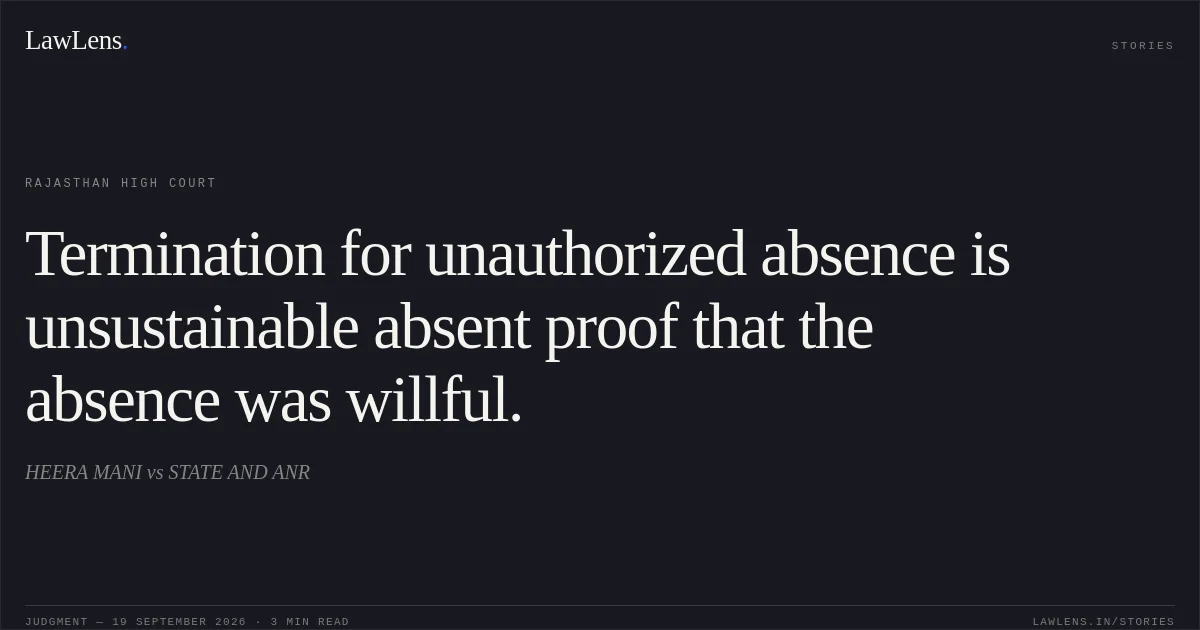
Source reference: no citationRelying on Krushnakant B. Parmar v. Union of India, (2012) 3 SCC 178, the Court held that unauthorised absence does not by itself establish misconduct; the Department must prove that the absence was wilful, and absence caused by compelling circumstances such as illness cannot be treated as wilful.
Source reference: p.6 / para. 12The Court also relied on Chhel Singh v. M.G.B. Gramin Bank, 2014 AIR SCW 6539, for the principle that unauthorised absence must be wilful and deliberate to justify disciplinary punishment.
Source reference: p.7 / para. 13Under Union of India v. Mohd. Ramzan Khan, (1991) 1 SCC 588, non-supply of the enquiry report and denial of an opportunity to make a representation constitute a violation of natural justice and render the final disciplinary order vulnerable.
Source reference: pp.8–9 / para. 16The same principle was reaffirmed through H.P. State Electricity Board Ltd. v. Mahesh Dahiya, (2016) 12 SCC 583.
Source reference: p.9 / para. 16Reasoning
The Court found that the Department proved the employee’s absence but failed to establish that it was wilful.
Source reference: pp.7–8 / paras. 14–15The evidence of Constables Naval Singh and Udai Raj supported the employee’s defence that he was suffering from tuberculosis and remained absent because of prolonged illness; the Enquiry Officer and Disciplinary Authority did not adequately address whether the absence was caused by compelling circumstances.
Source reference: pp.7–8 / paras. 14–15Applying Krushnakant B. Parmar, the Court held that absence due to illness cannot amount to misconduct in the absence of a finding of wilfulness.
Source reference: p.8 / para. 15Independently, the Court held that the enquiry report had not been supplied before the termination order was passed, depriving the employee of an opportunity to make an effective representation.
Source reference: pp.8–9 / paras. 16–17This constituted a breach of Rule 16(10) and natural justice under Mohd. Ramzan Khan and Mahesh Dahiya.
Source reference: pp.8–9 / paras. 16–17Accordingly, the termination could not be sustained.
Source reference: no citationHolding
The appeal was allowed.
The Court quashed the termination order dated 26 October 1996 and the learned Single Judge’s order dated 11 December 2008.
Source reference: p.10 / para. 18It held that the employee’s absence had not been shown to be wilful and that non-supply of the enquiry report independently vitiated the disciplinary action.
Source reference: p.9 / para. 17As the employee had died, the appellant-widow was directed to receive all consequential service and retiral benefits within 45 days from receipt of the certified copy of the judgment.
Source reference: p.10 / para. 18Original Court PDF
HEERA MANIvsSTATE AND ANR
Click to open original judgment
Original judgment, available to read, download and summarize on LawLens.in