Facts
The respondent was appointed as a security guard on an ad hoc basis on 9 September 1985 and his services were regularised with effect from 27 May 1986.
Source reference: p.2, para. 2His services were terminated with effect from 8 May 1990 by order dated 30 April 1990, allegedly on account of frequent absenteeism.
Source reference: p.2, para. 2; p.5, paras. 12, 15The respondent raised an industrial dispute, and the Central Government Industrial Tribunal held that the termination was illegal because it had not been effected by the competent authority and because the respondent had not been given an opportunity to explain the alleged misconduct. The Tribunal directed reinstatement with 20% back wages.
Source reference: p.2, paras. 3–4In the writ petition, the petitioner initially contended that the Industrial Disputes Act, 1947 was inapplicable because the respondent held a civil post; that contention had not been raised before the Tribunal and was held unavailable at the writ stage.
Source reference: p.2, para. 5; p.4, para. 13Issues
Whether the respondent’s termination was invalid because it was issued by an authority subordinate to the competent appointing or disciplinary authority.
Source reference: p.3, paras. 6–11Whether the termination, though ostensibly simpliciter, was founded on alleged misconduct and therefore required prior notice and an opportunity of hearing.
Source reference: p.4–5, paras. 12–15Whether reinstatement with back wages was an automatic consequence of the finding that the termination was illegal.
Source reference: p.6, paras. 16–19Law Applied
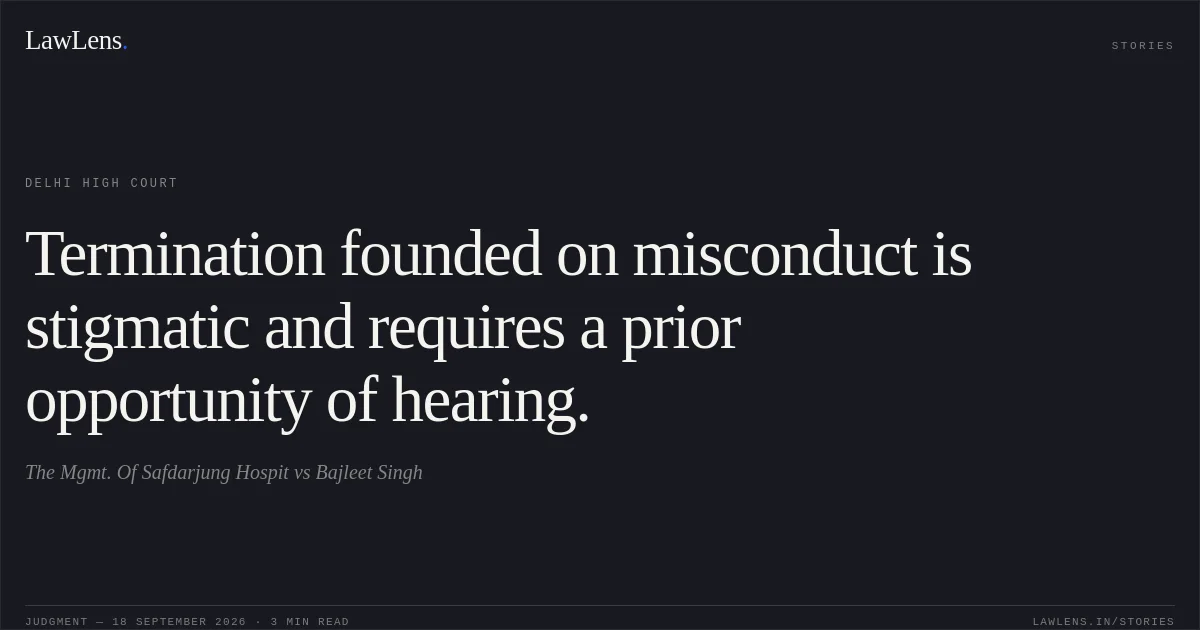
The Court applied the principle that an order of termination founded on misconduct is stigmatic and cannot ordinarily be passed without affording the employee an opportunity to explain the allegations, even if the order is framed as a termination simpliciter.
Source reference: p.5, paras. 14–15It further held that a plea regarding the inapplicability of the Industrial Disputes Act, particularly on the ground that the employee held a civil post, cannot ordinarily be introduced for the first time in a writ petition when the employer participated in the adjudication on merits without raising it before the Tribunal.
Source reference: p.2, para. 5; p.4, para. 13The Court also applied the settled principle that reinstatement with back wages does not follow automatically from a finding of illegal termination; relief must be moulded according to the nature and duration of employment, the passage of time, and the surrounding circumstances. In this regard, it relied on Allahabad Bank v. Krishan Pal Singh, (2021) 19 SCC 227.
Source reference: p.6, para. 17Section 17-B of the Industrial Disputes Act was relevant to the interim payment of wages last drawn or minimum wages during the pendency of the proceedings.
Source reference: p.6, para. 18Reasoning
The Court rejected the Tribunal’s finding that the termination was invalid solely because it had been issued by an incompetent authority. The appointment offer, departmental appointment order, regularisation order, notice proposing termination, and termination order were all signed by the Chief Administrative Officer, demonstrating that the officer had consistently acted for the management in relation to the respondent’s service.
Source reference: p.3–4, paras. 10–11However, the Court upheld the Tribunal’s alternative reasoning on procedural impropriety. Since the management itself relied on the respondent’s frequent absence and admitted that such absence was the reason for termination, the termination was founded on alleged misconduct rather than being a genuinely innocuous termination simpliciter. The respondent therefore ought to have been given notice and an opportunity to explain before termination.
Source reference: p.4–5, paras. 12–15Nevertheless, considering that the respondent had served only approximately four to five years, more than three decades had elapsed since termination, and he had reached superannuation, the Court held that reinstatement was no longer an appropriate remedy. The amount deposited pursuant to the interim order, with accrued interest, together with reasonable lump-sum compensation, was considered adequate relief.
Source reference: p.6, paras. 16–19Holding
The Court held that the Tribunal was not justified in concluding that the termination was invalid merely because it had been issued by an incompetent authority. However, the termination remained illegal because it was based on alleged absenteeism, a charge involving misconduct, without giving the respondent an opportunity to respond.
Reinstatement with 20% back wages was therefore not maintained. The award was modified, and the petitioner was directed to release to the respondent the amount deposited pursuant to the order dated 6 February 2008, together with accrued interest, and to pay an additional lump-sum compensation of ₹2,00,000 within eight weeks.
Source reference: p.6–7, paras. 18–20The writ petition and pending applications were disposed of accordingly.
Source reference: p.7, paras. 20–21Acts & Sections Cited
1 provisions across 1 statute referred to in this judgment. Linked provisions open on LawLens.
Industrial Disputes Act, 19471
Original Court PDF
The Mgmt. Of Safdarjung HospitvsBajleet Singh
Click to open original judgment
Original judgment, available to read, download and summarize on LawLens.in