Facts
The petitioner was appointed as a Typist by respondent No. 1 on probation on 17 May 1988 and was subsequently confirmed as a permanent employee after satisfactorily completing probation.
Source reference: para. 3; para. 12In 2000, he remained absent from duty on account of illness. Respondent No. 1 issued him a charge-sheet on 11 May 2000, to which he replied by attributing his absence to ill-health.
Source reference: paras. 4, 12Without conducting a departmental inquiry or providing an opportunity to substantiate his defence, respondent No. 1 terminated his services on the basis of the charge-sheet and reply.
Source reference: paras. 6, 12–14The petitioner raised an industrial dispute, which was referred to the Labour Court, Junagadh, as Reference Case No. 202 of 2001.
Source reference: para. 1By award dated 16 June 2011, the Labour Court held that the petitioner was a regular employee but awarded only lump-sum compensation of ₹50,000 in lieu of reinstatement, continuity of service and full back-wages, partly relying on the alleged absence of a fitness certificate.
Source reference: paras. 5, 15The petitioner challenged the award under Articles 226 and 227 of the Constitution and the Industrial Disputes Act, 1947, seeking reinstatement-related and consequential monetary benefits.
Source reference: paras. 1, 9Issues
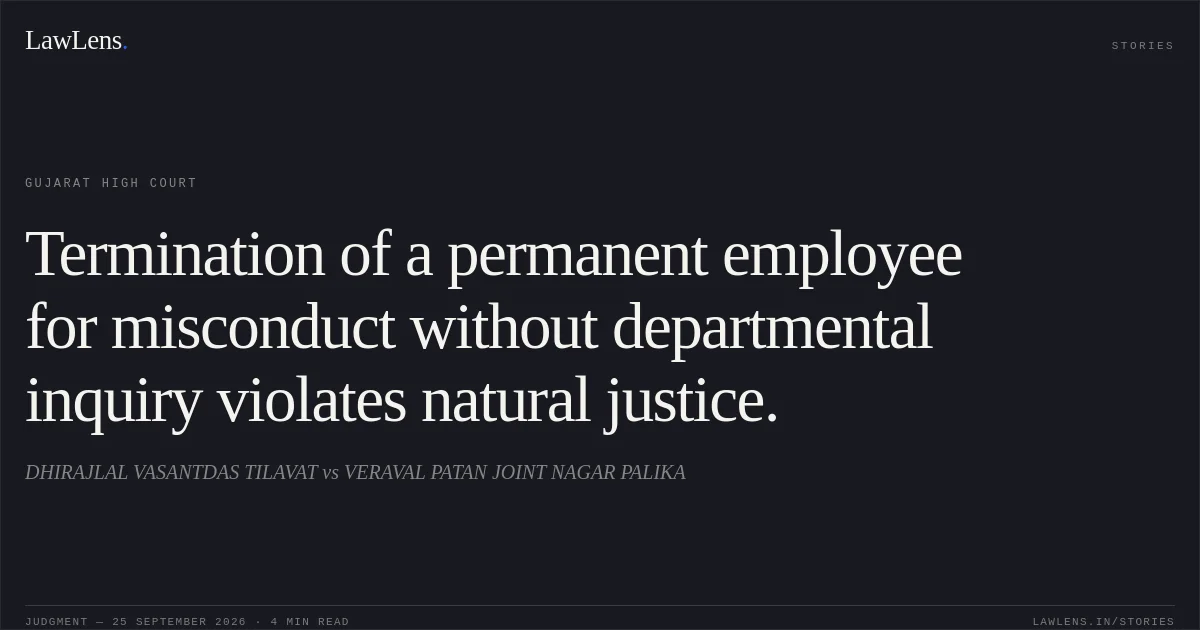
Whether the termination of a confirmed permanent employee for alleged unauthorized absence, without conducting a departmental inquiry, violated the principles of natural justice and applicable disciplinary procedure?
Source reference: paras. 12–15Whether the Labour Court erred in treating the petitioner as medically unfit and awarding only ₹50,000 as compensation in lieu of reinstatement?
Source reference: para. 15Whether the petitioner was entitled to reinstatement, continuity of service and back-wages, or an appropriate monetary and retiral-benefit relief after attaining superannuation?
Source reference: paras. 16–17Law Applied
The Court exercised jurisdiction under Articles 226 and 227 of the Constitution in relation to the Labour Court’s award and applied the principles governing disciplinary action under the Industrial Disputes Act, 1947.
Source reference: para. 1A confirmed permanent employee cannot be dismissed for alleged misconduct, including unauthorized absence, without establishing the charge through the prescribed departmental inquiry and affording a reasonable opportunity of defence; issuance of a charge-sheet and consideration of the employee’s reply do not substitute for a disciplinary inquiry where a major penalty is proposed.
Source reference: paras. 12–14The Court relied on Ratnesh Kumar Choudhary v. Indira Gandhi Institute of Medical Sciences, (2015) 15 SCC 151, and Chamoli District Co-operative Bank Ltd. v. Raghunath Singh Rana, (2016) 12 SCC 204, for the principle that termination founded on misconduct without compliance with disciplinary procedure and natural justice is unsustainable.
Source reference: paras. 8–9, 15However, back-wages are not an automatic consequence of an illegal termination and must be determined on the basis of the circumstances of each case, including length of service, nature of termination, conduct of the parties and other relevant factors.
Source reference: para. 16Reasoning
The Court found that the petitioner had acquired permanent status after completing probation and had rendered approximately 12 years of service.
Source reference: para. 12His absence on account of illness constituted an allegation of misconduct requiring proof in accordance with the applicable disciplinary procedure. Since respondent No. 1 admittedly conducted no departmental inquiry before imposing the major penalty of termination, the termination violated natural justice and could not be sustained merely because a charge-sheet had been issued and a reply received.
Source reference: paras. 12–14The Labour Court also erred in inferring medical unfitness solely from the petitioner’s failure to produce a fitness certificate. There was no cogent medical evidence establishing permanent incapacity, and respondent No. 1 had not otherwise established that the petitioner was unfit for duty.
Source reference: para. 15Although the termination was illegal, the Court declined to direct reinstatement because the petitioner had already reached superannuation.
Source reference: para. 16Considering the petitioner’s long service, the violation of natural justice, the absence of proof of gainful employment, and the fact that back-wages are discretionary rather than automatic, the Court considered 50% back-wages together with continuity for retiral and service-benefit purposes to be appropriate relief.
Source reference: paras. 16–17Holding
The petition was partly allowed.
The Court held that the petitioner’s termination was illegal and contrary to the principles of natural justice because it was imposed without a departmental inquiry.
Source reference: para. 17Since the petitioner had attained superannuation, reinstatement was not ordered.
Source reference: para. 17The intervening period was directed to be treated as continuous service for consequential retiral and service benefits.
Source reference: para. 17Respondent No. 1 was directed to pay 50% of the back-wages from the date of dismissal until the date of superannuation, subject to adjustment of the ₹50,000 already awarded or paid, and to compute and pay the consequential benefits within 12 weeks of receiving the order.
Source reference: paras. 17–18No order as to costs was made.
Source reference: para. 18Original Court PDF
DHIRAJLAL VASANTDAS TILAVATvsVERAVAL PATAN JOINT NAGAR PALIKA
Click to open original judgment
Original judgment, available to read, download and summarize on LawLens.in