Facts
The petitioner was appointed as Assistant (General) Grade-III at the Central Leather Research Institute (CLRI) on 19.08.2015, subject to a one-year probation period.
Source reference: p. 2-3His probation was extended twice via Office Memorandums dated 04.10.2016 and 17.05.2017 due to unsatisfactory performance, specifically citing non-completion of assigned tasks and discourteous behavior.
Source reference: p. 4-5Ultimately, his services were terminated on 10.09.2017 under Clause 13(1) of his appointment letter.
Source reference: p. 3The petitioner challenged this termination before the Central Administrative Tribunal (CAT), Chennai, which dismissed his application (OA No. 428 of 2018) on 25.03.2025.
Source reference: p. 2The petitioner subsequently filed this Writ Petition to quash the CAT order and seek reinstatement.
Source reference: p. 1-2Issues
1. Whether the termination of the petitioner’s services during the probationary period without a one-month notice period was in violation of the terms of the appointment letter.
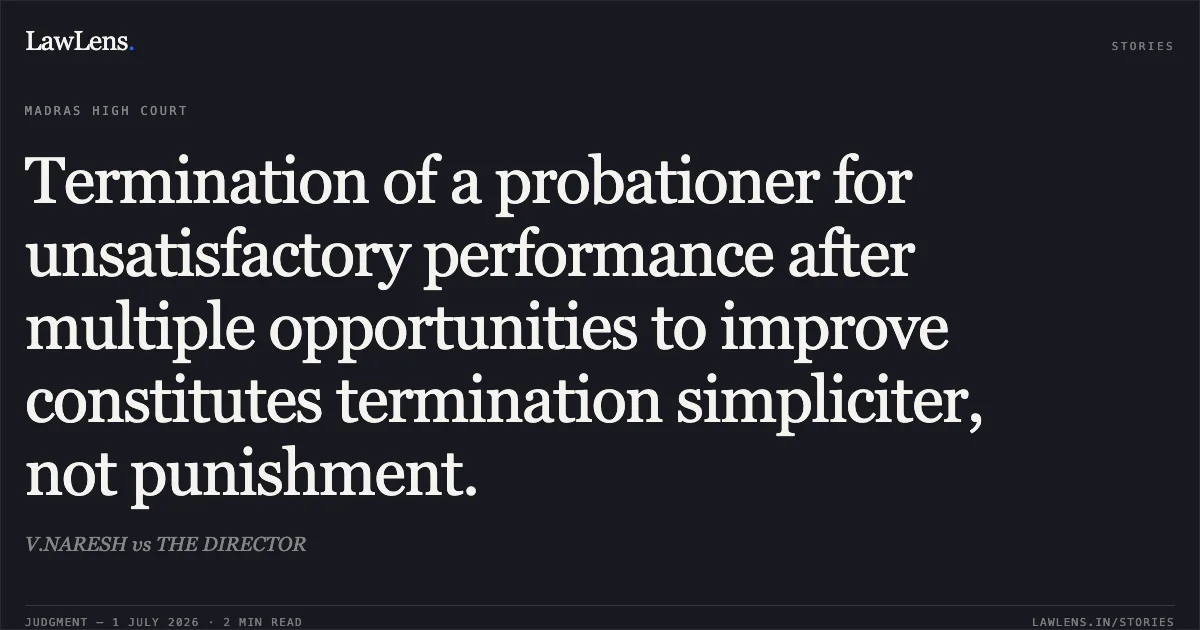
Source reference: p. 32. Whether the termination of a probationer for unsatisfactory performance constitutes a 'punitive' or 'stigmatic' action requiring a formal inquiry.
Source reference: p. 6Law Applied
The Court applied the principle of 'termination simpliciter' regarding probationary employment.
Source reference: no citationClause 13(1) of the appointment letter, which permits termination during probation "at any time without notice and without assigning any reasons".
Source reference: p. 4The precedent established by the Hon’ble Supreme Court in Ajit Singh v. State of Punjab (1983) 2 SCC 21, which holds that termination due to a probationer's unsatisfactory performance is not ipso facto 'stigmatic' or 'punitive'.
Source reference: p. 6The rule dictates that an employer is obligated to assess a probationer’s suitability, and if found unfit, may terminate the service without it being deemed a penalty.
Source reference: p. 7Reasoning
The Court rejected the petitioner’s argument that a one-month notice was mandatory, pointing out that Clause 13(1) of the specific appointment order explicitly allowed for termination without notice during the probationary period.
Source reference: p. 4The Court observed that the respondents had provided the petitioner with ample opportunity to improve by extending his probation twice and issuing warnings regarding specific shortcomings, such as non-completion of service verifications and discourteous behavior.
Source reference: p. 5By applying the Ajit Singh doctrine, the Court reasoned that since the termination was based on a subjective assessment of the petitioner's performance during his trial period, it remained a 'termination simpliciter'.
Source reference: p. 6-7The Court found that the authorities followed due procedure as per the contract of service, and the lack of improvement by the petitioner justified the invocation of the termination clause.
Source reference: p. 5-6Holding
The Court held that there was no infirmity in the order passed by the Central Administrative Tribunal.
It concluded that the termination was valid as it was performed in accordance with the terms of the appointment and established legal principles governing probationers.
Source reference: p. 6The High Court dismissed the Writ Petition and all connected miscellaneous petitions, denying the relief of reinstatement or continuity of service.
Source reference: p. 7-8Original Court PDF
V.NARESHvsTHE DIRECTOR
Click to open original judgment
Original judgment, available to read, download and summarize on LawLens.in