01Facts
The Petitioner joined the Delhi Pollution Control Committee (“DPCC”) as a Junior Environmental Engineer on 6 December 2021, on probation for two years.
¶ 1Before completion of probation, DPCC terminated his services on 10 March 2023 under Rule 5(1) of the Central Civil Services (Temporary Service) Rules, 1965, by granting one month’s pay and allowances in lieu of notice.
¶ 1The termination order did not disclose any reason or allegation of misconduct.
¶ 1The Petitioner’s departmental appeal, filed on 9 May 2023, was rejected on 13 September 2024, following which he approached the High Court.
¶ 2The record contained several show-cause notices alleging threats, intimidation, altercations, misconduct, insubordination and failure to perform official duties.
¶ 23–28DPCC asserted that the complaints were verifiable or supported by evidence and that the Petitioner’s explanations were unsatisfactory.
¶ 23–2802Issues
i.Whether the termination of the Petitioner during probation, though innocuous in form, was punitive in substance because it was founded on alleged misconduct and insubordination without a disciplinary inquiry.
¶ 5–6, 21–22ii.Whether DPCC could rely on Rule 5(1) of the Central Civil Services (Temporary Service) Rules, 1965, or the termination clause in the appointment memorandum, to terminate the Petitioner when the action was substantively based on misconduct.
¶ 39–40iii.Whether the Petitioner was entitled to reinstatement, continuity of service and back wages.
¶ 43–4703Law Applied
A probationer has no indefeasible right to continue in service merely because the probationary period has not expired, and an employer may ordinarily discontinue a probationer on the basis of an overall assessment of suitability under a termination-simpliciter clause.
¶ 4–5However, the employer cannot use such a clause to impose punishment for misconduct without complying with the applicable disciplinary procedure.
¶ 5, 21The distinction between motive and foundation is decisive: complaints may constitute the motive for assessing suitability where the employer leaves the allegations unresolved, but misconduct becomes the foundation of termination where the employer examines the allegations, rejects the employee’s explanation, treats the misconduct as established and terminates the employee on that basis.
¶ 8–13The Court relied on Anoop Jaiswal v. Government of India, (1984) 2 SCC 369; A.P. State Federation of Cooperative Spinning Mills Ltd. v. P.V. Swaminathan, (2001) 10 SCC 83; State Bank of India v. Palak Modi, (2013) 3 SCC 607; Governing Council of Kidwai Memorial Institute of Oncology v. Dr. Pandurang Godwalkar, (1992) 4 SCC 719; State of Punjab v. Sukhwinder Singh, (2005) 5 SCC 569; Government of NCT of Delhi v. Dalbir Singh, W.P.(C) 6596/2023, decided on 6 September 2023; and New Delhi Municipal Council v. Rahul Kumar, 2026:DHC:6505-DB.
¶ 14–20, 35–37Rule 5(1) and the contractual power to terminate during probation cannot authorise punitive termination for misconduct without due process.
¶ 4004Reasoning
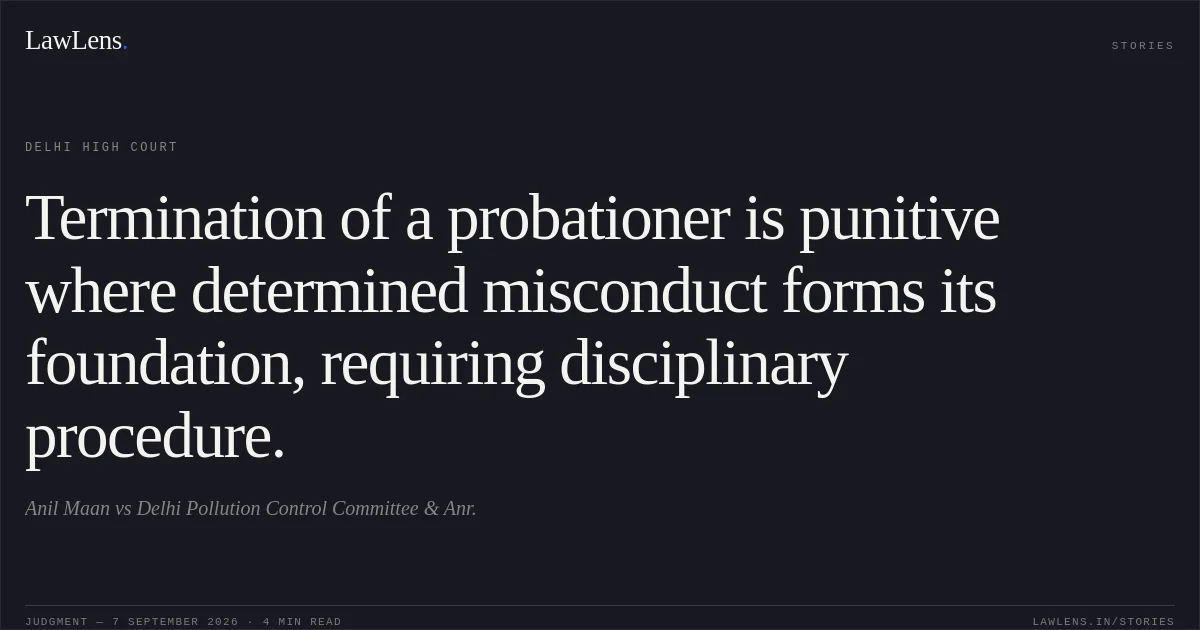
The Court held that the termination order, viewed alone, was non-stigmatic, but its legal character had to be determined from the material forming the basis of the decision.
¶ 22–23The show-cause notices went beyond recording complaints: they described the Petitioner’s conduct as “gross misconduct” and “wilful insubordination,” and threatened disciplinary action.
¶ 24–25DPCC’s counter-affidavit stated that the complaints were verifiable or supported by evidence, that the Petitioner’s replies lacked merit or were unsatisfactory, and that his conduct constituted misconduct under the CCS (Conduct) Rules.
¶ 27–28DPCC also stated that “in view of” those facts, the Petitioner’s services were terminated.
¶ 28The Court found no independent probation report or contemporaneous performance assessment supporting DPCC’s asserted overall suitability assessment; the material relied upon predominantly concerned specific acts characterised as misconduct.
¶ 30Consequently, the allegations were not merely the motive for a decision not to continue the Petitioner, but constituted the substantive foundation of the termination.
¶ 31–34Since DPCC had effectively acted upon a finding of misconduct without conducting the requisite disciplinary inquiry, the termination was punitive and legally unsustainable.
¶ 31–34The Court clarified that the mere issuance of show-cause notices or consideration of complaints would not automatically make a termination punitive; the decisive factor was DPCC’s treatment of the allegations as established misconduct.
¶ 16–2105Holding
The High Court allowed the writ petition and set aside the termination order dated 10 March 2023 and the appellate order dated 13 September 2024.
¶ 43DPCC was directed to reinstate the Petitioner within four weeks.
¶ 44Reinstatement did not amount to confirmation, and his status and further continuation were left subject to the applicable rules and lawful orders.
¶ 44The Court declined back wages because there was no material showing that the Petitioner remained without gainful employment and because the allegations had not been adjudicated.
¶ 47The Petitioner was, however, granted continuity of service for other service purposes.
¶ 47DPCC remained at liberty to initiate disciplinary proceedings regarding the allegations in accordance with law, without the judgment prejudicing either party.
¶ 46Original Court PDF
Anil MaanvsDelhi Pollution Control Committee & Anr.
Click to open original judgment
Original judgment, available to read, download and summarize on LawLens.in