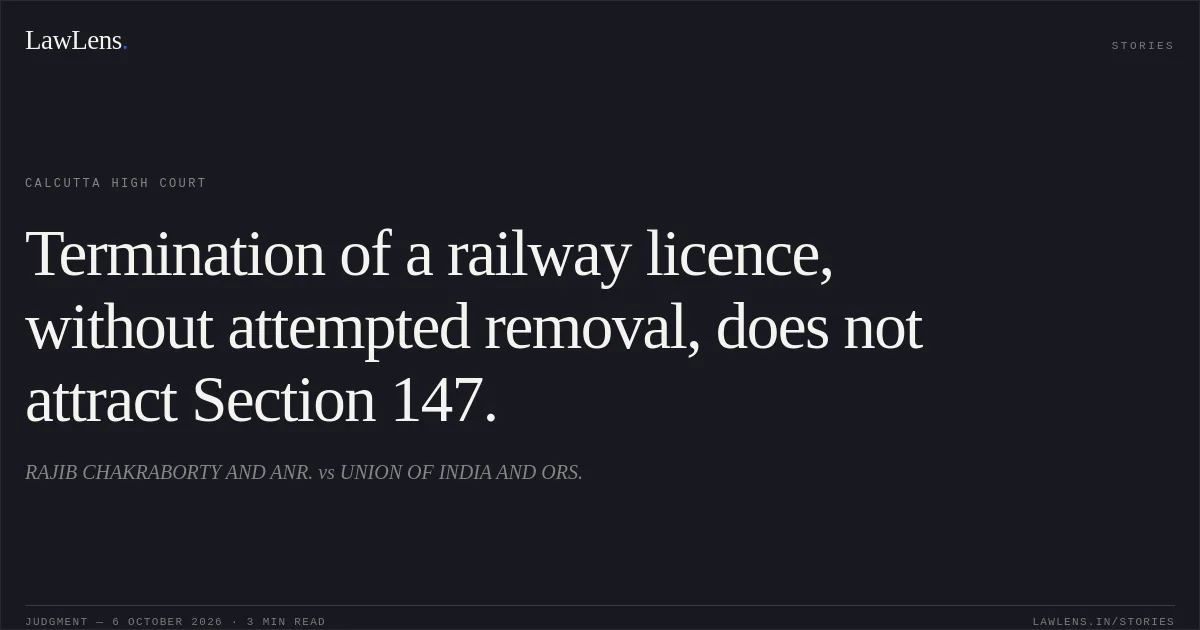
Facts
The Railway authorities issued a notice dated 21 July 2026 terminating the licence of petitioner no. 3 over a 1,000 sq. ft. plot at BZN Railway Station and directing him to vacate and deliver possession.
Source reference: p.1; pp. 7–8The petitioners contended that petitioner no. 3’s licence, originally granted in 1973 for three years, had continued through the Railway’s acceptance of licence fees; petitioners nos. 1 and 2 also claimed settled possession of separate plots under licences granted to their predecessors-in-interest.
Source reference: pp. 2–4, 10They challenged the notice, relying on decisions concerning the use of Section 147 of the Railways Act, 1989 to remove occupants from railway property.
Source reference: pp. 4–6The Railway objected that petitioners nos. 1 and 2 lacked standing because the notice was addressed only to petitioner no. 3, and argued that the notice validly terminated his licence.
Source reference: pp. 7–9Issues
1. Whether petitioners nos. 1 and 2 could maintain the petition challenging a termination notice addressed only to petitioner no. 3.
Source reference: pp. 8–92. Whether the notice terminating petitioner no. 3’s licence was unlawful because the Railway had not initiated eviction proceedings under the relevant public-premises or public-land legislation, or under Section 147 of the Railways Act, 1989.
Source reference: pp. 10–13Law Applied
Section 147 of the Railways Act, 1989 provides for punishment of a person who trespasses on railway property, misuses it, or refuses to leave, and permits removal by a railway servant or a person called to that servant’s aid.
Source reference: pp. 11–12The Court treated termination of a licence as distinct from removal under Section 147: a licensor may terminate a licence, while the notice at issue did not itself invoke Section 147 or effect an unlawful removal.
Source reference: pp. 10–13The Court considered *G. Phalaguna & Ors. v. General Manager & Ors.*, *M/s. South Bengal Automobiles v. Union of India & Ors.*, and *Sipra Maity & Ors. v. General Manager, South Eastern Railway & Ors.*, but held that their treatment of Section 147 did not apply to the facts before it.
Source reference: pp. 4–6, 12–13It also distinguished the Railway’s cited decisions, including *Subodh Pramanik*, *Motiur Rahaman Khan*, and *Jayadul Islam Khan*.
Source reference: pp. 8–9, 12–13Reasoning
Petitioners nos. 1 and 2 held, on their own case, separate licences from that of petitioner no. 3, and the impugned notice was directed only to petitioner no. 3; the Court therefore found no common cause of action and held that petitioners nos. 1 and 2 were not prejudiced by that notice.
Source reference: pp. 8–10As to petitioner no. 3, the Court accepted that the Railway had continued to accept licence fees after the original three-year term, but concluded that the Railway could nevertheless terminate the licence.
Source reference: p. 10Because the notice terminated the licence and directed petitioner no. 3 to vacate, but did not invoke Section 147 or itself remove him from possession, the Court found the cited Section 147 decisions inapplicable and detected no illegality in the notice.
Source reference: pp. 10–13Holding
The Court dismissed the petition as against petitioners nos. 1 and 2 for want of maintainability, holding that the notice was not addressed to them and that they had no joined cause of action with petitioner no. 3.
It dismissed the petition on the merits as to petitioner no. 3, finding no illegality in the licence-termination notice.
Source reference: pp. 13–14There was no order as to costs.
Source reference: p. 14Acts & Sections Cited
1 provisions across 1 statute referred to in this judgment. Each provision opens on LawLens.
Railways Act, 19891
Original Court PDF
RAJIB CHAKRABORTY AND ANR.vsUNION OF INDIA AND ORS.
Click to open original judgment
Original judgment, available to read, download and summarize on LawLens.in
![HRA parity claims must be assessed against similarly situated employees, with reasoned orders where parity is denied.. Shaphaba Thokchom vs DY. COMPTROLLER AND AUDITOR GENERAL OF INDIA. CAT - ['Guwahati']. LawLens](/stories/thumbnails/hra-parity-claims-must-be-assessed-against-similarly-situated-employees-with-reasoned-orde-a9c45995b0704be18e4bcf7b91c8e507.webp)
![Article 311(2)(c) dismissal is valid where relevant material shows an inquiry would endanger security sources.. Mohd Rafi vs GENERAL ADMINITRATIVE DEPARTMENT. CAT - ['Jammu']. LawLens](/stories/thumbnails/article-311-2-c-dismissal-is-valid-where-relevant-material-shows-an-inquiry-would-endanger-58dabaa9372a4b41bd304e91e9ebe890.webp)