Facts
Poonam Devi was appointed by Kirori Mal College on an ad hoc and temporary basis, initially as a Junior Assistant from 19 September 1989, thereafter as a Lower Division Clerk, and subsequently as a Junior Laboratory Attendant.
Source reference: paras. 2, 8–9, 21–22Her successive appointments were temporary and were extended pending regular recruitment; one appointment expressly provided that it would continue for three months or until the post was filled regularly, whichever was earlier.
Source reference: paras. 2, 8–9, 21–22She participated in the regular selection process for the post but was unsuccessful.
Source reference: paras. 2, 9, 21After a regularly selected candidate was appointed, her services were discontinued with effect from 1 June 1992.
Source reference: paras. 2, 9, 21The Labour Court held that her termination violated Section 25F of the Industrial Disputes Act, 1947 (“ID Act”), and directed reinstatement with full back wages and continuity of service.
Source reference: paras. 3–4The College challenged the award under Articles 226 and 227 of the Constitution.
Source reference: para. 5Issues
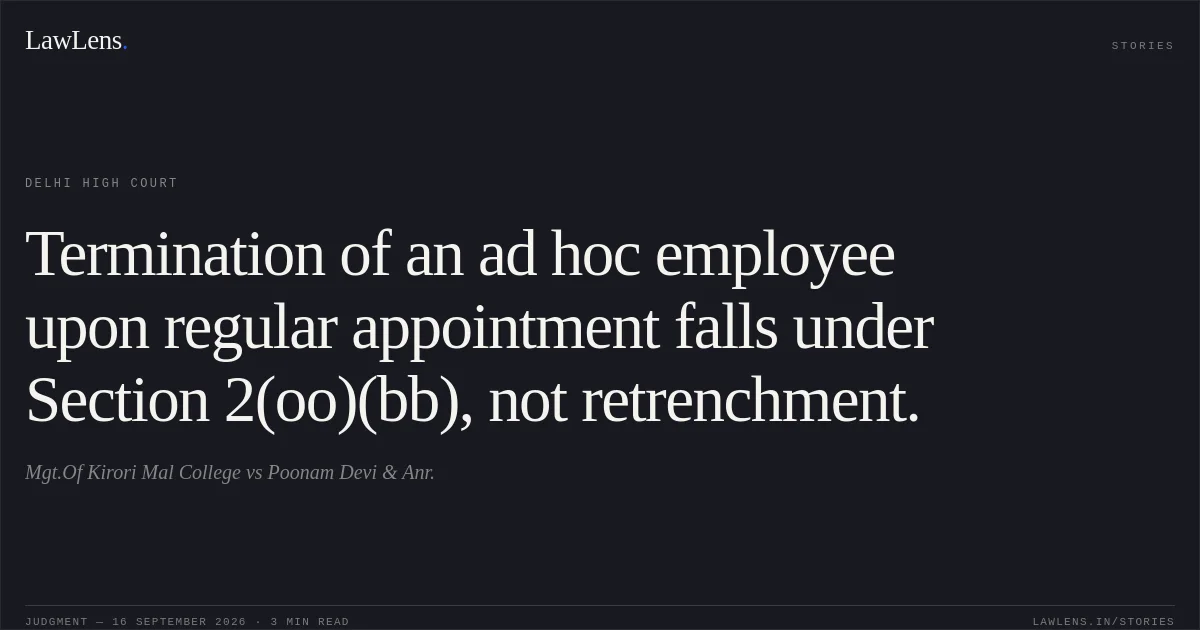
Whether the termination of Poonam Devi’s temporary/ad hoc employment upon appointment of a regularly selected candidate amounted to “retrenchment” under Section 2(oo) of the ID Act, or was excluded under Section 2(oo)(bb).
Source reference: paras. 18–23Whether completion of 240 days of service, by itself, entitled her to protection under Section 25F of the ID Act.
Source reference: paras. 26, 29–30Whether the Labour Court’s award warranted interference in the High Court’s writ jurisdiction.
Source reference: paras. 17, 30–31Law Applied
Section 2(oo) of the ID Act defines “retrenchment,” while Section 2(oo)(bb) excludes termination resulting from non-renewal or termination of a fixed-term contract in accordance with a stipulation contained therein.
Source reference: para. 19Section 25F applies only where the termination constitutes retrenchment; completion of 240 days does not independently attract Section 25F where the termination falls within Section 2(oo)(bb).
Source reference: paras. 29–30Under S.M. Nilajkar v. Telecom District Manager, termination of a worker engaged for a temporary project or specific period may fall within Section 2(oo)(bb) where the contractual terms so provide, the work or period has ended consistently with those terms, and the worker was made aware of the arrangement.
Source reference: para. 20The Court also relied on Ramjas College v. Presiding Officer, holding that termination of an ad hoc employee upon completion of regular recruitment is covered by Section 2(oo)(bb), notwithstanding completion of 240 days.
Source reference: para. 24In writ jurisdiction, factual findings of a Labour Court are ordinarily not disturbed unless they are perverse, based on no evidence, legally erroneous, or disclose jurisdictional error.
Source reference: para. 17Reasoning
The Court found that Devi’s engagement was consistently temporary and ad hoc, had been extended pending regular recruitment, and was never a regular appointment against the post.
Source reference: paras. 21–22, 25Her participation in the regular selection process, followed by the appointment of a successful regular candidate, demonstrated that the temporary arrangement ended when the post was filled through the prescribed process.
Source reference: paras. 22, 25, 27The Court held that the last appointment letter’s expression “till further orders” could not be read in isolation; the entire course of engagement and the surrounding circumstances showed that her employment was co-terminus with regular recruitment.
Source reference: para. 27The continued performance of similar work by other employees did not defeat Section 2(oo)(bb), because the relevant event was not cessation of the work but the appointment of a regular employee to the post for which Devi had been temporarily engaged.
Source reference: para. 28The Labour Court therefore erred by treating completion of 240 days as automatically attracting Section 25F without first determining whether the termination was retrenchment.
Source reference: paras. 26, 30Holding
The High Court held that Devi’s termination upon appointment of a regularly selected candidate fell within the exclusion under Section 2(oo)(bb) of the ID Act and did not amount to retrenchment.
Consequently, Section 25F was not attracted, notwithstanding her completion of more than 240 days of service.
Source reference: paras. 29–30The Labour Court’s award directing reinstatement with full back wages and continuity of service was set aside, and the writ petition was allowed.
Source reference: para. 31Acts & Sections Cited
4 provisions across 1 statute referred to in this judgment. Linked provisions open on LawLens.
Industrial Disputes Act, 19474
Original Court PDF
Mgt.Of Kirori Mal CollegevsPoonam Devi & Anr.
Click to open original judgment
Original judgment, available to read, download and summarize on LawLens.in