Facts
The Respondent was appointed as a Special Survey Amin on a contractual basis on 31.03.2020, with his contract subsequently extended until 31.03.2024
Source reference: para. 4Following a call for protest by an employees' association, the Appellants issued a show-cause notice to the Respondent and 500 other similarly situated employees on 18.01.2023, alleging obstruction of government work
Source reference: para. 4 & 4(a)Despite the Respondent providing a response within 24 hours, his contract was terminated on 19.01.2023 under Rule 8(4) of the 2019 Rules, while the other 500 employees remained in service
Source reference: para. 4(a) & 5The Writ Court quashed the termination, finding it stigmatic and arbitrary, and ordered reinstatement
Source reference: para. 7-7(a)Issues
1. Whether the termination order passed against the Respondent was stigmatic in nature, requiring a full-fledged departmental inquiry
Source reference: para. 112. Whether the Appellants acted arbitrarily and in violation of Article 14 of the Constitution by singling out the Respondent while retaining 500 similarly situated employees
Source reference: para. 13Law Applied
The court primarily applied Rule 8(4) of the "Bihar Special Survey Honorarium Based Contractual Employment Rules, 2019," which permits termination based on adverse reports after a hearing
Source reference: para. 8It relied on the principle that even a contractual employee is entitled to a full departmental inquiry if the termination order is "stigmatic"
Source reference: para. 7(a)The court also invoked the constitutional principles of equality and non-arbitrariness under Articles 14 and 16, referencing precedents such as Dr. Vijaykumaran CPV v. Central University of Kerala regarding the necessity of inquiry for stigmatic orders
Source reference: para. 7Reasoning
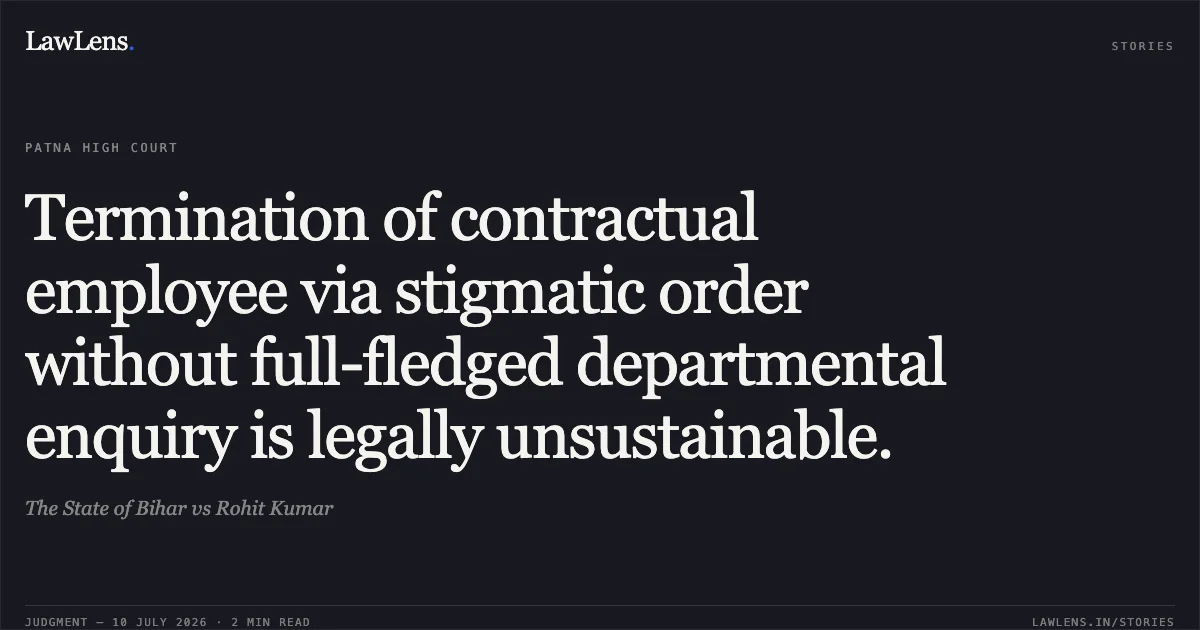
The Court observed that the termination order specifically accused the Respondent of "arbitrariness," "defiance of orders," and "provoking others," which constitutes a stigmatic dismissal rather than a simple termination of contract
Source reference: para. 11-12The Court found that by not conducting a formal inquiry to prove these specific aspersions, the Appellants violated the principles of natural justice
Source reference: para. 12Furthermore, the Court noted a clear case of discrimination; while 500 employees faced identical charges and provided identical responses, only the Respondent’s services were truncated, whereas the others were allowed to complete their contractual term
Source reference: para. 13This disparate treatment was held to be a violation of the guarantee of equality
Source reference: para. 13-14Holding
The Court upheld the Writ Court's finding that the termination was illegal and arbitrary
However, noting that the original contract period expired on 31.03.2024, the Court modified the relief: the order for reinstatement was set aside as the contract no longer survived. Instead, the Appellants were directed to pay the Respondent his wages for the remaining contract period (from 19.03.2023 to 31.03.2024) without interest
Source reference: para. 15The Letters Patent Appeal was dismissed with the aforementioned modifications
Source reference: para. 16Original Court PDF
The State of BiharvsRohit Kumar
Click to open original judgment
Original judgment, available to read, download and summarize on LawLens.in