Facts
The plaintiff-temple sought recovery of possession and a permanent injunction regarding a vacant site in Kancheepuram. The temple claimed the land was a ‘minor Inam’ granted to it
Source reference: p. 6, para 3.1In 1941, the temple executed a Cawl (lease) deed in favor of K.K. Venkatrama Iyer, which was subsequently transferred multiple times
Source reference: p. 7The first defendant (Appellant) purchased the property in 2009 via sale deeds (Ex-B.6 and Ex-B.7) from the legal heirs of the last Cawl transferee, who had claimed absolute ownership
Source reference: p. 7-8, para 3.3The defendant argued that under the Tamil Nadu Minor Inams (Abolition and Conversion into Ryotwari) Act, 1963, the temple lost title and his predecessors were granted Ryotwari patta
Source reference: p. 9-10The Trial Court decreed the suit in favor of the temple, holding it to be the absolute owner
Source reference: p. 12Issues
1. Whether the plaintiff-temple is the owner of the suit land and whether the sale deeds in favor of the first defendant are binding on the temple
Source reference: p. 20, para 192. Whether the patta issued under Section 13 of the Tamil Nadu Act No. 30 of 1963 conferred title on the defendant
Source reference: p. 20, para 193. Whether the suit for recovery of possession was maintainable without the termination of the lease under Section 106 of the Transfer of Property Act, 1882
Source reference: p. 28, para 25Law Applied
The Court applied the principles of Section 116 of the Indian Evidence Act, 1872 regarding estoppel of a tenant from denying the landlord's title
Source reference: p. 27, para 24Section 13 of the Tamil Nadu Minor Inams Abolition Act, 1963, which governs the vesting of buildings in the occupant
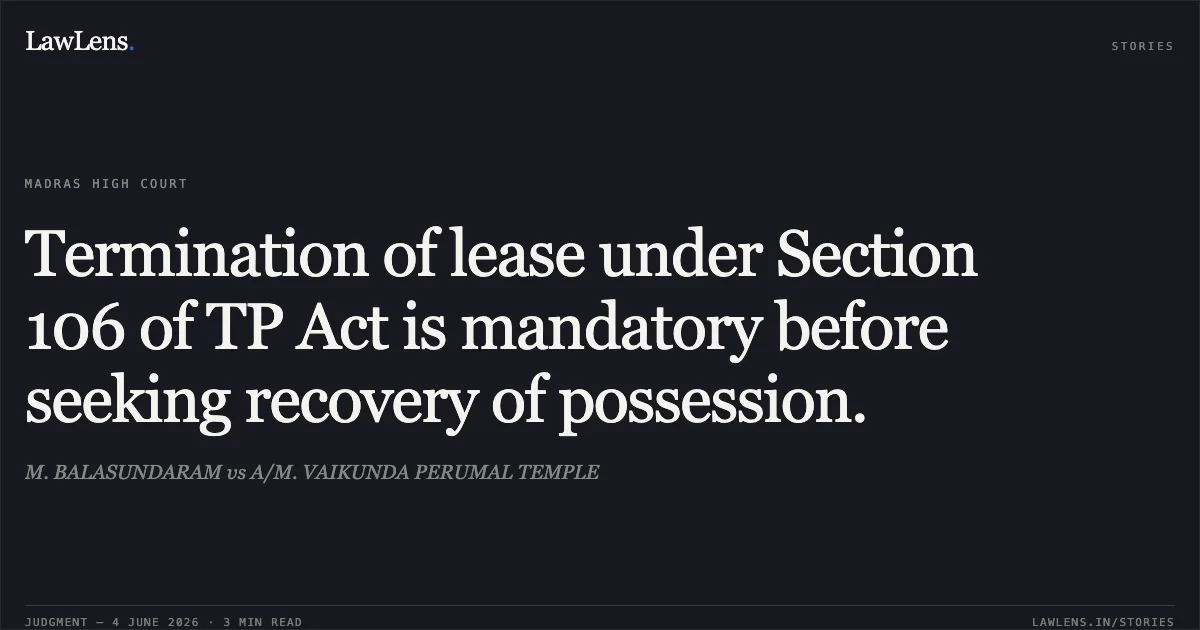
Source reference: p. 16Section 106 of the Transfer of Property Act, 1882, which mandates the formal termination of a lease before seeking recovery of possession from a lessee
Source reference: p. 28, para 25the Inam Fair Register as a primary document of title for religious institutions
Source reference: p. 21, para 20Reasoning
The Court found that the Inam Fair Register (Ex-A.8) clearly established the land as "Devadayam" (temple land)
Source reference: p. 21Since the first defendant derived his claim through a chain of Cawl (lease) transfers originating from the temple's 1941 deed, he was legally a tenant/lessee and was estopped under Section 116 of the Evidence Act from denying the temple's title
Source reference: p. 27The Court held that the sale deeds (Ex-B.6 and B.7) were invalid as they purported to transfer absolute title when the vendors only held leasehold rights
Source reference: p. 27The Court observed that because the temple admitted the existence of a Cawl (lease) and the defendant was a transferee of those rights, the relationship of landlord and tenant persisted. Therefore, the suit for recovery of possession was premature and legally unsustainable because the temple failed to issue a notice to terminate the lease under Section 106 of the Transfer of Property Act
Source reference: p. 28, para 25Holding
The Court held that while the temple proved its ownership of the land as against the defendant, it was not entitled to immediate recovery of possession or an injunction without first terminating the lease
The High Court set aside the Trial Court's Judgment and Decree, allowing the Appeal Suit. The Court granted leave to the plaintiff-temple to file a fresh suit for declaration, recovery of possession, and permanent injunction after duly terminating the lease in accordance with Section 106 of the Transfer of Property Act, 1882
Source reference: p. 29, para 27(iii)Acts & Sections Cited
3 provisions across 2 statutes referred to in this judgment. Each provision opens on LawLens.
Code of Civil Procedure, 19082
Transfer of Property Act, 18821
Original Court PDF
M. BALASUNDARAMvsA/M. VAIKUNDA PERUMAL TEMPLE
Click to open original judgment
Original judgment, available to read, download and summarize on LawLens.in


