01Facts
The petitioner, Kailash Kumar Ahirwar, was appointed as a Samvida Shala Shikshak (Contract Teacher).
On 26/09/2006, Respondent No. 4 issued an order cancelling the petitioner’s appointment and terminating his services.
p. 1The petitioner challenged this termination on the grounds that it was passed without providing an opportunity for a hearing, thereby violating the principles of natural justice.
¶ 2An interim order was granted on 01.12.2006, allowing the petitioner to remain in service throughout the pendency of the litigation.
¶ 2The State argued that the appointment was contrary to the Madhya Pradesh Panchayat Samvida Shala Shikshak (Employment and Conditions of Contract) Rules, 2005, but admitted that no prior notice or hearing was provided before termination.
¶ 202Issues
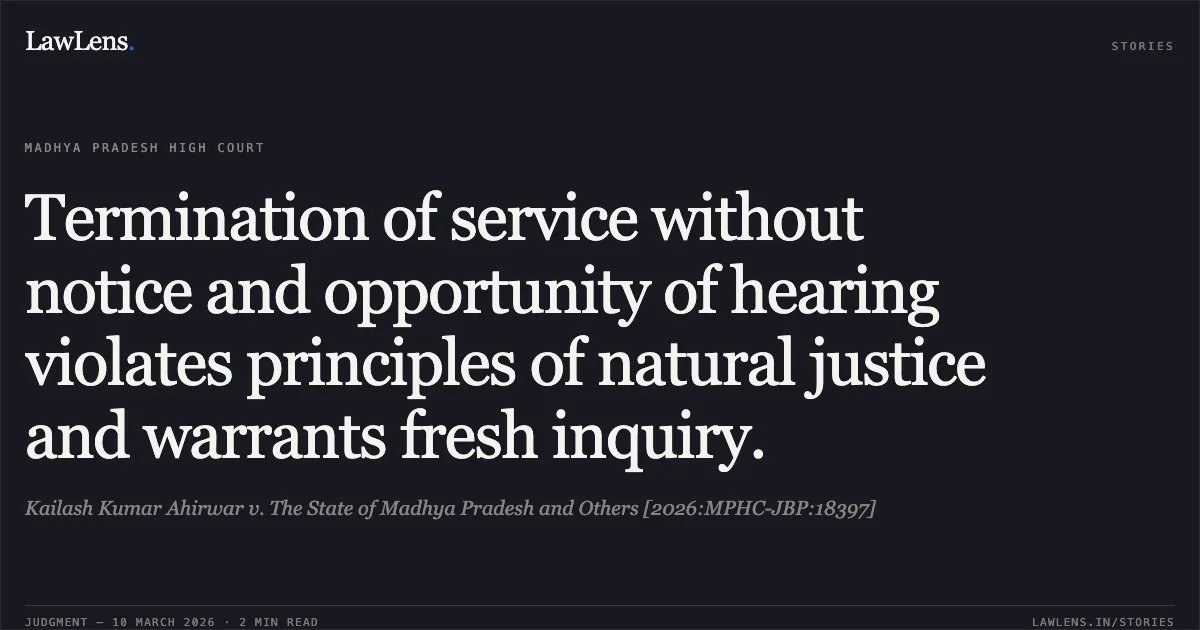
i.Whether the termination of the petitioner’s services without prior notice or an opportunity of hearing violates the principles of natural justice.
¶ 2ii.Whether the dispute regarding the legality of the petitioner’s appointment should be remanded to the Collector for fresh adjudication.
¶ 2, 503Law Applied
The Court applied the fundamental principles of natural justice, specifically the right to be heard (*audi alteram partem*), which requires that no person should be condemned or deprived of a right (such as employment) without a fair opportunity to defend themselves.
¶ 2The Court also relied on the Madhya Pradesh Panchayat Samvida Shala Shikshak (Employment and Conditions of Contract) Rules, 2005.
¶ 2The Court followed the precedents established in *Surendra Prasad Pathak v. State of M.P.* (W.P. No. 15600/2006) and *Rajendra Yadav v. State of M.P.* (W.P. No. 14829/2006), which mandated departmental inquiry and speaking orders in similar termination cases.
¶ 2, 704Reasoning
The Court observed that the respondents did not dispute the fact that the petitioner was terminated without any notice or hearing.
¶ 2While the State contended that the petitioner’s selection was non-compliant with the 2005 Rules, the Court held that such an allegation did not exempt the authorities from following due process.
¶ 2Following the reasoning in identical cases decided by Co-ordinate Benches, the Court determined that the merits of the appointment's legality should not be decided by the High Court in the first instance.
¶ 2Instead, the matter required an inquiry by the Collector to identify specific irregularities after giving the petitioner a chance to file objections.
¶ 2Because the petitioner had been working for nearly two decades under the protection of an interim stay, the Court emphasized that his continuation in service should be maintained until the fresh inquiry is concluded.
¶ 805Holding
The Court allowed and disposed of the writ petition by setting aside the impugned order in terms of the precedents cited.
¶ 7, 9The Court directed the Collector to conduct an inquiry into the petitioner’s appointment, issue a show-cause notice pointing out specific irregularities, and pass a speaking order after hearing all concerned parties within three months.
¶ 2The Court held that the interim order staying the termination shall remain in operation until the Collector makes a final decision, and the petitioner shall continue to work during this period.
¶ 8Original Court PDF
Kailash Kumar Ahirwar v. The State of Madhya Pradesh and Others [2026:MPHC-JBP:18397]
Click to open original judgment
Original judgment, available to read, download and summarize on LawLens.in