Facts
The respondent-workman was appointed as a daily wager (sweeper) in 1986 and was later granted fixed pay as a permanent employee after five years.
Source reference: p. 2The State alleged the workman abandoned his service in 1993 and failed to report for duty despite notices.
Source reference: p. 2The workman contended he suffered from tuberculosis and a brain injury, necessitating intermittent and long leaves, for which he submitted medical reports in 2004 and requested medical leave without pay from 1996 to 2004.
Source reference: p. 2-3The Labour Court found the termination was not preceded by an inquiry and directed reinstatement with continuity of service but denied back wages.
Source reference: p. 2-3The State challenged this before a learned Single Judge, who dismissed the writ petition and affirmed the award.
Source reference: p. 1-2Issues
1. Whether the workman’s absence from duty constituted "abandonment of service" or was justified by medical grounds
Source reference: p. 3 / para. 92. Whether the termination of the workman without an inquiry was valid, given his status as a permanent employee
Source reference: p. 3 / para. 63. Whether the State could characterize the termination as being on the ground of "continued ill-health" under Section 2(oo)(c) of the Industrial Disputes Act
Source reference: p. 4 / para. 10Law Applied
Principles of the Industrial Disputes Act, 1947, particularly Section 2(oo)(c) regarding retrenchment exceptions for continued ill-health.
Source reference: p. 4Requirement of holding a formal inquiry before terminating a permanent employee for unauthorized absence.
Source reference: p. 3Section 17B, which mandates the payment of last drawn wages to a workman during the pendency of proceedings in higher courts.
Source reference: p. 4Reasoning
The Court observed that the workman’s medical evidence regarding tuberculosis and brain injury was credible and remained unchallenged during cross-examination.
Source reference: p. 3Because the workman had sought medical leave and his health issues were proven, the State’s plea of voluntary "abandonment" was legally unsustainable.
Source reference: p. 3-4The Court further noted that since the workman was a permanent employee, he could not be terminated by mere letters calling him to duty; an inquiry was a prerequisite for a valid termination.
Source reference: p. 3Regarding Section 2(oo)(c), the Court held that the State failed to establish that the workman’s ill-health permanently affected the discharge of his duties to justify termination under that clause.
Source reference: p. 4The Court noted that the workman, now aged 66, had already been receiving Section 17B benefits since 2015, making further litigation superfluous.
Source reference: p. 4-5Holding
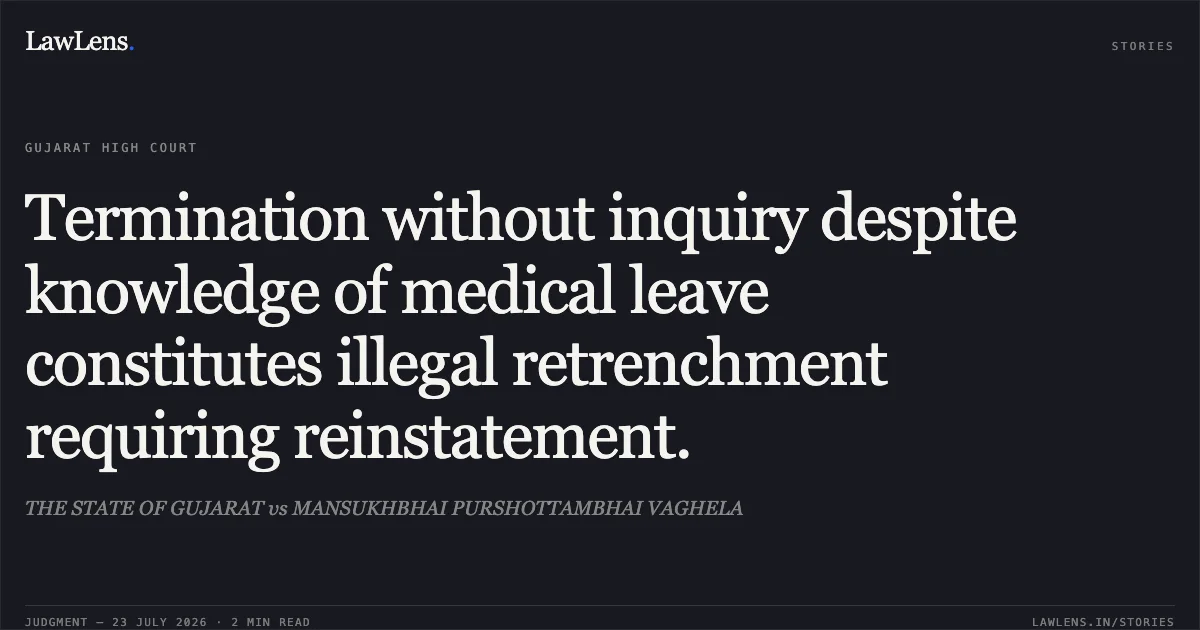
The Court dismissed the appeal, affirming the judgment of the learned Single Judge and the Labour Court’s award of reinstatement with continuity of service.
The Court held that the findings of fact regarding the workman’s illness and the lack of a proper termination inquiry barred the State from denying him employment.
Source reference: p. 4All pending applications were consigned to records, and the State’s oral request for a stay on the judgment was rejected.
Source reference: p. 5Acts & Sections Cited
2 provisions across 1 statute referred to in this judgment. Linked provisions open on LawLens.
Industrial Disputes Act, 19472
Original Court PDF
THE STATE OF GUJARATvsMANSUKHBHAI PURSHOTTAMBHAI VAGHELA
Click to open original judgment
Original judgment, available to read, download and summarize on LawLens.in