Facts
The petitioner/husband challenged the order dated 03.01.2020 passed by the Principal Judge, Family Court, Mandla in MJCR No. 78/2018, whereby the respondent/wife was awarded monthly maintenance of ₹3,000 under Section 125 of the Code of Criminal Procedure, 1973 (“CrPC”).
Source reference: p.1; para.1The parties’ marriage was undisputedly solemnized on 07.05.2017, and the wife had been living separately since February 2018.
Source reference: p.1; para.2The husband contended that the parties resided in different villages falling within the Tehsils of Ghughari and Nainpur, and not within the territorial jurisdiction of the Family Court, Mandla.
Source reference: p.1; para.2He further argued that, after the enactment of the Gram Nyayalayas Act, 2008, the Gram Nyayalaya alone had jurisdiction over the Section 125 proceedings.
Source reference: pp.1–2; para.2During the revision, the Family Court reported that, under Section 126 CrPC, the case did not fall within its territorial jurisdiction because neither party resided within Tehsil Mandla or the relevant municipal area.
Source reference: p.3; para.5However, the husband had not raised any objection to territorial jurisdiction in his reply, during evidence, or before the Family Court passed the final order.
Source reference: p.3; para.7Issues
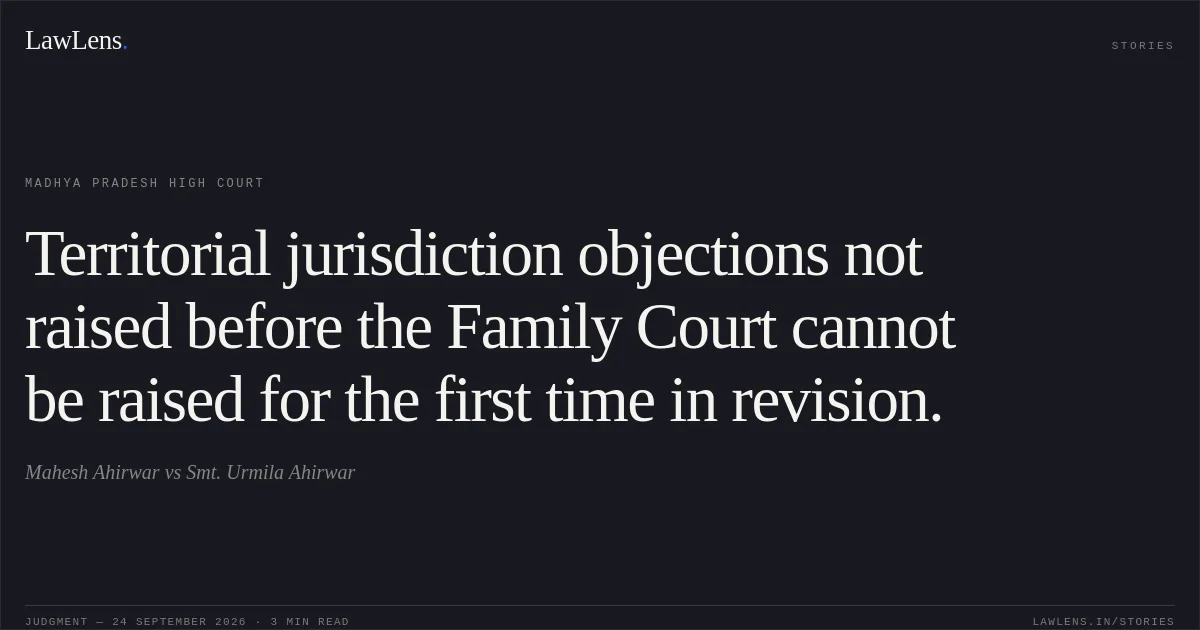
Whether the objection that the Family Court, Mandla lacked territorial jurisdiction under Section 126 CrPC could be raised for the first time in criminal revision after the petitioner had participated in the proceedings without objection.
Source reference: pp.3–5; paras.7–10Whether the alleged availability of jurisdiction before a Gram Nyayalaya under the Gram Nyayalayas Act, 2008 rendered the Family Court’s order granting maintenance under Section 125 CrPC a nullity.
Source reference: pp.1–3, 5; paras.2, 5–11Whether the award of ₹3,000 per month as maintenance suffered from any illegality warranting interference in revision.
Source reference: p.5; para.12Law Applied
The Court applied Section 125 CrPC, which provides a beneficial remedy for maintenance to a wife unable to maintain herself, and Section 126 CrPC concerning the territorial jurisdiction for proceedings under Section 125.
Source reference: no citationIt relied on Section 462 CrPC, under which an order is not to be set aside merely because proceedings were conducted in a wrong territorial jurisdiction unless such error has occasioned a failure of justice.
Source reference: no citationFollowing Ashok Kumar Tiwari v. Malti Bai, 1990 JLJ 134, the Court held that an objection to territorial jurisdiction cannot ordinarily be raised for the first time in revision where no foundation was laid before the trial court and no failure of justice is shown.
Source reference: p.4; para.8Relying on Praveen Bajpai v. Ku. Ayushi Bajpai, ILR 2019 MP 2594, it further held that participation in proceedings without objecting to territorial jurisdiction bars a belated challenge, particularly in proceedings under the beneficial provisions of Section 125 CrPC.
Source reference: p.4; para.9Reasoning
The Court accepted that the Family Court’s territorial jurisdiction was questionable in light of the parties’ places of residence and the report submitted by the Family Court.
Source reference: p.3; para.5Nevertheless, the petitioner had fully participated in the proceedings and had failed to object to jurisdiction in his reply, during evidence, or before the final order was passed.
Source reference: p.3; para.7Applying Ashok Kumar Tiwari and Praveen Bajpai, the Court treated the defect, if any, as a curable territorial irregularity rather than a jurisdictional nullity, since no failure of justice was demonstrated.
Source reference: pp.4–5; paras.8–10The Court also held that the authorities cited by the petitioner concerning jurisdiction and Gram Nyayalayas did not assist him in view of these binding coordinate-Bench decisions.
Source reference: p.5; para.11Independently, it found no illegality in the quantum of ₹3,000 per month after considering the husband’s income and financial status.
Source reference: p.5; para.12Holding
The Court held that the petitioner could not challenge the Family Court’s territorial jurisdiction for the first time in revision after participating in the proceedings without objection.
The alleged territorial defect did not invalidate the maintenance order, and the Gram Nyayalayas Act did not provide a basis for setting it aside in the circumstances of the case.
Source reference: pp.4–5; paras.10–11Finding no illegality either in the exercise of jurisdiction or in the award of ₹3,000 per month, the Court dismissed the criminal revision and disposed of any pending applications.
Source reference: p.5; paras.12–14Acts & Sections Cited
4 provisions across 1 statute referred to in this judgment. Each provision opens on LawLens.
Code of Criminal Procedure, 19734
Original Court PDF
Mahesh AhirwarvsSmt. Urmila Ahirwar
Click to open original judgment
Original judgment, available to read, download and summarize on LawLens.in