Facts
The Appellant (Complainant) filed a complaint under Section 138 of the Negotiable Instruments Act (NI Act) alleging that the 1st Respondent (Accused) issued a cheque (Ext.P1) for ₹3,00,000 to discharge a debt, which was subsequently dishonored for "funds insufficient".
Source reference: p. 3Despite a statutory notice, the Accused failed to pay.
Source reference: p. 3The Trial Court (JFCM-IV, Neyyattinkara) acquitted the Accused on June 15, 2007, holding that while the Accused had signed the cheque, the Complainant failed to prove the underlying transaction and that the transaction was "otherwise than what had been spoken".
Source reference: p. 6Issues
1. Whether the learned Magistrate erred in finding that the complainant failed to prove the transaction leading to the execution of Ext.P1 cheque?
Source reference: p. 5 / para. 82. Whether the acquittal of the Accused was justified given the evidence of PW1 and the legal presumptions available under the NI Act?
Source reference: p. 5 / para. 8Law Applied
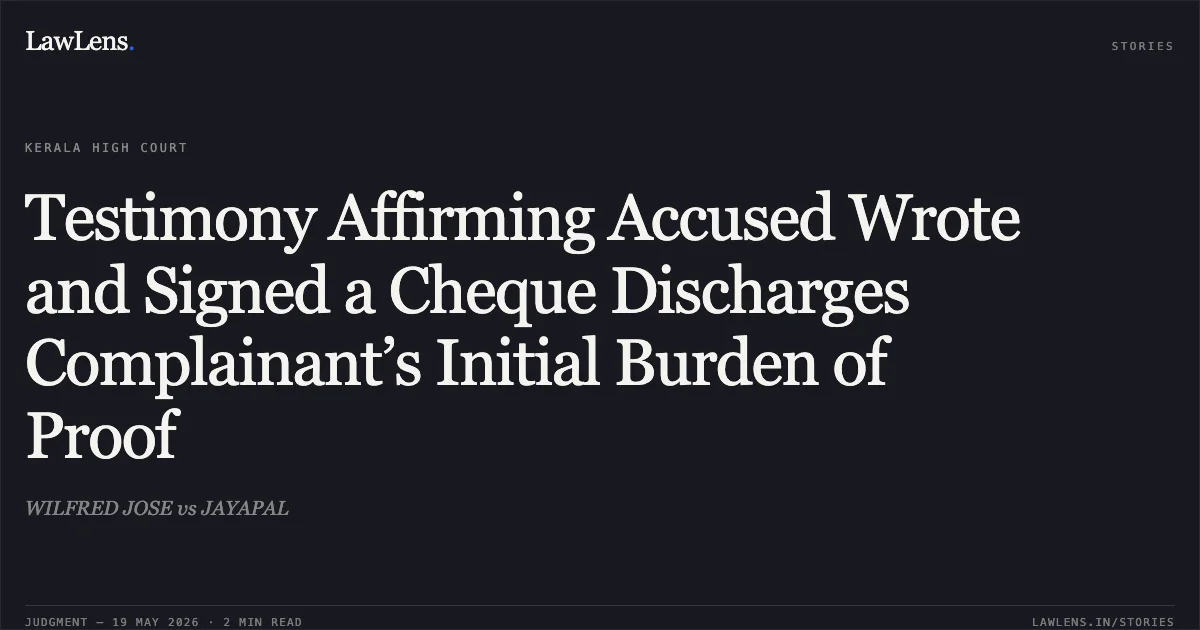
The court primarily applied Sections 118 and 139 of the Negotiable Instruments Act, 1881, which mandate a statutory presumption that a cheque is issued for consideration and in discharge of a legally enforceable debt once execution is proved.
Source reference: p. 11-12the initial burden on the complainant is discharged through substantive oral evidence regarding the execution of the cheque, which then shifts the onus to the accused to rebut the presumption through evidence or cross-examination.
Source reference: p. 9-12Reasoning
The High Court found the Trial Court’s reasoning "not digestible to prudence".
Source reference: p. 11The Magistrate had explicitly concluded that "the accused himself wrote the cheque and signed the same".
Source reference: p. 10The High Court reasoned that once the signature and writing are admitted or proved, the complainant has successfully discharged the initial burden, triggering the presumptions under Sections 118 and 139.
Source reference: p. 11The Accused failed to adduce any independent evidence, such as examining the witness 'Radhakrishnan' through whom he claimed the cheque reached the complainant, to rebut these presumptions.
Source reference: p. 10The Court also noted that the Complainant provided bank statements (Ext.P7-P10) showing he had secured a personal loan of ₹3,20,000 shortly before the transaction, establishing financial capacity.
Source reference: p. 8Holding
The High Court answered the issues in the affirmative for the Appellant, holding that the Magistrate took a "hyper-technical stand" and failed to correctly apply statutory presumptions.
The judgment of acquittal was set aside. The 1st Respondent was convicted under Section 138 of the NI Act and sentenced to simple imprisonment for one day (till rising of the court) and a fine of ₹4,50,000. Of this, ₹4,25,000 is to be paid as compensation to the Complainant, with a default sentence of six months' imprisonment.
Source reference: p. 12-13Acts & Sections Cited
4 provisions across 2 statutes referred to in this judgment. Each provision opens on LawLens.
Negotiable Instruments Act, 18813
Code of Criminal Procedure, 19731
Original Court PDF
WILFRED JOSEvsJAYAPAL
Click to open original judgment
Original judgment, available to read, download and summarize on LawLens.in