Facts
On May 21, 1999, at approximately 10:00 PM, a quarrel occurred near the Railway Staff Quarters, Lawrence Road, where Narender (deceased) and Simran (PW-2, injured witness) were allegedly attacked by brothers Paras Nath and Ramu.
Source reference: p. 2PW-2 claimed Paras stabbed him below the eye and inflicted fatal abdominal blows on Narender while Ramu held the victim.
Source reference: p. 2-3Narender succumbed to injuries the next day.
Source reference: p. 3The Trial Court convicted both under Sections 302/34 and 324/34 IPC, despite finding the recovery of the weapon doubtful.
Source reference: p. 3-4Paras Nath died during the pendency of the appeal, leaving Ramu as the sole appellant.
Source reference: p. 2Issues
1. Whether the testimony of the sole injured witness (PW-2) was of "sterling quality" sufficient to sustain a conviction despite material contradictions and improvements.
Source reference: p. 8-102. Whether the prosecution established "common intention" under Section 34 IPC against appellant Ramu for the acts of the deceased appellant Paras Nath.
Source reference: p. 53. Whether the recovery of the weapon and the arrest procedure were proved beyond reasonable doubt.
Source reference: p. 10-12Law Applied
The Court applied Section 302 (Murder), Section 324 (Voluntarily causing hurt by dangerous weapons), and Section 34 (Common Intention) of the IPC.
Source reference: p. 4It relied on the principle that while an injured witness’s testimony carries high evidentiary value (Abdul Sayeed v. State of M.P.), a "sterling witness" must be of high caliber and unassailable consistency (Rai Sandeep v. State (NCT of Delhi)).
Source reference: p. 8-9It further applied the principle that if two views are possible, the one favoring the accused must prevail in criminal jurisprudence.
Source reference: p. 15Reasoning
The Court found that PW-2’s testimony was not of "sterling quality" as it "bristled with serious inconsistencies" compared to his initial statement (Ex. PW-2/A), specifically regarding the sequence of events and the specific role of Ramu.
Source reference: p. 8PW-2 turned hostile regarding the arrest of the accused and the recovery of the weapon, contradicting the police version that he was present during the apprehension.
Source reference: p. 10-12PW-2’s ocular evidence regarding the location of the injuries (private parts) was directly contradicted by the post-mortem report, which found no such injuries.
Source reference: p. 12-14Given the admitted prior enmity between the parties, the Court determined that PW-2’s testimony required independent corroboration—which was missing as the only other eye witness (PW-3) turned hostile—making it unsafe to rely on a solitary, inconsistent witness to prove common intention under Section 34 IPC.
Source reference: p. 14-15Holding
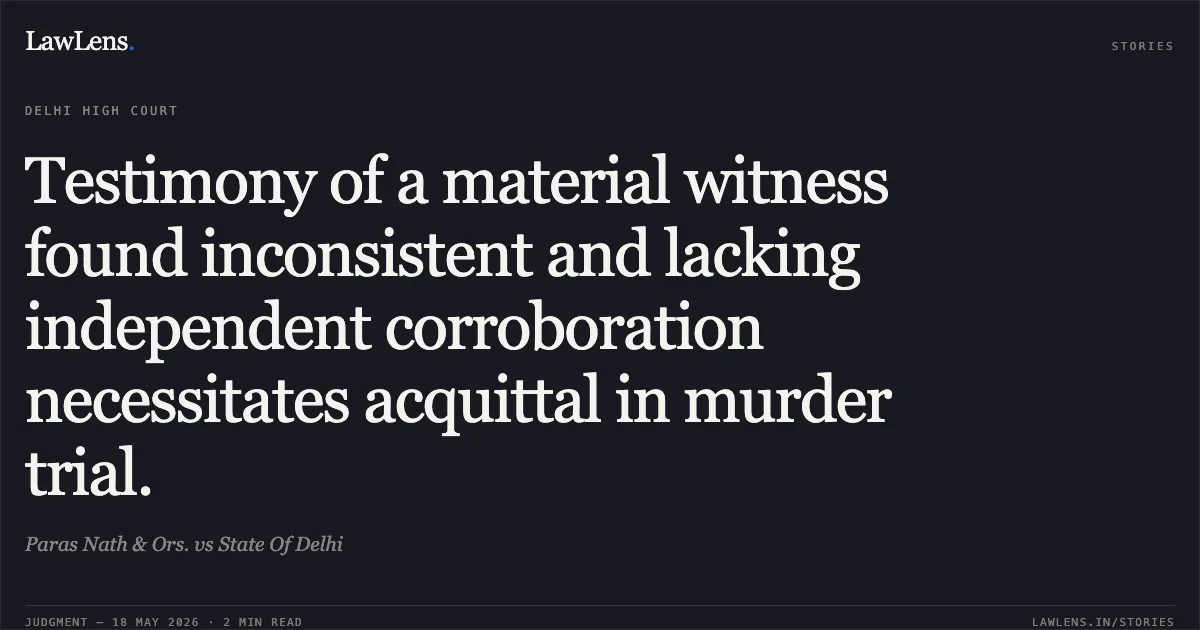
The Court held that the prosecution failed to prove its case against appellant Ramu beyond a reasonable doubt.
The Court allowed the appeal, setting aside the conviction and sentences under Sections 302/34 and 324/34 IPC, and the appeal against Paras Nath was noted as abated due to his death.
Source reference: p. 15Ramu was acquitted, and his bail bonds were cancelled.
Source reference: p. 15-16Acts & Sections Cited
4 provisions across 1 statute referred to in this judgment. Each provision opens on LawLens.
Indian Penal Code, 18604
Original Court PDF
Paras Nath & Ors.vsState Of Delhi
Click to open original judgment
Original judgment, available to read, download and summarize on LawLens.in


![Subsequent exoneration does not retrospectively invalidate a finalized promotion select list.. UNNIKRISHNAN M vs M/o Environment And Forests. CAT - ['Ernakulam']. LawLens](/stories/thumbnails/subsequent-exoneration-does-not-retrospectively-invalidate-a-finalized-promotion-select-li-ce80a0e84f2f4887857271e8b4341c42.webp)