Facts
The appellant (prosecutrix) filed an appeal against the judgment dated 23.09.2022 passed by the Special Sessions Judge (SC/ST Act), Sehore, which acquitted the respondents of offenses under Sections 294, 354(ka), 323, 506 (Part-II), and 34 of the IPC, and Sections 3(1)(r) and 3(2)(va) of the SC/ST (Prevention of Atrocities) Act.
Source reference: para. 1The prosecutrix alleged that on 02.01.2021, the respondents diverted water onto her pathway, and when questioned, Respondent No. 1 caught her hand with ill intent and assaulted her with a spade while both respondents hurled caste-based abuses.
Source reference: para. 2The Trial Court acquitted the accused citing material contradictions and unreliable witness testimonies.
Source reference: para. 5Issues
1. Whether the Trial Court’s judgment of acquittal was perverse or based on a misreading of evidence.
Source reference: para. 19-212. Whether the testimony of the prosecutrix (PW-1) and corroborated witnesses was reliable enough to reverse the order of acquittal.
Source reference: para. 6, 9-11Law Applied
The Court applied Section 378(4) of the CrPC regarding appeals against acquittal.
Source reference: para. 1An appellate court should not interfere with an acquittal unless the Trial Court's view is "patent[ly] perverse" or "wholly unreasonable," as acquittal reinforces the presumption of innocence.
Source reference: para. 20, 21Principles established in H.D. Sundara v. State of Karnataka (2023) and Babu Sahebagouda Rudragoudar v. State of Karnataka (2024).
Source reference: para. 20-21Requirements for proving offenses under the SC/ST Act, specifically that the act must occur in public view.
Source reference: para. 17Reasoning
The Court found that the prosecutrix (PW-1) admitted to prior land disputes, which affected her credibility regarding the motive for false implication.
Source reference: para. 8Significant contradictions were noted: PW-1 claimed her husband (PW-2) arrived after the incident, while her son (PW-3) gave conflicting accounts of family rifts.
Source reference: para. 9, 12PW-1’s court testimony included "material improvements" regarding the assault that were absent in her Section 161 CrPC statement.
Source reference: para. 11Medically, PW-7 and PW-4 stated the injuries were simple and consistent with slipping on a wet pathway rather than a deliberate assault.
Source reference: para. 15, 18Regarding the SC/ST Act, the Court observed from the spot map (Ex.P-2) that the incident occurred in a private field, not within "public view".
Source reference: para. 17Consequently, the Trial Court’s view was deemed a "plausible and reasonable view".
Source reference: para. 19Holding
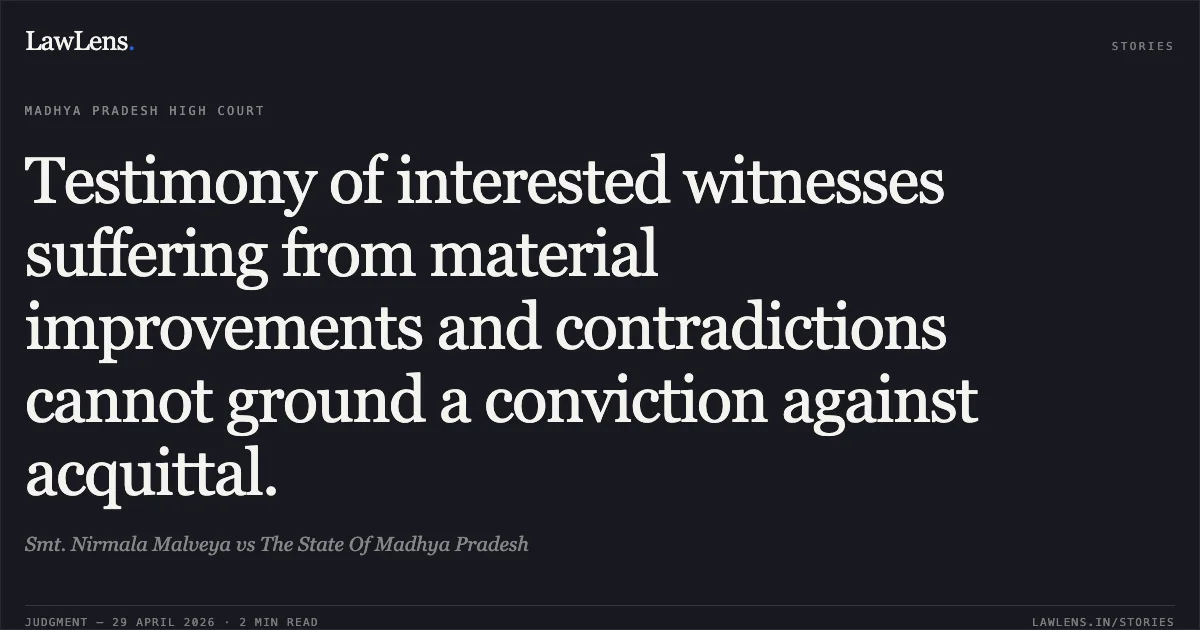
The prosecution failed to prove the charges beyond a reasonable doubt and that the appellate court cannot overturn an acquittal merely because a different view is possible.
The High Court dismissed the appeal and affirmed the judgment of acquittal.
Source reference: para. 25Acts & Sections Cited
2 provisions across 2 statutes referred to in this judgment. Each provision opens on LawLens.
Limitation Act, 19631
Scheduled Castes and the Scheduled Tribes (Prevention of Atrocities) Act, 19891
Original Court PDF
Smt. Nirmala MalveyavsThe State Of Madhya Pradesh
Click to open original judgment
Original judgment, available to read, download and summarize on LawLens.in


