Facts
The State appealed against the judgment dated 02.09.2014 passed by the Additional Sessions Judge, Delhi, which acquitted the Respondent (Rakesh) of charges under Section 354A of the IPC and Section 8 of the Protection of Children from Sexual Offences (POCSO) Act
Source reference: p. 1-2The prosecution alleged that on 29.08.2013, the Respondent, a tuition teacher, sexually harassed the minor victim (PW5, aged 11) at his coaching centre
Source reference: p. 2The victim did not immediately inform her parents but disclosed the incident to her school teacher (PW7) and Principal the following day
Source reference: p. 8The Respondent pleaded innocence, asserting an alibi that he was conducting home tuition in Mangol Puri at the time of the alleged incident
Source reference: p. 5The Respondent suggesting the case was a false implication due to his prior complaints about the victim’s poor academic performance
Source reference: p. 4, 12Issues
1. Whether there was any procedural infirmity or prejudice caused to the accused due to non-compliance with Section 232 of the Cr.P.C. regarding the hearing after the close of prosecution evidence
Source reference: p. 52. Whether the testimony of the minor victim (PW5) was of "sterling quality" sufficient to sustain a conviction despite material inconsistencies and the defense of alibi
Source reference: p. 193. Whether there is any perversity or infirmity in the trial court's order of acquittal warranting interference by the Appellate Court
Source reference: p. 7, 22Law Applied
The court primarily applied Section 354A of the IPC (sexual harassment) and Section 8 of the POCSO Act (punishment for sexual assault)
Source reference: p. 2Regarding appellate powers, the court relied on the principles from Chandrappa v. State of Karnataka and Babu Sahebogouda Rudragoudar v. State of Karnataka, establishing that an appellate court should not disturb an acquittal if two reasonable conclusions are possible, respecting the "double presumption of innocence"
Source reference: p. 17-18It further applied the rule from Ganesan v. State that while a conviction can be based on the sole testimony of a prosecutrix, it must be of "sterling quality" and inspire confidence
Source reference: p. 19Regarding procedural lapses, the court cited Moidu K. v. State of Kerala, stating that non-compliance with Section 232 Cr.P.C. does not vitiate proceedings unless substantial prejudice is shown
Source reference: p. 5Reasoning
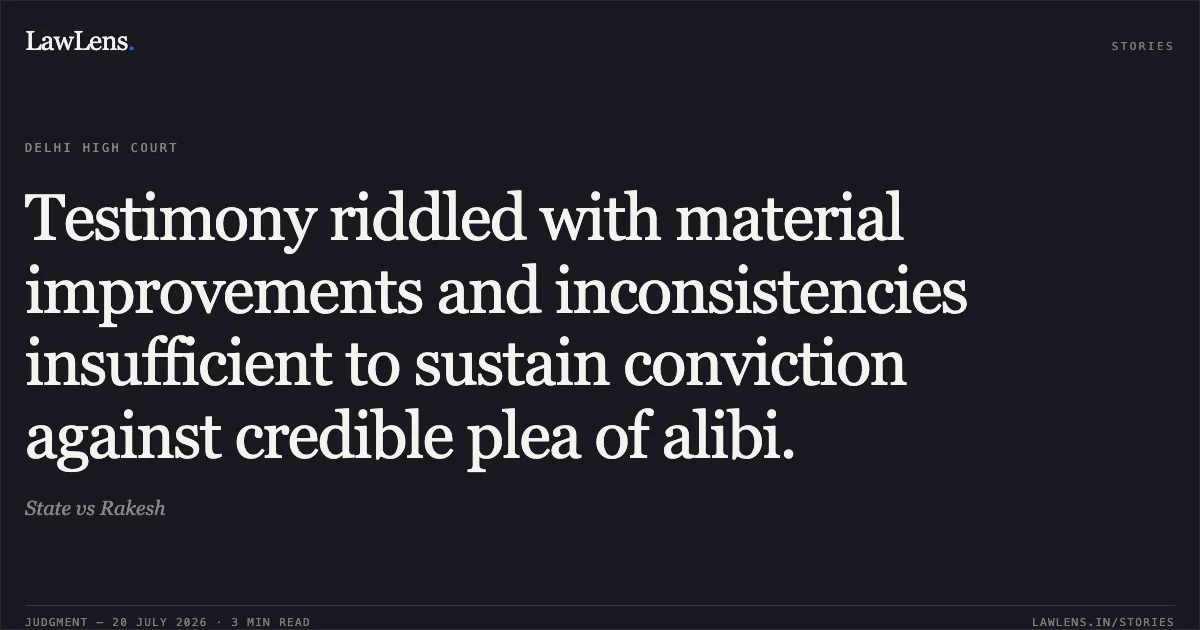
The High Court observed that the testimony of PW5 was inconsistent across her initial statement (FIS), her Section 164 statement, and her oral deposition before the trial court
Source reference: p. 20-21Specifically, she introduced new details during the trial—such as being instructed to wait in a cabin—that were absent in her earlier statements
Source reference: p. 20The Court weighed these inconsistencies against evidence that PW5 was angry with the Respondent for complaining to her parents about her studies
Source reference: p. 12, 21Furthermore, the defense successfully established a doubt regarding the Respondent's presence at the crime scene through alibi witnesses DW1 and DW2, whose testimonies remained undiscredited
Source reference: p. 15, 21-22The Court found that the trial court's decision was a "reasonable and plausible" view of the evidence
Source reference: p. 19, 22Holding
The High Court dismissed the appeal, holding that the prosecution failed to prove the case beyond a reasonable doubt
The court answered the issues by affirming that the testimony of PW5 lacked the "sterling quality" required to overcome the reinforced presumption of innocence following an acquittal
Source reference: p. 19, 22Finding no perversity or error in the trial court's appreciation of evidence, the judgment of acquittal was upheld
Source reference: p. 22-23Acts & Sections Cited
3 provisions across 3 statutes referred to in this judgment. Linked provisions open on LawLens.
Code of Criminal Procedure, 19731
Indian Penal Code, 18601
Protection of Children from Sexual Offences Act, 20121
Original Court PDF
StatevsRakesh
Click to open original judgment
Original judgment, available to read, download and summarize on LawLens.in


![Subsequent exoneration does not retrospectively invalidate a finalized promotion select list.. UNNIKRISHNAN M vs M/o Environment And Forests. CAT - ['Ernakulam']. LawLens](/stories/thumbnails/subsequent-exoneration-does-not-retrospectively-invalidate-a-finalized-promotion-select-li-ce80a0e84f2f4887857271e8b4341c42.webp)