Facts
The petitioners, two regularly appointed Staff Nurses in the Department of Medical Education, Uttar Pradesh, applied for maternity leave for their second pregnancies
Source reference: para. 6, 7Petitioner No. 1 sought 180 days’ leave starting January 19, 2026, and Petitioner No. 2 sought 180 days’ leave starting January 21, 2026
Source reference: para. 6, 7Respondent No. 3 rejected both applications via orders dated January 9, 2026, and January 6, 2026, respectively
Source reference: para. 2The rejections were based on Rule 153(1) of the U.P. Financial Handbook and a Government Order dated December 8, 2008, which stipulate that a second spell of maternity leave cannot be granted unless two years have elapsed since the expiry of the last maternity leave
Source reference: para. 6, 7Issues
1. Whether Rule 153(1) of the U.P. Financial Handbook/Government Order dated 08.12.2008, which imposes a two-year gap between maternity leaves, is applicable to regular Government servants in light of the Code on Social Security, 2020
Source reference: para. 82. Whether the provisions of a Central enactment (the Code on Social Security, 2020) prevail over State executive instructions or the Financial Handbook in the event of an inconsistency regarding maternity benefits
Source reference: para. 8, 22Law Applied
Section 161 of the Code on Social Security, 2020, which contains a non-obstante clause ensuring the Code prevails over any inconsistent law or contract
Source reference: para. 10Article 42 of the Constitution of India, which mandates the State to secure just and humane conditions of work and maternity relief
Source reference: para. 9Section 60 of the Code, 2020, which defines the right to maternity benefits without prescribing a minimum time gap between children
Source reference: para. 25-26The precedent in Dr. Rachna Chaurasiya v. State of U.P. and Smt. Anupam Yadav v. State of U.P., establishing that statutory maternity benefits prevail over restrictive executive instructions in the Financial Handbook
Source reference: para. 27-28Reasoning
The Court reasoned that the U.P. Financial Handbook rules, framed under the Government of India Act, 1935, hold the status of executive instructions and must yield to Central legislation
Source reference: para. 17Under the constitutional scheme, specifically Entry 24 of List III, the Parliament's enactment of the Code on Social Security, 2020, occupies the field
Source reference: para. 22, 29The Court observed that while Rule 153(1) of the Financial Handbook imposes a two-year embargo between maternity leaves, the Code, 2020, contains no such restriction
Source reference: para. 24, 26Applying the doctrine of repugnancy and the specific mandate of Section 161 of the Code, the Court held that the statutory right to maternity leave cannot be curtailed by State executive orders
Source reference: para. 24, 30The Court emphasized that maternity relief is a constitutional obligation under Articles 15(3), 39, and 42, and any policy inconsistent with the Central Code is "patently illegal"
Source reference: para. 3, 21Holding
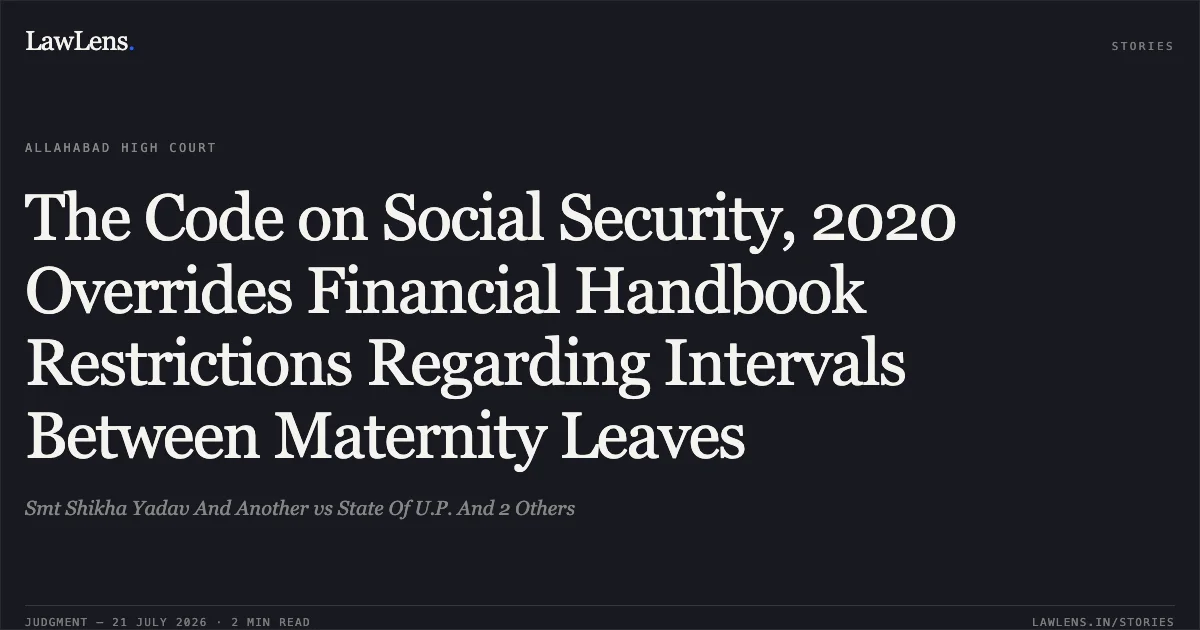
The Court answered that the Code on Social Security, 2020, prevails over Rule 153(1) of the Financial Handbook
The Court quashed the impugned rejection orders dated January 9, 2026, and January 6, 2026, and directed Respondent No. 3 to reconsider the petitioners' applications in accordance with the Code, 2020, which does not require a time gap between pregnancies
Source reference: para. 30-31The respondent was ordered to complete this exercise within two weeks of receiving fresh applications and the writ petition was allowed
Source reference: para. 32-33Acts & Sections Cited
4 provisions across 1 statute referred to in this judgment. Each provision opens on LawLens.
Code on Social Security, 20204
Original Court PDF
Smt Shikha Yadav And AnothervsState Of U.P. And 2 Others
Click to open original judgment
Original judgment, available to read, download and summarize on LawLens.in