Facts
The applicant, a Station Master at Kotra Station, was on duty on April 26, 2019, when four empty wagons of a goods train derailed, infringing upon the down track and causing a collision with Train No. 12155
Source reference: p. 2An in-house inquiry committee found that the applicant failed to check the load despite being informed by a gateman about unusual sounds and flashing points
Source reference: p. 6Consequently, a charge sheet was issued under Rule 9 of the Railway Servants (D) Rules, 1968
Source reference: p. 6Following a formal inquiry where the charges were proved, the Disciplinary Authority imposed a penalty of reduction of pay by two stages for three years with cumulative effect via order dated July 22, 2020
Source reference: p. 2The Appellate Authority upheld this decision on November 3, 2020
Source reference: p. 2The applicant challenged these orders, alleging a lack of supplied documents and arguing that he was made a "scapegoat" while others received only warnings
Source reference: p. 3Issues
1. Whether the disciplinary proceedings and subsequent penalty were vitiated by procedural irregularities or violation of natural justice
Source reference: p. 4-62. Whether the penalty imposed was disproportionate to the misconduct or discriminatory compared to the treatment of other employees involved in the incident
Source reference: p. 3, 53. Whether the Tribunal has the jurisdiction to substitute the quantum of punishment determined by the employer
Source reference: p. 7-8Law Applied
Rule 9 of the Railway Servants (Discipline Appeal) Rules, 1968, governing the procedure for imposing major penalties
Source reference: p. 6The principle that judicial review of administrative action is limited to the decision-making process rather than the decision itself
Source reference: p. 5B.C. Chaturvedi v. Union of India [1995 Law Suit (SC) 1015], establishing that courts cannot normally substitute their own conclusion on penalty unless it "shocks the conscience"
Source reference: p. 7Union of India v. S.S. Ahluwalia [2007 Law Suit (SC) 950] regarding the limited scope of interfering with punishment
Source reference: p. 8State of Meghalaya v. Mecken Singh N. Marak [2009 Law Suit (SC) 1935], which restricts interference to exceptional cases of shocking disproportionality
Source reference: p. 8-9Reasoning
The Tribunal found that the disciplinary process adhered to statutory provisions, as the applicant was provided with a memorandum of charges, represented by a Defence Assistant, and given an opportunity to participate in the inquiry
Source reference: p. 4, 6Regarding the "scapegoat" argument, the Tribunal noted that the in-house inquiry report specifically identified the applicant's failure to act on information regarding "unusual sound" and "flashing of points" as a root cause of the collision
Source reference: p. 6The Tribunal rejected the plea of discrimination, noting that disciplinary action was taken against other officials based on their respective roles
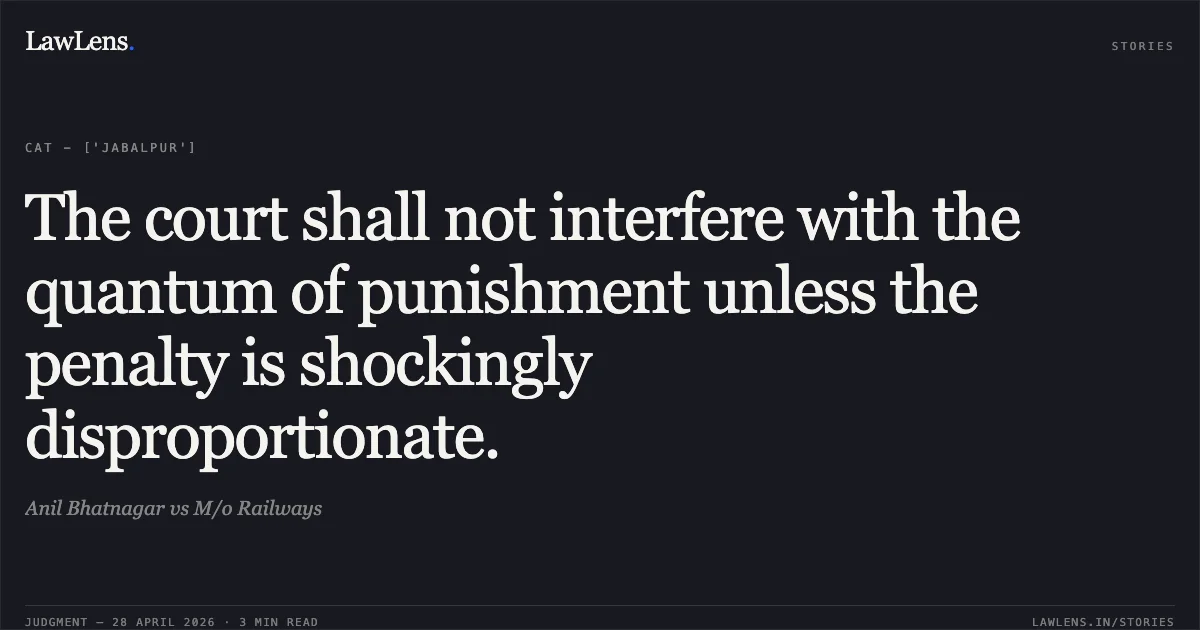
Source reference: p. 4Applying the cited precedents, the Tribunal reasoned that because the findings were based on evidence and the procedure was followed, it could not sit as an appellate court over the quantum of punishment, as the penalty was provided under the rules and was not "shockingly disproportionate" to the gravity of a railway accident
Source reference: p. 5, 7Holding
The Tribunal answered the issues in the negative, holding that there was no irregularity in the inquiry proceedings and the penalty was commensurate with the misconduct
The Tribunal held that the scope of judicial review is restricted to the decision-making process, and since the applicant failed to prove any vice in the proceedings, the court would not interfere with the Disciplinary Authority’s discretion
Source reference: p. 5, 9The Original Application was dismissed, and the impugned orders dated July 22, 2020, and November 3, 2020, were upheld
Source reference: p. 9Original Court PDF
Anil BhatnagarvsM/o Railways
Click to open original judgment
Original judgment, available to read, download and summarize on LawLens.in


![Subsequent exoneration does not retrospectively invalidate a finalized promotion select list.. UNNIKRISHNAN M vs M/o Environment And Forests. CAT - ['Ernakulam']. LawLens](/stories/thumbnails/subsequent-exoneration-does-not-retrospectively-invalidate-a-finalized-promotion-select-li-ce80a0e84f2f4887857271e8b4341c42.webp)