Facts
The claimants, the parents and sister of the deceased Karthick, sought compensation after he died in a collision between the vehicle he was driving and a lorry on 28 December 2019.
Source reference: pp. 2, 4–6; paras. 2, 7–8The Tribunal found both drivers negligent, attributing 50% contributory negligence to the deceased, and awarded ₹9,42,200 after applying that reduction to a total assessment of ₹18,84,400.
Source reference: pp. 2, 4–6; paras. 2, 7–8It assessed the deceased’s monthly income at ₹12,000, added 40% for future prospects, and applied a multiplier of 18.
Source reference: pp. 2, 4–6; paras. 2, 7–8The claimants appealed under Section 173 of the Motor Vehicles Act, 1988, seeking a reduction in the deceased’s share of negligence and enhancement of compensation.
Source reference: pp. 2, 4–6; paras. 2, 7–8Issues
1. Whether the Tribunal erred in attributing 50% contributory negligence to the deceased, and whether that apportionment should be modified
Source reference: pp. 6–7; paras. 9–122. Whether the Tribunal’s assessment of the deceased’s income and the resulting compensation required enhancement
Source reference: pp. 6–9; paras. 9, 13–14Law Applied
Section 173 of the Motor Vehicles Act, 1988, provides for an appeal against an award of the Motor Accident Claims Tribunal.
Source reference: p. 1In assessing compensation, the Court applied National Insurance Company Ltd. v. Pranay Sethi, which supports adding future prospects to income, and Sarla Verma v. Delhi Transport Corporation, which guided selection of the multiplier by the deceased’s age.
Source reference: pp. 4–5; para. 7The Court also applied the principle of contributory negligence by apportioning responsibility between the deceased and the lorry driver according to their respective negligence.
Source reference: p. 7; para. 12Reasoning
The FIR and rough sketch indicated that the deceased’s vehicle struck the lorry from behind, while the lorry’s rear-right indicator and bumper were damaged.
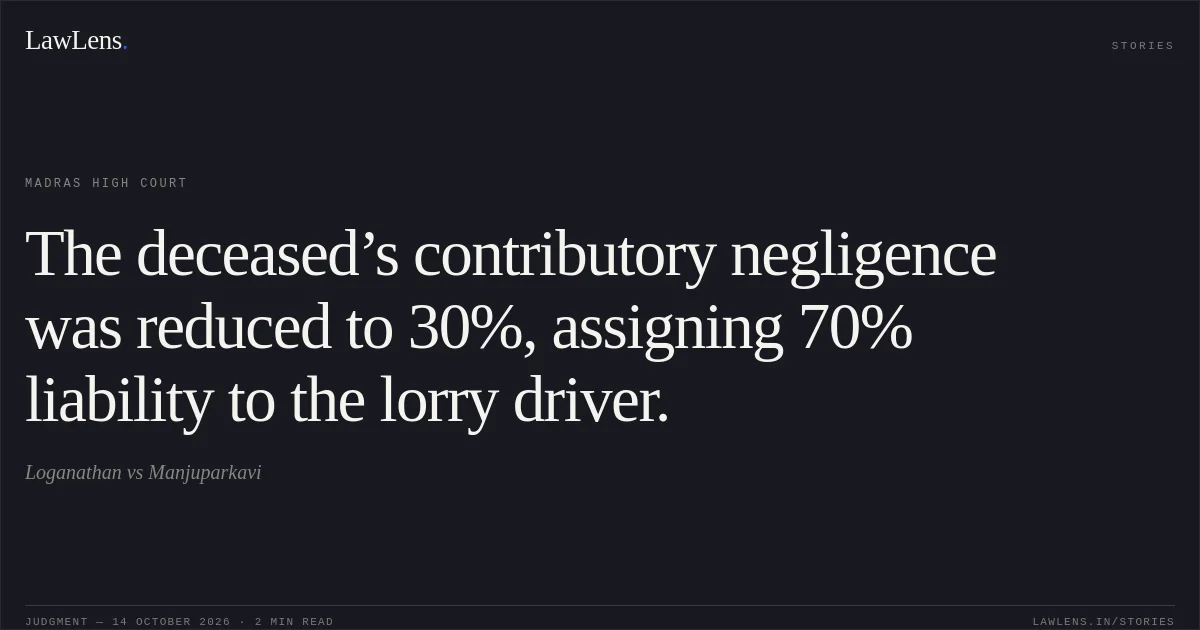
Source reference: p. 7; para. 12The Court considered that the lorry driver should not have turned suddenly, but that the deceased should have maintained a safe distance; it therefore reduced the deceased’s share of negligence from 50% to 30% and attributed 70% to the lorry driver.
Source reference: p. 7; para. 12On quantum, the Court held that ₹12,000 per month was inadequate for a 25-year-old working as a driver in 2019, despite the absence of proof supporting the claimed ₹25,000 income.
Source reference: pp. 7–9; paras. 13–14It fixed monthly income at ₹15,000, added 40% future prospects, deducted half for personal expenses, and applied a multiplier of 18, producing loss of dependency of ₹22,68,000.
Source reference: pp. 7–9; paras. 13–14It also awarded the deceased’s sister ₹40,000 for loss of love and affection, while leaving the other conventional heads undisturbed.
Source reference: pp. 7–9; paras. 13–14Holding
The appeal was allowed in part.
The Court increased the total compensation to ₹23,78,000 and, after deducting 30% for the deceased’s contributory negligence, fixed the payable compensation at ₹16,64,600.
Source reference: pp. 9–10; para. 15The insurer of the lorry was directed to deposit that amount, with interest at 7.5% per annum from the claim-petition filing date until deposit, less any amount already deposited.
Source reference: pp. 9–10; para. 15The claimants were not entitled to interest on the enhanced compensation for the 362-day delay period previously excluded by the Court; the Tribunal’s apportionment and other disbursement directions remained in force.
Source reference: pp. 9–10; para. 15Acts & Sections Cited
1 provisions across 1 statute referred to in this judgment. Each provision opens on LawLens.
Motor Vehicles Act, 19881
Original Court PDF
LoganathanvsManjuparkavi
Click to open original judgment
Original judgment, available to read, download and summarize on LawLens.in


