Facts
The High Court of Delhi adjudicated a batch of writ petitions challenging the issuance and continuation of Look Out Circulars (LOCs). These LOCs were issued either at the behest of Public Sector Banks for debt recovery or by investigating agencies (SFIO, Income Tax, MCA, CBI).
Source reference: p. 5The petitioners, ranging from entrepreneurs to foreign directors, alleged that the LOCs restricted their fundamental right to travel despite their cooperation with investigations.
Source reference: p. 18, 22-29In several cases, petitioners had previously been granted judicial permission to travel and had returned to India, demonstrating no flight risk.
Source reference: p. 23, 25, 30Issues
1. Whether the Chairman or CEOs of Public Sector Banks possess the legal authority to request the issuance of an LOC.
Source reference: p. 6 / para. 42. Whether the "economic interests of India" under Clause 6(L) of the 2021 Office Memorandum can be invoked for routine loan defaults or individual business failures.
Source reference: p. 11 / para. 19; p. 16 / para. 363. Whether the continuation of an LOC is permissible when the subject is not an accused in a cognizable offence or has consistently cooperated with the investigation.
Source reference: p. 10 / para. 18; p. 17 / para. 38Law Applied
The court primarily relied on Article 21 of the Constitution of India, which recognizes the right to travel abroad as an integral facet of personal liberty.
Source reference: p. 7It applied the "tripartite test" from Maneka Gandhi v. Union of India, requiring restrictions to be non-arbitrary and established by law.
Source reference: p. 8The court followed Sumer Singh Salkan v. Asst. Director, which mandates that LOCs be issued only in cognizable offences where the accused evades arrest.
Source reference: p. 10It further applied the ratio from Viraj Chetan Shah v. Union of India, which struck down the power of Bank officials to request LOCs, and the 2021 Office Memorandum (OM) issued by the Ministry of Home Affairs, specifically Clause 6(L) regarding "exceptional cases".
Source reference: p. 11, p. 10Reasoning
The court reasoned that an LOC is a "coercive measure of last resort" and not a tool for debt recovery. It held that Bank-led LOCs are invalid because executive instructions (OMs) cannot substitute for legislative mandate when restricting fundamental rights, and the specific clause empowering bank CEOs had already been judicially quashed.
Source reference: p. 9, 16Regarding investigating agencies, the court found that "economic interest" must signify a threat of a magnitude that imperils the national economy, not merely individual defaults.
Source reference: p. 11, 17Since petitioners had shown "bona fides" by returning to India after court-sanctioned travels and joining investigations, the court determined that the "flight risk" justification was unsustainable.
Source reference: p. 23, 28, 31The court emphasized that guilt is personal, not vicarious, and family members or former associates cannot be restrained without specific evidence of wrongdoing.
Source reference: p. 17Holding
The Court quashed the LOCs in Categories A and B (Banks and Agencies), holding that the originating agencies failed to justify the necessity and proportionality of the measures.
Directives were issued to the Bureau of Immigration to lift these restrictions immediately, subject to petitioners providing itineraries for future travel. For Category C, petitioners were relegated to trial courts. One petitioner was ordered to disclose foreign assets to the IT Authority within 15 days.
Source reference: p. 21, 31, 32, 33-36Acts & Sections Cited
7 provisions across 5 statutes referred to in this judgment. Each provision opens on LawLens.
Code of Civil Procedure, 19081
Insolvency and Bankruptcy Code, 2016.1
Companies Act, 20133
Prevention of Corruption Act, 19881
Indian Penal Code, 18601
Original Court PDF
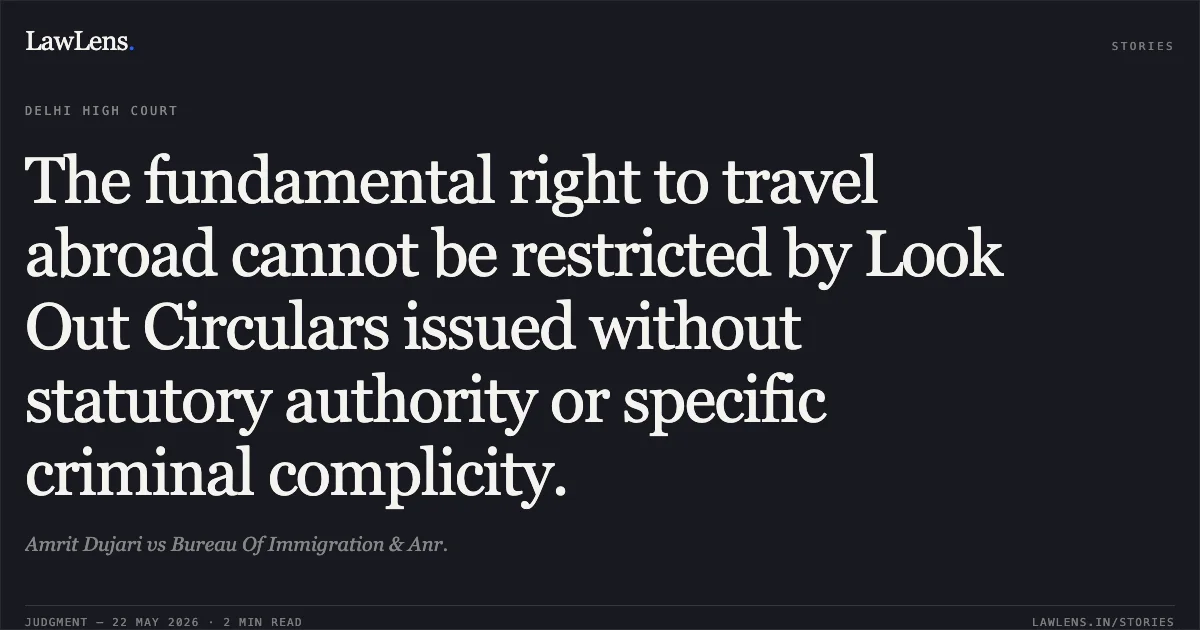
Amrit DujarivsBureau Of Immigration & Anr.
Click to open original judgment
Original judgment, available to read, download and summarize on LawLens.in


