Facts
The appellant was convicted under Section 6 of the Protection of Children from Sexual Offences Act, 2012 (“POCSO Act”) by the Special POCSO Court, Barasat, in Sessions Trial No. 10 (03) of 2017 arising from Special Case No. 20 of 2017; the conviction and sentence orders were dated 18 and 19 March 2025.
Source reference: p.1, para. 1The prosecution alleged that on 12 February 2017 the appellant took the nine-year-old victim to a nearby place called “Lambu Bagan” on the pretext of tying a goat and sexually assaulted her.
Source reference: pp.9–10, paras. 9–10The FIR was lodged by the victim’s mother on 15 February 2017, stating that the victim disclosed the incident only on that date.
Source reference: pp.9–10, para. 10In her testimony before the Trial Court, however, the victim gave a version materially differing from her Section 164 Cr.P.C. statement regarding where she was taken from and the surrounding circumstances.
Source reference: pp.8–10, paras. 8–12The defence relied on contradictions, delay in reporting, prior enmity between the families, inconclusive medical evidence, non-examination of material witnesses, and irregularities in the recording of the child’s evidence.
Source reference: pp.2–3, paras. 1–2The State argued that the victim’s testimony was sufficient for conviction and that an intact hymen did not exclude sexual assault.
Source reference: pp.5–7, paras. 5–7Issues
1. Whether the victim’s testimony, considered with her FIR and statement under Section 164 Cr.P.C., was sufficiently consistent, reliable, and trustworthy to sustain the appellant’s conviction under Section 6 of the POCSO Act without corroboration.
Source reference: pp.7–10, 15–16, paras. 8–12, 20–242. Whether the medical evidence, surrounding circumstances, and testimony of other witnesses sufficiently corroborated the prosecution case despite the inconsistencies in the victim’s evidence.
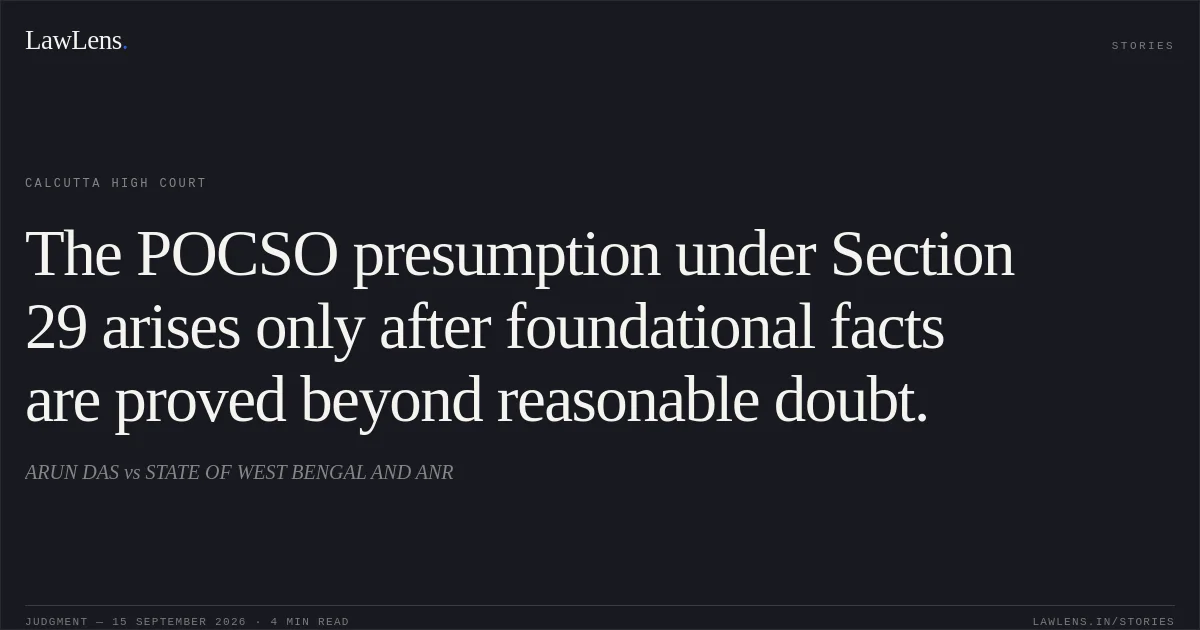
Source reference: pp.10–15, paras. 13–15, 20, 24–253. Whether the statutory presumption under Section 29 of the POCSO Act could be invoked when the prosecution had not first established the foundational facts beyond reasonable doubt.
Source reference: p.14, para. 154. Whether the Trial Court’s failure to record a finding or certificate regarding the competency and understanding of the child witness affected the reliability of the trial evidence.
Source reference: p.16, para. 20Law Applied
The Court applied Section 6 of the POCSO Act, which prescribes aggravated punishment for penetrative sexual assault in the circumstances covered by the provision, and Section 29, under which a presumption may arise only after the prosecution establishes the foundational facts of the offence.
Source reference: pp.1, 14, paras. 1, 15It applied the principle that the credible and trustworthy testimony of a prosecutrix may, by itself, sustain a conviction, but corroboration may be required where her evidence contains material contradictions or does not inspire confidence.
Source reference: pp.5–7, 14–15, paras. 6–7, 16–20The Court relied on Krishan Kumar Malik v. State of Haryana, (2011) 7 SCC 130, and Rai Sandeep alias Deepu v. State (NCT of Delhi), (2012) 8 SCC 21, for the requirement that a sole prosecutrix’s testimony must be unblemished, consistent, and of sterling quality.
Source reference: pp.3–5, paras. 3–4, 21–23It also considered State of Himachal Pradesh v. Manga Singh, Raju @ Umakant v. State of Madhya Pradesh, 2025 INSC 615, and Bharwada Bhoginbhai Hirjibhai v. State, AIR 1983 SC 753, recognising that an intact hymen or minor discrepancies is not, by itself, decisive where the victim’s testimony is cogent and reliable.
Source reference: pp.6–7, 16–19, paras. 7, 16–19Statements under Section 164 Cr.P.C. were examined for consistency with the testimony at trial.
Source reference: pp.8–10, paras. 9–12Reasoning
The Court found that the victim’s evidence did not meet the standard of a reliable or “sterling” witness.
Source reference: pp.8–10, paras. 8–12Her trial testimony materially departed from her Section 164 Cr.P.C. statement and the FIR regarding the place from which the appellant allegedly took her and the surrounding sequence of events.
Source reference: pp.8–10, paras. 8–12The Court also noted the inconsistency as to when the victim disclosed the incident: her trial evidence suggested disclosure to her mother on the date of occurrence, whereas the FIR stated that the mother learnt of the incident only three days later.
Source reference: pp.12–13, para. 14The medical evidence was considered inconclusive: although there was an abrasion on the vulva, the hymen was substantially intact, no age of injury was recorded, and no injuries were noted on the victim’s back or pelvic region despite the allegation that she had been forcibly pinned to the ground.
Source reference: pp.10–11, 15, paras. 13, 15The Court further relied on evidence of prior litigation and animosity between the families, the non-examination of the “Panchayat Kaku,” and the failure of the aunt to investigate the victim’s alleged terror immediately.
Source reference: pp.11–13, paras. 13–14Since the prosecution evidence itself failed to establish the foundational facts beyond reasonable doubt, the presumption under Section 29 could not automatically operate.
Source reference: p.14, para. 15The Court additionally treated the Trial Court’s failure to record a finding that the child understood the questions and was competent to testify as a material procedural deficiency.
Source reference: p.16, para. 20Collectively, these circumstances created reasonable doubt regarding the prosecution case.
Source reference: no citationHolding
The Court held that the victim’s testimony was materially inconsistent and did not inspire confidence; the medical and other evidence did not cure those defects, and the foundational facts necessary for invoking Section 29 of the POCSO Act were not proved beyond reasonable doubt.
The conviction orders dated 18 and 19 March 2025 were set aside, CRA (DB) 196 of 2025 was allowed, and the appellant was acquitted of all charges.
Source reference: p.17, paras. 26–28The Court directed that the appellant be released forthwith and that the Trial Court Records be returned to the Trial Court.
Source reference: p.17, paras. 28–29Acts & Sections Cited
4 provisions across 2 statutes referred to in this judgment. Each provision opens on LawLens.
Protection of Children from Sexual Offences Act, 20122
Code of Criminal Procedure, 19732
Original Court PDF
ARUN DASvsSTATE OF WEST BENGAL AND ANR
Click to open original judgment
Original judgment, available to read, download and summarize on LawLens.in