Facts
The Appellant/Plaintiff instituted a suit for declaration of title and permanent injunction regarding "suit land" admeasuring 2.021 hectares, claiming ownership through a Will dated 09.02.2015 executed by his grandmother, Sukhni Bai.
Source reference: para. 2The Plaintiff alleged that after Sukhni Bai’s death on 15.02.2015, he obtained mutation of the land, which was subsequently set aside by the Sub-Divisional Officer.
Source reference: para. 2The Defendants (Respondents 1-10) contested the suit via a counter-claim, asserting the land originally belonged to Hirau Satnami (Sukhni Bai’s husband) and that they were the rightful legal heirs under the Hindu Succession Act as Sukhni Bai died issueless.
Source reference: para. 3While the Trial Court decreed the suit in favor of the Plaintiff, the First Appellate Court reversed the judgment, dismissing the suit and allowing the Defendants' counter-claim after finding the Will suspicious.
Source reference: para. 4Issues
Whether the Will dated 09.02.2015 was duly proved in accordance with Section 68 of the Indian Evidence Act or remained shrouded in suspicious circumstances.
Source reference: para. 5, 7Whether the findings of the First Appellate Court were perverse or suffered from material irregularity warranting interference under Section 100 of the CPC.
Source reference: para. 9, 11Whether the Appellant demonstrated any substantial question of law to maintain the Second Appeal.
Source reference: para. 11, 12Law Applied
Section 100 of the Code of Civil Procedure, 1908, which restricts the jurisdiction of the High Court in Second Appeals to cases involving "substantial questions of law" and mandates that findings of fact by the First Appellate Court are generally binding unless proved perverse.
Source reference: para. 9, 11Section 68 of the Indian Evidence Act, 1872, regarding the requirements for proving an attested document.
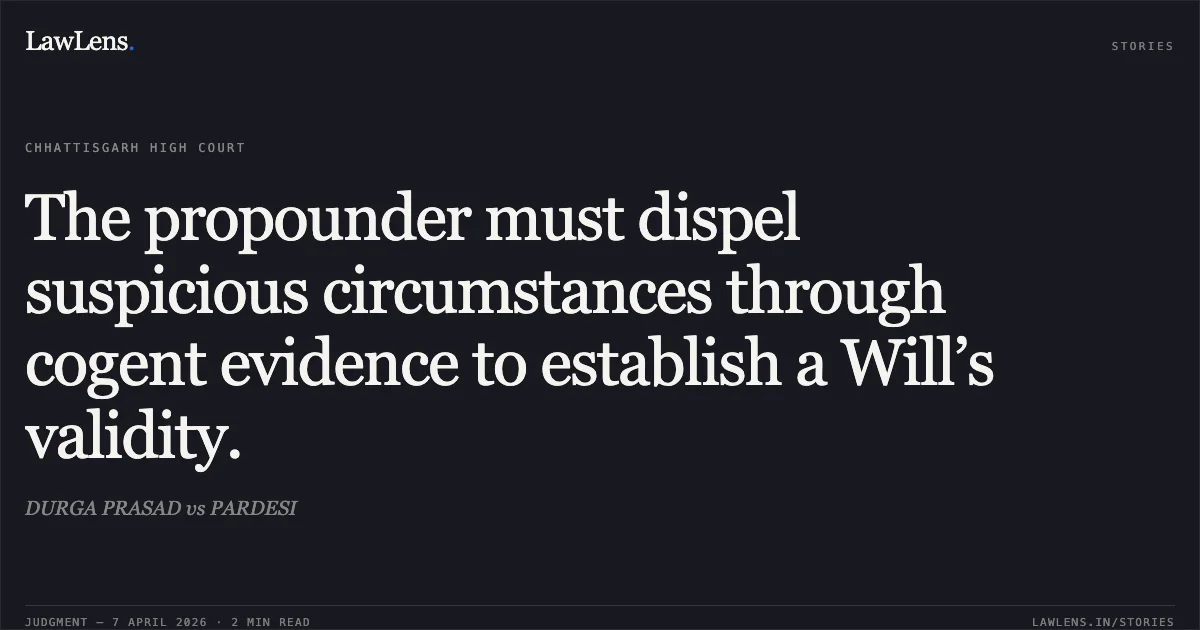
Source reference: para. 5The propounder of a Will bears the burden of dispelling suspicious circumstances—such as the active involvement of a beneficiary or the physical incapacity of the testator—through cogent evidence.
Source reference: para. 8Reasoning
The High Court concurred with the First Appellate Court’s finding that the Will was surrounded by unresolved suspicious circumstances. Specifically, the Court noted that a document resembling a relinquishment deed was executed citing the testatrix's "serious illness" just one day prior to the alleged Will; this made the claim that she traveled the very next day to execute the Will highly doubtful.
Source reference: para. 7Furthermore, the Court identified material contradictions in the testimonies of the attesting witnesses and noted the beneficiary's active role in the preparation of the document.
Source reference: para. 7The Court emphasized that when a Will is suspicious, the propounder must provide a satisfactory explanation, which the Plaintiff failed to do.
Source reference: para. 8Because the First Appellate Court’s findings were based on a thorough re-appreciation of evidence and were not perverse, the High Court determined that no substantial question of law was raised.
Source reference: para. 11, 12Holding
The High Court dismissed the Second Appeal and upheld the judgment and decree of the First Appellate Court.
The Court held that the Plaintiff failed to prove the Will in accordance with law and could not claim exclusive title over the suit property.
Source reference: para. 8In the absence of perversity or misreading of evidence, findings of fact by the First Appellate Court do not merit interference under Section 100 of the CPC.
Source reference: para. 11, 12Acts & Sections Cited
2 provisions across 1 statute referred to in this judgment. Each provision opens on LawLens.
Code of Civil Procedure, 19082
Original Court PDF
DURGA PRASADvsPARDESI
Click to open original judgment
Original judgment, available to read, download and summarize on LawLens.in