Facts
The parties married on 23 June 2023, had no children, and began living separately on 16 March 2024 after disputes arose and reconciliation efforts failed.
Source reference: para. 2They jointly sought divorce by mutual consent under Section 13-B of the Hindu Marriage Act, 1955, and applied to waive the statutory cooling-off period.
Source reference: para. 2Their settlement provided for payment of ₹7,00,000 as full and final settlement and withdrawal of pending litigation.
Source reference: para. 4The Family Court rejected the waiver application on 13 August 2026, prompting the husband’s petition under Article 227 of the Constitution.
Source reference: para. 2Issues
Whether the Family Court’s refusal to waive the statutory cooling-off period under Section 13-B(2) should be set aside in the circumstances of the case.
Source reference: paras. 2, 9–10Whether the parties’ application to waive that period should be allowed where reconciliation had failed and their disputes had been settled.
Source reference: paras. 4–5, 9–10Law Applied
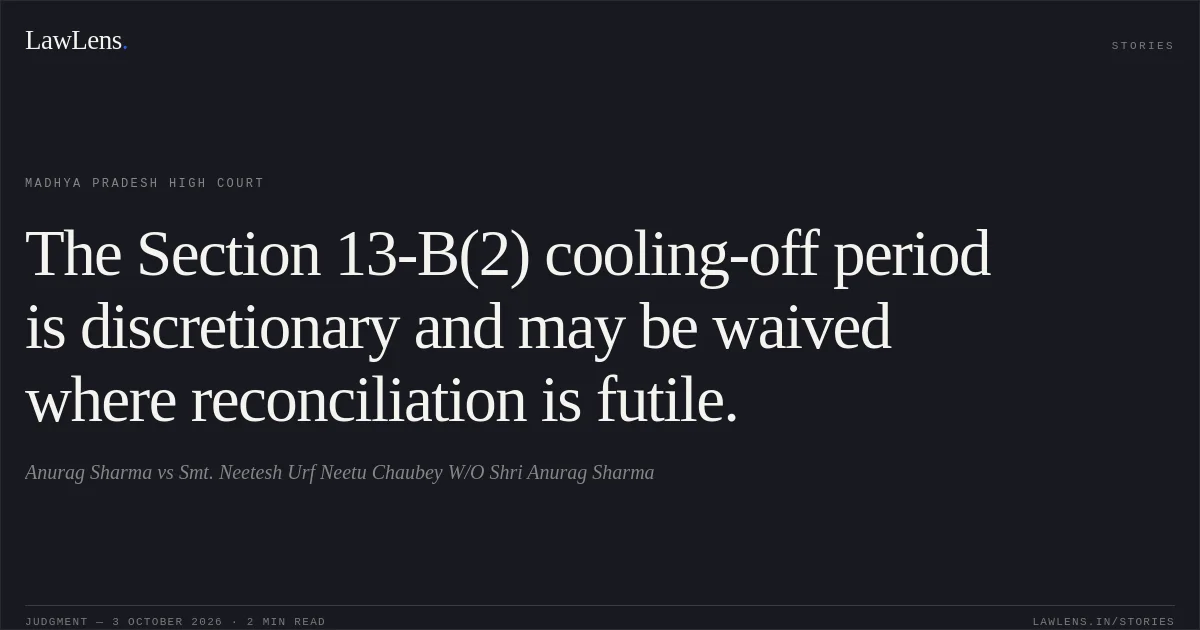
Section 13-B(2) of the Hindu Marriage Act prescribes a six-month waiting period for the second motion in a mutual-consent divorce, but that period is discretionary and may be waived by the court.
Source reference: para. 7Under Amardeep Singh v. Harveen Kaur, waiver may be considered where the statutory separation periods have elapsed, reconciliation efforts have failed, the parties have genuinely settled their disputes, and waiting would prolong their hardship.
Source reference: para. 7Amit Kumar v. Suman Beniwal clarifies that the Amardeep Singh considerations are not inflexible mandatory conditions and identifies relevant factors including the duration of the marriage and separation, the pendency of litigation, the possibility of reconciliation, children, and whether the settlement was voluntary and addressed maintenance and custody.
Source reference: para. 8Reasoning
The Court found that the parties had lived separately for approximately two and a half years, reconciliation efforts had failed, there were no children, and all disputes had been amicably settled.
Source reference: para. 9Both had unequivocally expressed their wish to end the marriage by mutual consent.
Source reference: para. 9Applying the principles in Amardeep Singh and Amit Kumar, the Court concluded that requiring the parties to complete the cooling-off period would serve no useful purpose and would prolong their suffering; the Family Court had not properly considered those principles.
Source reference: paras. 8–9Holding
The Court allowed the petition, set aside the Family Court’s order dated 13 August 2026, and allowed the application to waive the cooling-off period under Section 13-B(2).
It directed the Family Court to decide the Section 13-B proceedings expeditiously in light of Amit Kumar.
Source reference: para. 10The petition was disposed of accordingly.
Source reference: para. 11Acts & Sections Cited
2 provisions across 2 statutes referred to in this judgment. Each provision opens on LawLens.
Hindu Marriage Act, 19551
Family Courts Act, 19841
Original Court PDF
Anurag SharmavsSmt. Neetesh Urf Neetu Chaubey W/O Shri Anurag Sharma
Click to open original judgment
Original judgment, available to read, download and summarize on LawLens.in