01Facts
The Appellant filed an application under Section 94 of the Insolvency and Bankruptcy Code (IBC).
¶ 3On 08.07.2025, the Adjudicating Authority (NCLT) granted the Appellant seven days to remove certain defects in the application.
¶ 3The Appellant filed an additional affidavit to cure these defects on 02.08.2025, beyond the seven-day window.
¶ 3On 19.01.2026, the Adjudicating Authority dismissed the petition solely on the ground that the defects were not cured within the prescribed seven days.
¶ 3The Appellant subsequently filed this appeal along with an application for condonation of a 13-day delay, citing the necessity of obtaining physical signatures and affirmations from Maharashtra.
¶ 102Issues
i.1. Whether the seven-day period provided for curing defects in an application under the IBC is mandatory or directory in nature.
¶ 4ii.2. Whether the Adjudicating Authority erred in dismissing the Section 94 petition despite the defects being cured prior to the date of the dismissal order.
¶ 503Law Applied
The Court primarily applied the principles established by the Hon’ble Supreme Court in Surendra Trading Company v. Juggilal Kamlapat Jute Mills Company (2017) 16 SCC 143.
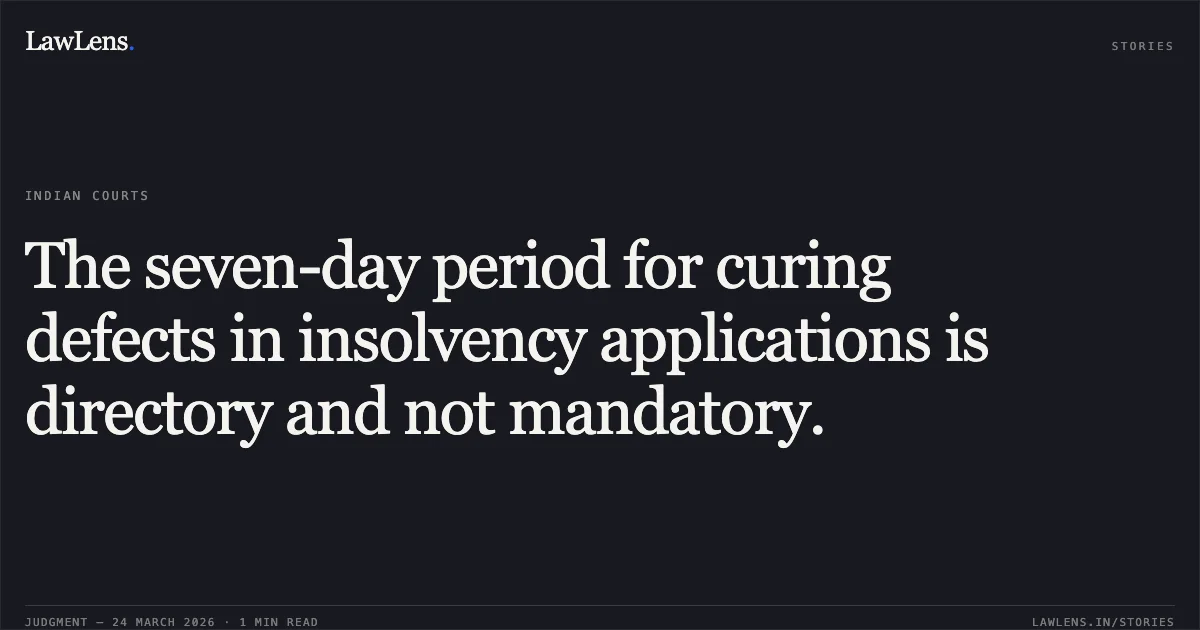
¶ 4The doctrine establishes that the seven-day period for removing defects, as mentioned in the proviso to the IBC (specifically regarding Sections 7, 9, or 10), is directory rather than mandatory.
¶ 4The Court noted that the 180-day limit for the insolvency process commences only upon admission of a validly filed application, and the time consumed in scrutinizing or curing defects is not part of that timeline.
¶ 4Provisions in the judgment · 5 · Linked ones open on LawLens
Insolvency and Bankruptcy Code, 2016. Section 7Section 9Section 10Section 12Section 94
04Reasoning
The NCLAT observed that the Adjudicating Authority dismissed the petition in mechanical adherence to its previous order dated 08.07.2025, ignoring that the Appellant had already filed the curative affidavit on 02.08.2025.
¶ 3Relying on Surendra Trading Company, the Tribunal reasoned that treating the seven-day defect-curing period as mandatory would lead to a "travesty of justice," potentially barring meritorious claims on purely administrative grounds.
¶ 4The Tribunal emphasized that since an applicant could simply file a fresh application if a previous one was rejected for technical defects, no purpose is served by a rigid interpretation of the timeline.
¶ 4Therefore, it was well within the Adjudicating Authority's power to extend the time and consider the affidavit filed on 02.08.2025.
¶ 505Holding
The NCLAT condoned the 13-day delay in filing the appeal, finding sufficient cause.
¶ 1Regarding the merits, the Tribunal held that the seven-day timeframe for curing defects is directory.
¶ 5Consequently, the NCLAT set aside the Adjudicating Authority’s order dated 19.01.2026 and revived Company Petition (IB) No. 640/MB/2025 for fresh consideration of the additional affidavit dated 02.08.2025.
¶ 5The Tribunal clarified it expressed no opinion on the merits of the Section 94 petition itself.
¶ 5Original Court PDF
Aruna Bhupendra Vasa vs
Click to open original judgment
Original judgment, available to read, download and summarize on LawLens.in